

The Medicare agent squeeze

Zachary Freeman has been a Medicare agent for nearly 12 years and described the current environment for agents this way.
“It truly is the wild, wild West.”
 Freeman is an agent at Ann M. Wiley Insurance in Conneaut, Ohio, where he works solely with Medicare clients. He told InsuranceNewsNet the current Medicare market is “chaotic.”
“We’re seeing insurance companies cutting commissions. Making the market harder for agents to navigate and be able to help their clients. We’re seeing a lot of plans pulling out from certain areas. It’s chaos,” he said.
Several hundred Medicare Advantage and Part D plans have stopped paying agent commissions on new enrollments over the past three years, although commissions on renewals continue to be paid.
Freeman said he has lost between $20,000 and $30,000 in commissions in the past year but remains committed to helping clients choose the plan that best suits their needs.

“I’ve taken a hit. But my main priority is the client.”
In addition to the dropped commissions, Freeman said that he and his clients are affected by carriers removing Medicare Advantage plans from the market.
“In the past couple of years, we’ve seen a carrier come in with a rich-benefited plan during open enrollment season. They’ll be in the market for a year, and one of two things will happen. They’ll pay commission on it for a year, then pull it out of the market completely. Or they will, as I like to put it, throw a bait at the end of the fishing line. They’ll throw the plan out there for two weeks or so in open enrollment and then take out commissions. So what they essentially did is create interest on the client side and give agents two or three weeks to talk about it with all their clients and then hold the ability to sell it, so those clients will still want it, but now the carriers don’t have to pay the agents.”
Freeman described the removal of Medicare Advantage plans and agent commissions as “a double-edged sword.”
“Insurance companies are definitely playing the game here. They’re putting rich-benefited plans out there, then cutting the agents away from them and trying to save money on the other end because they overshot their benefits. You’re seeing a lot of companies mismanage how many people they will have enroll in their plans when they do their predictions. Then when they’re two or three weeks into open enrollment, they realize they can’t afford to do this and they have to cut something, so they cut out the agent.”

Fewer plans, higher premiums
Four firms left the Medicare Advantage market entirely in 2026, and nine had contracts taken over by other insurers, according to KFF, a nonprofit health policy research, polling and news organization. In addition, six Medicare Advantage organizations ended operations in 2026. This affected nearly 100,000 individual Medicare Advantage prescription drug plan enrollees.
Four major plan sponsors — Cigna, Clear Spring Health, Elevance Health and Mutual of Omaha — exited the Medicare Part D market.
The total number of Medicare Advantage prescription drug plans declined 10% nationally, from 3,719 plans in 2025 to 3,373 plans in 2026, KFF reported. Several major national carriers also sharply reduced the number of counties in which they offer plans.
UnitedHealthcare exited 225 counties while entering only 14 new ones, and Humana left 198 counties but entered just five new ones. Each insurer now offers plans in 80% of all U.S. counties. This is a decrease from nearly 90% in 2025.
Part D drug plans also saw a drop in 2026. KFF reported 360 PDPs offered nationwide in 2026 — a 22% drop from 464 in 2025. The number of PDPs has fallen by 55% since the passage of the Inflation Reduction Act of 2022, which included a cap on annual out-of-pocket prescription drug costs and allowed Medicare to negotiate drug prices with pharmaceutical companies.
Medicare beneficiaries have been impacted by the termination of plans. KFF said about 13% of those who were enrolled in individual Medicare Advantage PDPs — about 2.6 million people — had their plans terminated for 2026. This is up from the 1.3 million Medicare Advantage enrollees whose plans were dropped for 2025. The forced disenrollment rate in Medicare Advantage plans reached a record high of 10% for 2026.
Financial pressure is the primary driver for carriers eliminating Medicare Advantage and Part D plans, with carriers citing rising healthcare costs and changes to Part D resulting from the Inflation Reduction Act. In response, the Centers for Medicare & Medicaid Services announced a 5.06% average increase in the government’s final reimbursement rates for 2026 Medicare Advantage health plans run by private insurers, more than double the increase it proposed in January.
Although the Medicare Supplement market hasn’t seen as big a plan exit as Medicare Advantage, premium increases have hit enrollees hard. More than 400,000 people who lost Medicare Advantage coverage moved to MedSupp, usually because there was no other Advantage plan in their area. That influx of enrollees, combined with the rising healthcare costs hitting every segment of insurance, led in 2025 to some of the highest MedSupp rate hikes ever recorded, KFF reported. Premiums rose between 8% and 50%, depending on the carrier and state.
As carriers end the era of benefit-rich Medicare products with lower premiums while repricing risk and cutting back from certain geographic areas, it’s more important than ever for Medicare beneficiaries to conduct an annual plan review. This is where Medicare advisors come in.
Clients depend on advisors more than ever
In Connecticut, where about 60,000 Medicare Advantage beneficiaries had to search for new coverage after they lost their plans for 2026, advisors like Traci O’Brien were busy helping them enroll in other plans.
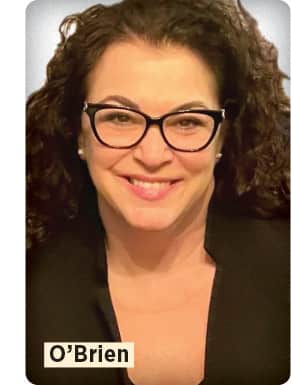 O’Brien owns Senior Insurance Consultants in Orange, Conn., with her husband, Christopher Wojtusik, and has a downline of 40 agents.
“We had to have very difficult but very honest conversations with our clients about what 2026 would look like for them,” O’Brien told InsuranceNewsNet. “If we can put people in the right plans with carriers that want their business, we can hopefully add to the solution and not be part of the problem.”
O’Brien said she has a special gift for understanding the details of every plan available for her to offer clients.
“I can tell you what the preferred pharmacy is for every carrier, what this plan’s dental coverage is versus another plan and all those different things that are so important. We have so many tools to take information from beneficiaries and put it into a system, and the system will tell us what the best plan is for them without having to spend hours putting together spreadsheets and possibly choosing the wrong plan. We just want to make sure people are in the right and best plan for them.”
Clients are frustrated
Mark Bilgere said that one of the most challenging parts of his job as a Medicare advisor is dealing with clients’ frustration over their Medicare Advantage plans, especially as once-plentiful perks such as transportation and allowances for healthy food and over-the-counter medications are being cut back or eliminated.
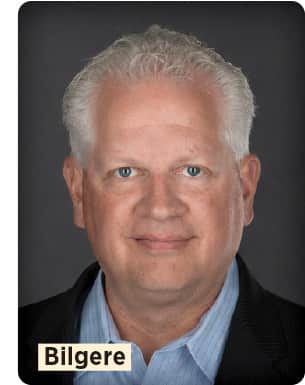 Bilgere is owner of Bilgere Insurance in Bedford, Texas.
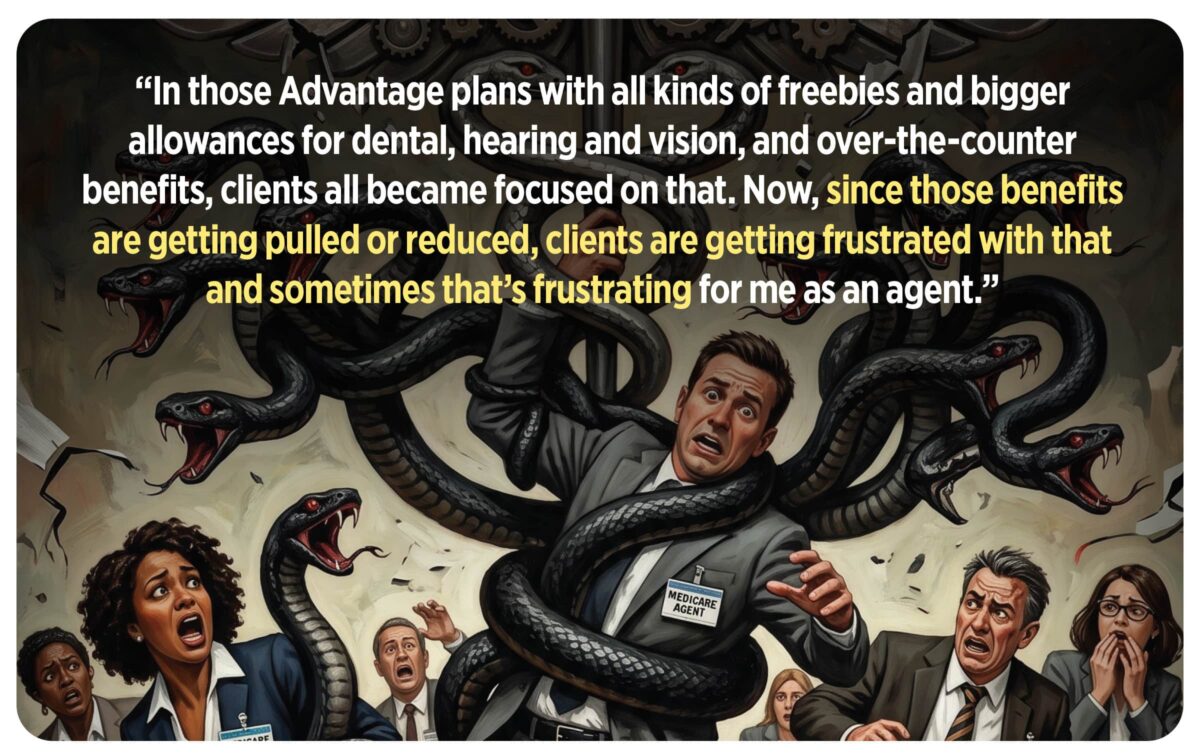
“Clients really got spoiled in a sense,” he said. “In those Advantage plans with all kinds of freebies and bigger allowances for dental, hearing and vision, and over-the-counter benefits, clients all became focused on that. Now, since those benefits are getting pulled or reduced, clients are getting frustrated with that and sometimes that’s frustrating for me as an agent. We spend a lot of time with our clients because what I want them to focus on is, ‘This is your healthcare first, this is your health insurance. It’s trying to prevent you from a catastrophic financial loss and give you the healthcare you need.’ But some clients have been so conditioned to think of only the extra benefits that they sometimes lose sight of how important the health insurance aspect is.”
Bilgere said clients also are frustrated with hospitals being dropped from insurer networks, an issue he tries to help them work through.
“The big hospital systems used to negotiate with the carriers kind of privately and got it settled,” he said. “Now either the carrier or the hospital system sends letters to Medicare clients saying that the plan is going to drop its contract with the hospital system and then everyone is upset. For the agents, we have fewer things to offer clients because when carriers suppress plans, what they’re really telling us is that they don’t want people in that plan because it’s not profitable. We’re conditioned to do the best for the client, and you always want to do that, but you can’t offer them those plans.”
Bilgere said he is adjusting his practice to the changing Medicare landscape by doing more cross-selling of ancillary products to clients.
“Hospital indemnity plans, cancer plans, dental plans are big,” he said. “I believe agents must educate themselves about long-term care, short-term care — not just how they work but how they help people.”
Bilgere predicted the Medicare market will reset in the next couple of years as carriers figure out how they can be profitable in the wake of changing regulations and government reimbursements.
“I think Medicare will become more healthcare and network focused,” he said. “I think everyone who is in an Advantage plan will go into an HMO. I think choice will go away and networks will become more important.”
Changing networks leave clients scrambling
William Gray, aka “The Medicare Dude,” works with Medicare clients in Florida and around the country from his office in Daytona Beach. After nearly three decades of experience in the market, he said he is seeing consolidation of hospital systems and changing Medicare Advantage networks leaving his clients scrambling for answers and help.
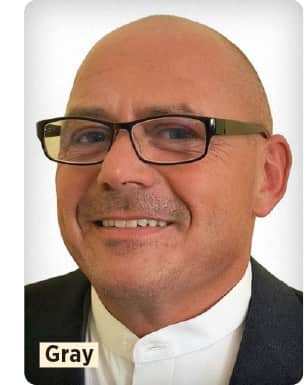 “We’ve seen a lot of controversy about who’s going to stay in network and who’s not, and a lot of carriers arguing right up to the last minute,” he said. “We have people who didn’t know until the very end of open enrollment what plan was going to be accepted by what hospital. So people go running to their agent, saying, ‘Help me out,’ and that left us to work with them to try to figure out what plans they can use.”
Gray said he believes the Medicare Advantage model “is not sustainable.”
“I believe you’ll see premiums for Medicare Advantage plans start coming up. So you won’t see zero-premium plans. The extra benefits, like dental, will either go away or be cut back dramatically.”
Part D is daunting for many seniors
Rebecca Davis is owner and founder of Kannonball Insurance Solutions in Stephenville, Texas, where she has spent nearly a decade helping clients with Medicare.
 In addition to the challenges described by agents earlier in this article, Davis said she has found her clients are increasingly turning to her for help with Part D.
“The whole Part D debacle has been an absolute nightmare ever since the changes made by the Inflation Reduction Act a few years ago,” she said. “It sounds good on paper, but seniors are getting front-loaded. Even though they have a maximum out-of-pocket of $2,100, if the plan actually covers all their meds — which adds up to a lot less than years past when they had the doughnut hole and the $6,000 out-of-pocket maximum — that sounds great.
“But the carriers are front-loading these plans. So the senior is basically responsible for almost all that money with these high deductibles and high copays until they hit the $2,100. A senior making, let’s say, $1,800 a month makes too much for extra help or Medicaid. They’re basically taking that senior’s entire paycheck for the first couple of months of the year just to get their medications. What happens is that people end up just not getting their medications at all.”
Davis said she and her staff often try to find other financial resources for their senior clients to pay for prescription drugs that they cannot afford.
“But there are still some meds that there is just no help for. So the client chooses not to take the med. That might be a life-altering medication, and now the client has just put themselves in harm’s way. I’ve had clients who will say to me, ‘Well, I guess I’m just going to die then because I can’t afford it.’”
Davis said she predicts prescription drug affordability for seniors will only get worse in the coming years.
While prescription drug coverage has become confusing and expensive for seniors, agents are feeling the pinch as well, as Davis said all but one of the Part D plans she sells are noncommissionable.
Davis also sells individual health insurance in the Affordable Care Act market, and said that with ACA open enrollment and Medicare annual enrollment both ending in December, agents will be hard-pressed to review coverage and get clients enrolled by the deadline.
“It’s going to take so many man-hours to rework Part D plans this fall. But now with the ACA hard stop of Dec. 15 instead of in January, we’ll have to choose between helping seniors and helping our ACA clients.”
Davis said she wishes CMS would allow an open enrollment period only for Part D.
“If they would do that, every agent will follow up with their senior clients in January and double-check to make sure their drug plan will work for them — because agents will have time to check up on their clients. Agents want to help, but CMS is making it dang near impossible for us to help.”
Seniors need agents
With carriers discontinuing certain Medicare Advantage plans, provider networks changing and seniors having a 54-day window each year to enroll in or change coverage, Medicare beneficiaries need guidance from advisors to choose the best plan for their needs.
 Jeanette Logan owns JJL Insurance Services in Austintown, Ohio. She said that the elimination of commissions is leading agents to either shift their business to other segments or exit their practices altogether. Seniors are the ones who will be hurt by what she called a “snowball problem.”
“With carriers suppressing plans and making plans noncommissionable, we have no warning,” she said. “This is a huge problem, especially during annual enrollment. We don’t have much time to look at what the plan changes will be for the coming year. Is this plan still suitable for the client to stay in for the next year? Will the carrier eliminate this plan for next year? Clients have fewer plan selections and they need information.
“There truly is a disconnect here, and unless people are working with a broker, a lot of people are unaware of the changes happening until it is almost too late.”
Logan said clients often don’t receive carrier notifications of changes until after annual enrollment has begun.
“There’s no warning with carriers pulling plans,” she said. “We’ve had carriers pulling plans left and right in the middle of annual enrollment period. It’s extremely frustrating.”
Logan said what complicates the situation for clients is when a carrier removes commission from a plan that a client had decided to enroll in.
“Now the client can’t go through me, and I have to explain to them. It’s confusing to the client, and they don’t understand why it’s happening. I have to tell them that I can still help them get into this plan but now I’m not the agent of record, I’m not receiving the commission. And if I’m not the agent of record, then I’m not the agent who can stay in contact with them. So in order for me to continue to work with them, I had to create a letter so they fully understand what that means.”
She described the changes in plans as being “a financial disconnect and harmful thing” for clients, as well as an emotional burden.
“I don’t want people to go through that,” she said. “I want to be able to help my clients, be their resource.”



How to have a black belt practice — With John Terry
What’s fueling record annuity growth?
Advisor News
- A rising retirement challenge: The license to spend
- Financial stress leaves less room for retirement saving
- Giving while you’re living: 3 frequently asked questions about gifting
- Helping clients prepare for one of their biggest retirement expenses
- Important year-end financial conversations every advisor must have
More Advisor NewsAnnuity News
- A rising retirement challenge: The license to spend
- What lower interest rates mean to annuity payouts
- AM Best downgrades A-Cap insurers amid financial and regulatory troubles
- Lawsuit claims Delaware Life hid billions in insurer-linked investments
- AM Best to Deliver Presentation at 2026 ACLI Annual Conference
More Annuity NewsHealth/Employee Benefits News
Life Insurance News