

How to have a black belt practice — With John Terry
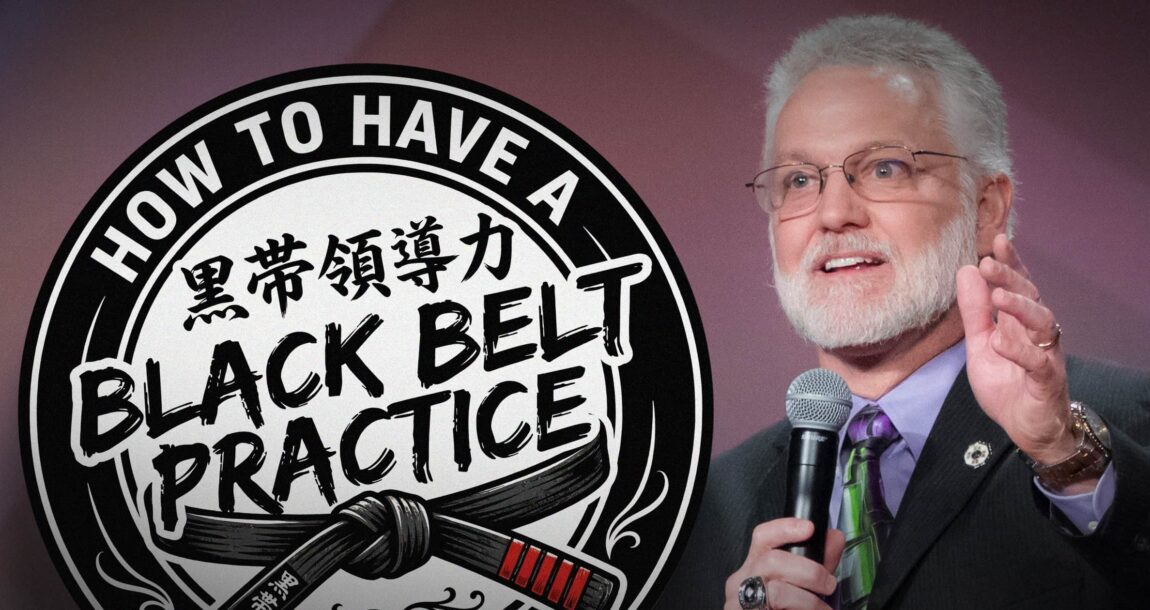
A black belt in martial arts is one of the most recognized symbols — but it’s often misunderstood. It doesn’t simply mean “expert fighter.” It represents a combination of skill, discipline and personal development earned over years of training.
John Terry earned black belts in five different martial arts systems. But he said earning the black belt is about more than kicking and punching; it’s a lifestyle in which you try to live each day by doing better than you did the day before.
Terry is the director of training for Legacy Marketing Group. He is a seasoned sales and marketing coach with over 30 years of experience in the financial services industry, focusing on developing training programs to help agents and advisors.
He is also the author of 11 books. The most recent one, Mastering Business Success: Defeat the 7 Saboteurs Destroying Your Business; Master the 10 Disciplines Needed to Win, released in April.
In this interview with InsuranceNewsNet Publisher Paul Feldman, Terry describes how to apply “black belt mentality” to expand your practice and gives tips on how advisors can turn clients into lifelong fans.
PAUL FELDMAN: How did you get into financial services?
JOHN TERRY: My grandfather was a banker, and my uncle was an accountant. I started doing taxes with my uncle when I was 13. We had what we called the “pizza and Dr Pepper rule.” He would teach me how to do the simple returns — that’s back when we did it with a pencil on paper. And the rule was we did tax returns until we ran out of pizza or until the two bottles of Mountain Dew or Dr Pepper that he bought went empty.

But my uncle started pouring his vision of the world into me. This was during the Glass-Steagall era. So insurance was insurance, banking was banking and investing was investing. The three couldn’t combine. He envisioned a world where Glass-Steagall was gone and we could come together and do all of this as financial professionals. That stuck with me, and I became very fascinated with money early on.
When I wrote my first book on financial principles, I went into the Bible and wrote a book on what the Bible says about money. That book was picked up by a seminary and went into 25 countries around the world. Soon after that, I received an invitation to join Prudential, and I thought, “Well, why not? I’m writing about finances; I’d love an opportunity to help people with their finances. Why not go and see what this world looks like?” That’s where I got my start, back in the late 1980s, and I’ve been in love with this industry ever since I became successful as a personal producer.
My competition carrier called and asked, “Would you like to make an override to train your competition?” And I said, “What’s an override?” I didn’t know what that was.
The next thing I knew, I’d built what today we would call an independent marketing organization. I had Insurance Marketing Group of America, a life and health IMO. We built a broker-dealer, built a registered investment advisory. Over the years, I’ve asked, “What’s next?” That’s a question I love to ask when it comes to innovation: What’s next?
I had the opportunity to move to Hot Springs, Ark. Somebody wanted to buy the broker-dealer I was part of. I came with the deal, and they discovered all this incredible knowledge in my head. I went from being more of a product guy in the IMO space to being a consultant and focusing on coaching, consulting, mentoring and training. For the last 20 years, I’ve been more on the coaching and consulting side.
I still understand the products and still know how to sell the products and teach the products, but I do it more from the perspective of, let’s look at the process itself and let’s learn the processes, but let’s also learn the leadership aspects we need to know, to lead ourselves and to lead our clients. How do we become better communicators? How do we understand how to deal with human behavior when we’re dealing with all these different personalities and they want to be communicated with in different ways? Those are the types of things I’m doing today, and I love what I do.
FELDMAN: Tell me about your interest in martial arts.
TERRY: It goes back to my being bullied as a 13-year-old kid. Dad’s solution was to throw me in a martial arts class, where I was the only kid in the class.
In the 1970s, martial arts was an adult thing. They didn’t teach kids, but the school owner made an exception. I was about the same size as a 23-year-old woman who was in the class. So my dad was paying good money for me to get beaten up by a girl. And that became the standing joke: my dad saying, “When you learn to fight like a girl, the bully in school will stop.” Fast-forward, five black belts and three Hall of Fame inductions later, and it turned out to be a pretty good life.
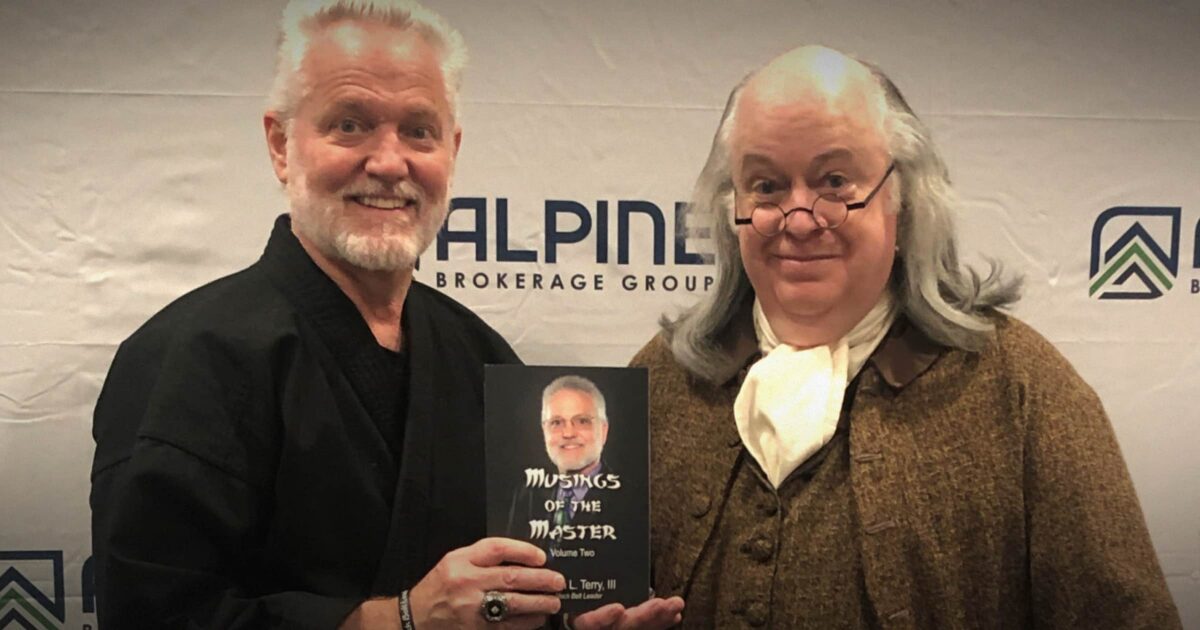
FELDMAN: You’re the highest degree of black belt.
TERRY: I have five black belts in five different martial arts systems. I’ve been inducted into three different martial arts halls of fame: the United States Martial Arts Hall of Fame in 2008, the Masters Hall of Fame in 2016 and the International London Martial Arts Hall of Fame in 2022.
FELDMAN: Tell us how that applies to a financial advisor or any other professional.
TERRY: The black belt is not something you earn just by punching and kicking. It is a lifestyle, a discipline you learn to live, where you strive every day to become a little bit better version of yourself than you were the day before. One of the things I’m doing here as director of training at Legacy Marketing Group is having an opportunity to bring these black belt principles into business, because what I often see in our industry is that we have some incredible financial professionals who are gifted at their trade. They can sell insurance; they can make investments and do all the other things they do in that space. But many of them are what I call the proverbial white belt when it comes to the business aspect of running the business.
I saw the same thing in the martial arts industry. You have incredible instructors who can teach taekwondo and kung fu and all the different martial arts styles. But when it comes to understanding how to run a successful business, how to understand human behavior, how to engage in all the things necessary to scale and grow a business, there are a lot of white belts out there who are wondering why they’re not as successful as they could be.
We’re all black belts at something because, if you think about our industry, we have some incredible professionals who show up and show out in what they do in terms of understanding products and services and how to engage with their customers. But often it’s the back-end systems and processes and other things they miss in their business. They end up putting what I call saboteurs in their way, and they sabotage their own success by not paying attention to working on their business and not working in their business.
FELDMAN: What do you see other financial professionals doing?
TERRY: The biggest thing I see is that many of our peers in the financial services industry have stopped learning and growing. To me, that is a problem. It takes me back to something Albert Einstein said back in the early 1900s.
Einstein made a powerful statement. He said the world we have created is a product of our thinking. That world can’t be changed without first changing our thinking. We stop changing our thinking and developing the quality of who we are when we stop being curious and we stop learning.
The biggest thing I see today with financial professionals is that they get their license, they learn how to sell insurance and they learn how to manage assets. But once they learn how to do it a certain way, they stop learning, they stop growing and they stop discovering what might be new and whether there is a better way than the way they’re doing things. It’s that status quo mentality that often holds them back from stepping into the next level of that success, because they’re stuck in the same old ways of doing things in the way they’ve always done them.
FELDMAN: How do we “unstick” them from these same old ways?
TERRY: The easiest way to unstick them is through personal growth. I write about that in my book Black Belt Leadership 101. The first principle of becoming a black belt leader is belief, and you cannot achieve what you do not believe. That’s the No. 1 principle that comes out of that book.
We have producers who go into the mindset “If I can only get to $5 million a year, I’ve made it.” Then once they get there, that becomes the ceiling that they set for themselves. They get to $5 million, and they wonder why they can’t get from $5 million a year to $7 million or $10 million.
It’s because of a limiting belief they imposed on themselves that became their own saboteur of their success, because they stopped looking at how they can grow their business beyond $5 million and position their business so they can go from $5 million to $7 million to $10 million to $20 million to $50 million. They get content with a certain level of production and a certain level of influence. At that point, they get the mindset that they’ve learned all they need to be successful, and they end up stymieing their own growth and their potential to make a bigger impact.
FELDMAN: Give them three steps to get out of that mindset.
TERRY: My latest book, Mastering Business Success, came out in April. In that book, I write about the seven saboteurs that we often place in our way. One of those saboteurs is an unwillingness to systemize, delegate and prioritize.
Here’s one thing I often see producers doing: They run a successful business, they get to about $5 million and that’s probably all they can handle on their own, with maybe one assistant. At that point, if they’re not delegating processes, they’re not bringing on new people they can train to take on the 80% of mundane tasks that they don’t need to be doing so they can focus on the 20% of tasks they do best. That becomes a roadblock.
The second step is engaging in personal growth. One thing I’ve learned in studying the most successful people who ever lived is that they start their day reading something inspirational, vocational, educational or biographical, so they can stretch the quality of their thinking to be able to see things that are right in front of them that they’ve not yet trained their mind to see. So learning to stretch yourself and grow would be the second step.
The third step is to learn to become much more efficient at managing time, because we all have 1,440 minutes a day. How many of those 1,440 minutes are wasted because we’re doing mundane things or because we’re doing busywork rather than doing productive work that drives our business forward?
In my new book, I write that one of the challenges is the fact that we can’t manage time, but we can manage what we do with our time. It’s about constantly asking ourselves whether what we are doing right now is the best use of our time. And if it’s not the best use of our time, why are we doing that when we could do something to move our business forward or help us grow into a better version of ourselves to show up and serve our clients at a higher level than we’re serving them today?
Another saboteur I write about is the failure to innovate, and that’s an area that is killing advisors. I tell advisors, artificial intelligence will not necessarily replace you, but you will be replaced by agents and advisors who learn to use AI as a resource in their business, because they’re adopting innovation that’s letting an incredible partner do their research. You have to check it to make sure it’s all correct. But there are things we can do with technology today that can simplify our lives, take the mundane routine things that we’re still doing manually, and put those into a system or a process to make us more efficient and more effective.

FELDMAN: Where are you seeing AI helping advisors?
TERRY: In Geoff Woods’ book, The AI-Driven Leader, he writes about making AI a thought partner. If you lead your organization, you are the thought leader. But Geoff says you need a thought partner that can do the heavy lifting.
So when it comes to developing a plan for your business for the next 12 months, you can put that plan together, build that out, give it to AI and ask AI to question and challenge it. AI can take on different personalities. It can be an analyst. It can be a researcher. We can use that technology in different roles to make sure that we’re being the very best that we can be.
It’s through asking the right questions and asking the right prompts, and giving AI an assignment to do and a goal that we want it to achieve, and asking it to deliver results — but validated results where you can check the sources — that’s where AI can be valuable.
Let’s say I have a client who wants to retire at age 65 and here are the parameters. Let AI do some research and come back with a variety of different plans. Now you, as the thought leader, can say, “Let’s add my color; let’s add my flair, let’s add my wisdom that AI doesn’t have and now make this my own.” Suddenly, a project that would have taken you two weeks to put together for a client is done in 30 minutes to an hour.
FELDMAN: Let’s talk about Black Belt Marketing. How is it working with advisors?
TERRY: Where agents and advisors are crushing it, they’re taking the time to understand their clients’ wants, needs and concerns, and the goals and objectives they want to achieve. They’re tailoring that message directly to that audience. Previously, I saw many financial professionals had a general story of “I’m an insurance agent, come see me.”
What I’m seeing now is that the insurance agent is also getting a Series 6 or Series 7; the investment guy is adding insurance to their practice. They’re bringing in an estate planner, they’re bringing in an accountant and being much more holistic.
But they’re also using a more emotional approach that speaks to the consumer’s needs and desires because they’re beginning to understand something I’ve been teaching for a long time. From what I know about human behavior, our initial decision to say yes or no to an offer is an emotional decision because of all the stimuli that we receive from seeing, hearing, speaking, tasting and feeling. As those impulses flow up through our body into our brain, they immediately enter the primal part of our brain, where our emotions reside. That nonverbal response of saying yes or no to an offer is initially emotion driven. If someone likes the idea, it has been pushed into the conscious mind, where it’s now intellectually validated.
But for years, we saw advertising that was kind of the Joe Friday approach — just the facts — and all the reasons why you should do business with me. What people are learning today is that approach doesn’t work because people are always asking: What’s in it for me? We see that pivot in the conversation now. Consumers are more savvy; they can do research on Google or AI, and they can learn all the facts there. They need somebody who can say, “I understand your pain, I understand your fear, I understand your concern. This is how I can help.” That approach makes a huge difference.
I love to tell financial professionals, “If the consumer doesn’t know who you are, they don’t know what you do, they don’t know how you uniquely do it so you’re different than everybody else in the people pile. And most importantly, if they don’t know how it benefits clients, you’re the invisible man or you’re the invisible woman.”
FELDMAN: Will you give us some sales tips?
TERRY: One ninja trick I’m using right now is an old trick, but it’s a new trick to a generation of financial professionals who haven’t heard it. It goes back to something that we heard from Steven Covey: Start with the end in mind. What I see most financial professionals do is walk in the door with a presupposition — this client needs an annuity or they need life insurance or they need managed money.
The approach I take is, let’s move that to the end of the conversation and let’s start with the client. Let’s start with asking questions to understand exactly what that client or prospect wants or needs and identifying why that’s important or why it’s keeping them awake at night.
The second part of that conversation is explaining the benefits of the solution that you’re going to bring. Whatever those benefits are, bring them out first, get the consumer to say that’s what they want. The minute they say the benefit of that product or service is what they want, they’ve already leaned in to the annuity or the life insurance or the managed money or the stock portfolio.
Now you don’t have to do the heavy lifting because they see the benefit to them first before they ever see the solution.
And I describe it as being like having the plumber come to your house. When the plumber comes in your house, he walks in with a toolbox, but he doesn’t know what tool he’s going to use until he analyzes the problem that needs to be fixed.
When we sell from that perspective, we’re engaging in a sales process that makes sense in the client’s mind. It works in conjunction with how their brain makes a buying decision, and it lets them see the benefit of the solution before they ever see the tool you’re going to pull out of the toolbox and all the financial products you have to solve the problem.
Suddenly, it’s not just a transaction; the agent becomes part of that individual’s family because they know what’s important to them and why. And as they’re building a relationship, those clients now become walking, talking billboards for that financial professional as they go around saying, “You will not believe what Paul did for me. He sat down, and we had a conversation. He understood exactly what was going on in my world, and he said, ‘I can fix that. I can make that pain go away,’ or ‘I can help you achieve that objective.’ And guess what? He did!”
Now they become your marketing team, and you’re not paying them to do it. They’re paying you for the service that you’re providing, but they’re out there telling your story. And when somebody really likes you, they’re going to talk about you all day long, and they can’t stop.


ACA subsidy turbulence is reshaping employee benefits
The Medicare agent squeeze
Advisor News
- Addressing the longevity paradox
- Employers shift focus from retirement access to financial outcomes
- Helping widowed clients navigate their new financial reality
- Navigating client communication in a digital age
- Can your advisory firm survive without you?
More Advisor NewsAnnuity News
- Farm Bureau P&C insurers post first underwriting gain since 2021
- Legacy Marketing, Malibu Life launch two fixed indexed annuities
- Changing client priorities are reshaping annuity conversations
- Solen Software acquires annuity software provider Cooperative Technologies
- MassMutual Expands Lending Options With New Secured Credit Line
More Annuity NewsHealth/Employee Benefits News
- AmeriHealth Caritas to join Ohio Health Insurance Marketplace in 2027
- Legislators hear report on thin hospital margins, advance prior authorization reform
- As Children’s Mercy is dropped by ACA Marketplace, MO insurance group makes statement
- 87,000 Iowans face Medicare plan cancellations
- Medicare plans to change
More Health/Employee Benefits NewsLife Insurance News