

Start 2026 workplace benefits education now

Although the 2026 open enrollment season is months away, LIMRA research suggests now is the time to start educating workers about their benefits to generate more engagement next fall. Data from LIMRA’s BEAT study reveals that many workers struggle to understand their benefits and desire more frequent communication.
Fewer than 6 in 10 employees believe they understand their insurance and retirement benefits well. For younger workers, self-reported knowledge is even lower, perhaps because they have less experience with these offerings.
Understanding also varies considerably by product. Employees feel the most knowledgeable about dental and medical plans — benefits they tend to use at least occasionally — and least confident in their understanding of disability and supplemental health plans.
Lack of knowledge undermines participation
Poor understanding of benefits presents several challenges to employers. First, when employees don’t understand their benefits, they are less likely to choose to enroll. Low participation can impact the long-term success of a benefits program as well as leave employees without important financial protection.
In addition, workers with low benefits knowledge are less willing to spend money on benefits — about $100 less per month, on average — compared with workers who have a very high understanding.
Moreover, employers offer benefits as an attraction and retention tool. If their workers don’t know about or appreciate the value of their benefits packages, companies may not be getting the full return on investment for the benefits they make available.

Improving benefits communication
Clearly, benefits communications are falling short. Only 53% of workers say their employer conveys benefits information to them very or extremely well, with younger employees giving the lowest ratings.
What can we do to improve communication? Research points to several promising strategies for enhancing employees’ understanding of their benefits.
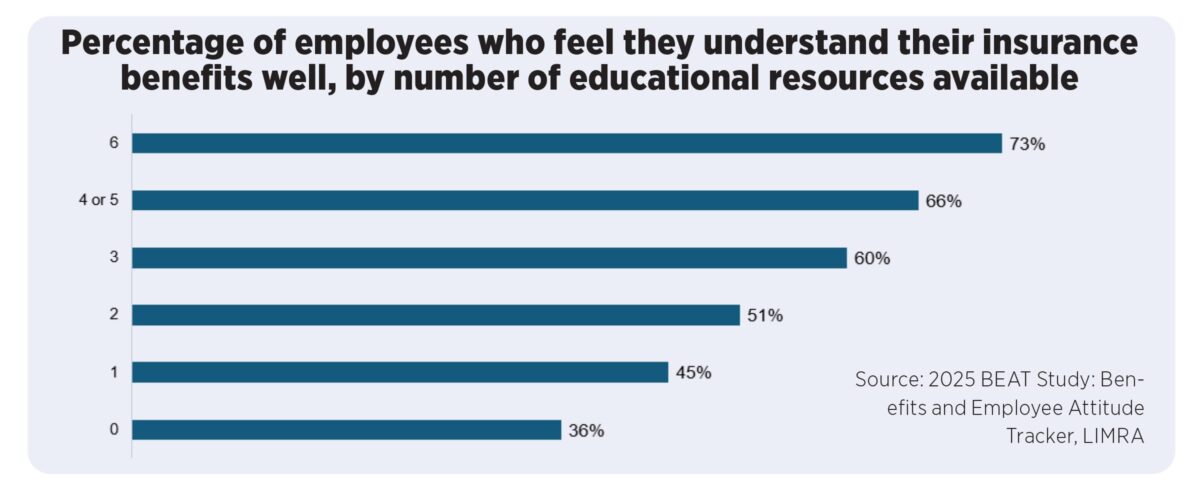
» Use multiple channels. The more different types of educational resources employees have available, the better they understand their benefits. Employees all have unique learning styles and prefer to absorb information in different ways. A multichannel approach increases the odds that workers will receive benefits information in a manner that works for them.
» Summarize the value of benefits. Workers who receive total compensation statements — which summarize the total value of an employee’s compensation and benefits package — report a better understanding of their insurance and retirement plans. These statements can help workers recognize the full value of the investment their employer is making in them, beyond just their salary.
» Provide personalized guidance. When considering the educational resources they used during open enrollment, workers say the most helpful opportunities were those that allowed them to talk to someone or get advice. The most helpful resource was one-on-one in-person benefits meetings — while group meetings, interactive recommendation tools and phone consultations all ranked within the top five.
» Communicate throughout the year. Employees who receive benefits information periodically throughout the year, rather than only during open enrollment, report a better understanding of their benefits.
Poor employee understanding has been a persistent, ongoing challenge for the workplace benefits industry, particularly when it comes to nonmedical and voluntary benefits. Improving the situation will require a multipronged approach and collaboration from numerous stakeholders, including carriers, brokers, benefits technology providers and employers.
The potential payoff is big — employees who understand their benefits well are far more likely to be satisfied with their benefits offerings; only 18% of workers who do not understand their insurance benefits are satisfied with them, compared with 73% of those who understand them extremely well. By improving education, the industry can lift benefits satisfaction and help workers make the optimal choices for their future financial security.



Growing together: The power of professional study groups
Building momentum — with Lonniece McDonald
Advisor News
- Employers shift focus from retirement access to financial outcomes
- Helping widowed clients navigate their new financial reality
- Navigating client communication in a digital age
- Can your advisory firm survive without you?
- I started using AI, but what now?
More Advisor NewsAnnuity News
- Farm Bureau P&C insurers post first underwriting gain since 2021
- Legacy Marketing, Malibu Life launch two fixed indexed annuities
- Changing client priorities are reshaping annuity conversations
- Solen Software acquires annuity software provider Cooperative Technologies
- MassMutual Expands Lending Options With New Secured Credit Line
More Annuity NewsHealth/Employee Benefits News
- Centene exiting Hawaii’s Med-QUEST program at end of year
- US DEPARTMENTS OF LABOR, HEALTH AND HUMAN SERVICES EXPAND EFFORTS TO HELP EMPLOYEES ACCESS HEALTH BENEFITS
- Antidote Health Expands into Texas and Georgia, Bringing Affordable Coverage and $0 Virtual Care to New ACA Shoppers
- About four in 10 FSA account holders forfeited unused funds to employers, EBRI finds
- U.S. News & World Report Names the 2027 Best Insurance Companies for Medicare
More Health/Employee Benefits NewsLife Insurance News