

Annuities are for everyone — With Mike Downing co-president of Athene USA

Annuity sales are skyrocketing, and Mike Downing is on the front lines of those record-busting sales. Downing is co-president of Athene USA and chief operating officer of Athene Holding. He is responsible for the day-to-day operations and is an advocate for unlocking the demand for annuities by improving the customer experience.
Downing believes the annuity industry is on the brink of transformation as the population ages and younger workers see the need for guaranteed income for their post-employment years.
In this interview with publisher Paul Feldman, Downing describes where he sees the demand for annuities going in the future, as well as the role the technology has in making annuities more accessible to consumers.
PAUL FELDMAN: Tell me how you started in the industry.
MIKE DOWNING: I’ve been in the retirement industry for my whole career — 30-plus years. My technical qualification is that I’m a pension actuary. I started in the retirement industry as a pension consultant, working with large companies that had traditional defined benefit plans for the first 15 years of my career. I saw the apex of that market; I really started to see that market through its slow decline as the nature of a defined benefit promise became less compelling. For employees, there was a lack of portability, and it was hard to understand. Some of the costs and risks became prohibitive for employers. I started to see these plans begin to freeze and even terminate.
I joined the insurance industry during the financial crisis in 2008. I think one of the interesting aspects of my background is that I’ve been in retirement and saw both sides: guaranteed income when it existed and the decline of guaranteed income. The part of the business that I’m excited about today is insurance that is uniquely positioned to restore the lost promise that existed with traditional defined benefit plans and can help consumers and plan participants transition from savings to spending in retirement. Only insurance can solve that equation, because we can provide guaranteed income and no one else can.
It’s almost two stories: the story of the decline of one system and the story that we are in the nascent days of a new system that I think will result in protection as well as portability and flexibility.

FELDMAN: As you talk about the rise of a new system, how can we do a better job of getting people to think about annuities instead of just putting their money in the stock market?
DOWNING: One thing we can do is dispel a lot of the myths around annuities. I’m often asked what is the average age of someone who buys an annuity? That age is typically near or at retirement. But when you look at the products that exist today, as opposed to what existed 30 years ago, annuities are really for everyone.
A big feature of annuities is tax deferral. Tax deferral is a young person’s benefit. Tax deferring starting at age 40 is a lot more effective than starting tax deferral at age 60.
And the array of products is much more diverse today than 30 years ago. Thirty years ago, the choices were simple: a single premium immediate annuity — which is guaranteed income for life — or a simple accumulation annuity. Today we have fixed indexed annuities, which provide market upside. The index can be pegged to an S&P index or, at Athene, we have multiple other indexes you can plug into. This offers a more compelling proposition for a younger customer where you have principal protection but you still have equity-like upside. The newest segment that is emerging is the registered index-linked annuity, which provides even more upside with less downside protection, but still has guardrails. That should attract an even younger customer base.
The big thing we need to do is to continue to simplify the products and educate the customer base around the fact that annuities are really for everyone, and the amount of protection they can provide against your traditional portfolio is substantial. The value proposition is quite strong.
FELDMAN: I completely believe in portfolio diversity. How are you creating diversity with the different indexes you offer?
DOWNING: We’re offering two flavors. One is choice. We allow advisors to kind of pick and choose and advise their clients on a particular type of index. And then there is the other where we try to simplify the sales process by coming up with preblended indexes, where we might take three of our indexes and blend them together to create more stable outcomes. We call that a preselect process, where you preset your strategy and it can take a set-it-and-forget-it mode.
We also have lock-in opportunities, which create more active engagement. The idea is to have an index for every type of economic environment that is less correlated with the S&P for diversification.
FELDMAN: I was told 60% of annuities sold are tied to the S&P index. Is that your experience?
DOWNING: Our experience is quite the opposite. We have the vast majority going into custom indexes. That’s partly because we were an early adopter of custom indexes with the idea of creating diversification for customers and choices for financial advisors to present to their customers. Part of the reason our success is so strong is we’ve been able to build a track record.
The challenge with new custom indexes is that they are based on historical theoretical performance, but the real proof is how they perform on an ongoing basis. Some of our oldest indexes have been around for a decade and have great track records. Those track records in combination with Athene as a brand has created a large following for our custom indexes, and they continue to perform.
FELDMAN: Athene has been one of the top annuity sellers over the years. What’s the secret of your success?
DOWNING: Our secret has been focus, execution, having an excess supply of capital to meet the doubling of demand in the industry, and consistently having great relationships with our distribution partners. The combination of the doubling of overall industry growth with a large increase in our distribution footprint gives us the ability to serve our largest distribution partners. We put a lot of focus on our back-office operations, and we pride ourselves on having a market-leading operation that is able to deliver the largest volumes in the industry.
FELDMAN: How do you see technology and artificial intelligence affecting the annuity industry?
DOWNING: People immediately see AI as having chatbots replace individuals in the call centers instead of having a representative provide the human interface. I would say that’s probably the wrong way to look at applying AI in the insurance space.
The best way to use AI in the insurance sector is to use it in a way to stop the call from coming in the first place. A lot of calls come in because of confusion. There’s confusion in the process. The customer doesn’t understand, the advisor doesn’t understand, so they pick up the phone and call in. AI can help understand what’s causing the confusion in the first place and then set up your infrastructure and process to avoid that confusion altogether.
It’s like a pizza tracker or an Amazon-type experience of, my policy left the building, it’s in good order or it’s not in good order. If it’s not in good order, what information is needed? All of that communication can be done through better investment in technology to anticipate the types of questions customers and advisors have and get ahead of those questions.
We know what drives the questions, so we can start to build the technology and insights to prevent those questions in the first place. If all companies invest more in tech, it will accelerate the creation of industry standards, which will allow us to reach more customers.
FELDMAN: How would you describe where you thought you would be in 2015 to where you are now?
DOWNING: I think we all thought our business model was a great model. We felt it was a better mousetrap, although unproven; I would say our success even exceeded our initial optimistic projections. I think it’s a testament to three things. One is the fact that building around retirement services has proven to be a smart business decision. The retirement market is immense, and there are many different ways to participate in it. You can scale up a business in an efficient way by centering it around retirement and all the spread-based opportunities in that market.
The second is the large influx of capital that Apollo has been able to bring in. An insurance company can grow only as much as its earnings support without having capital infused from the outside.
And third is investment insurance, high-grade insurance, quality assets that are nearly all investment-grade but also looking at a more diverse asset pool to back our liabilities. This has created a modest amount of excess yield, but we’re able to pass that on to the customer.
The combination of structure, our ability to compete and this availability of capital has allowed us to grow and take advantage of the doubling of the market that happened when rates reverted to more historical norms.
FELDMAN: Private equity has changed the annuity landscape. How has it helped Athene?
DOWNING: I believe the notion of private equity is a misnomer. Our structure of an insurance company married with an asset management company is a standard structure that has been in effect for decades. MetLife has a similar structure. Prudential has a similar structure. The other aspect of Apollo’s investment skills that sit in Athene’s general account is the investment in private credit, which is just taking advantage of an asset class that has a little less liquidity and still has the same credit superiority. We’ve proven through our track record that there’s such a thing as good private credit, just as there are good corporate bonds and bad corporate bonds and potentially bad private credit, but it’s all about putting the right assets inside an insurance balance sheet.
The complete integration of Apollo and Athene as a single organized company creates a lot of synergies in terms of being able to create a management team that is entirely centered around Athene’s general account. Athene is still highly regulated; it’s still an insurance company like any other company. It has been a huge positive, and I think it’s going to be a huge positive for the industry.
FELDMAN: What does it take in the back office for a carrier to scale the way Athene has?
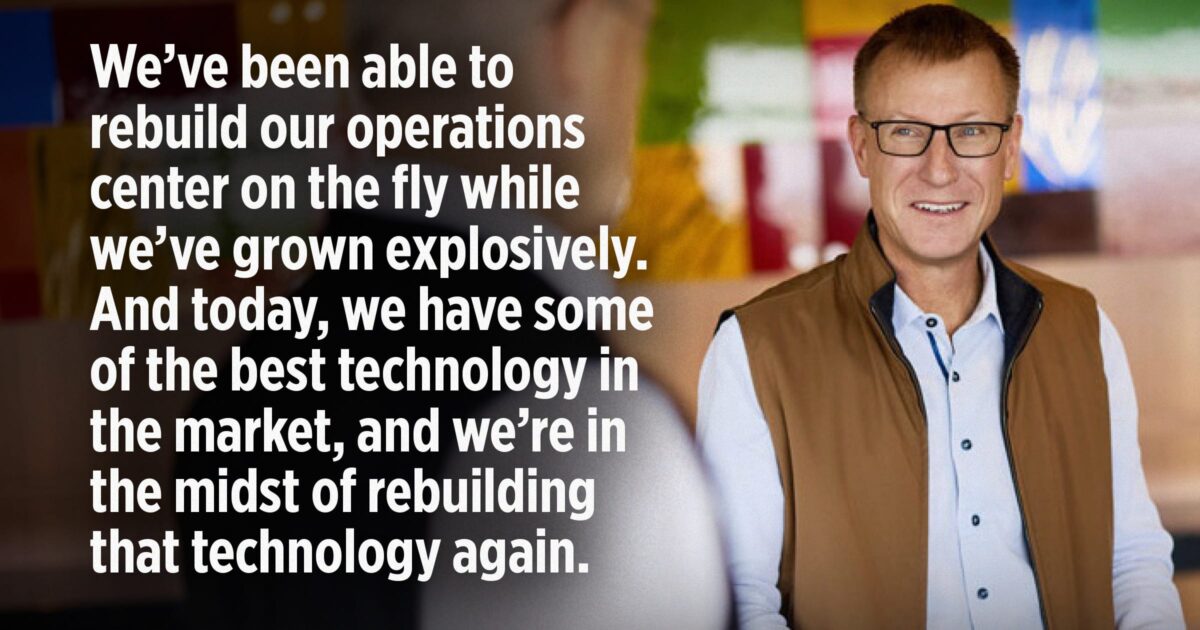
DOWNING: We don’t outsource any of our back office. It’s all done right here in Des Moines, and it’s centrally located, which helps in terms of investing in technology and moving the company forward. We’ve been able to rebuild our operations center on the fly while we’ve grown explosively. And today, we have some of the best technology in the market, and we’re in the midst of rebuilding that technology again.
FELDMAN: What are you looking at rebuilding?
DOWNING: We believe that every three or four years, technology changes enough to consider incorporating some of that new technology into our infrastructure. As a recent example, there has been an industry effort to address the challenges of customers who have an insurance product with one company and want to buy an insurance product with another company, the process being a 1035 exchange. The process historically took almost 20 business days. That’s almost a calendar month in which a customer wants to exchange one policy for another and they’re stuck in limbo while the advisor is frustrated with the process.
The technology that we’ve built and invested in has allowed for paperless exchanges, something that has been eluding the industry for about three decades. Now we can shorten that process to 24 hours. That totally transforms the experience.
FELDMAN: What must the industry do to obtain more business?
DOWNING: I believe a lot of things must happen. When you look at simple, lazy money — certificates of deposit and money market accounts that are just sitting around — I think that’s an aggregate that’s close to $10 trillion. What if 20% of that were converted to simple annuities? That’s a $2 trillion opportunity.
Another opportunity is individual retirement accounts. That market is close to $20.5 trillion when you combine IRA-type savings with nonqualified savings. If you treat insurance like part of your investment portfolio, and you can get about half of that money into various types of annuities, you can increase a retirement paycheck by almost 50% because you can raise your withdrawal rate and never run out of paychecks.
We need to do a better job of messaging as well as making the experience simple for the customer.
FELDMAN: How do we get more young people to consider annuities?
DOWNING: One step is to start with some of the simple money. Ask a 40-year-old what money they have sitting in a CD today that they’re just going to continue to park, and have them put that in a multiyear guaranteed annuity and see the extra dollars they get in savings.
The second is to focus on some of the products, such as registered index-
linked annuities, which have more significant upside. A younger saver will have the comfort to say, “I’m not giving up much in the way of upside because of the structure of these products, but I’m actually getting better tax deferral that I can’t otherwise get,” which is a huge selling point. And if things really go wrong, they’re protected.
When you look at the alternatives to volatile equity markets and uncertain rate environments, it’s compelling.
FELDMAN: Where do you think the biggest opportunity is for annuities with advisors?
DOWNING: Focusing on the money that’s sitting outside the sector. Unlocking the market that’s sitting in CDs and money markets and money that’s already in defined contribution plans and converting that into annuities.
I think advisors have the best message and can simplify the pitch in ways consumers can understand.
Over time, as more consumers adopt annuities at younger ages and start to see the benefits, it will transform the industry and protect people the way they need to be protected today.
FELDMAN: There are so many benefits, such as riders, in annuities. What are some of the best and some of the new things coming out?
DOWNING: The one that I think really resonates the most with consumers is fixed indexed annuities that have income riders attached to them because they provide two things consumers want. One is the option of having income if they want, and when they want it. The consumer can choose when they want to take income. They can take it right away. They can take it in year five or in year 10 but the flexibility is there.
Another option is simple accumulation products. The advantage of these is there is not a rider. They typically offer a little bit more upside in terms of accumulation. Imagine a scenario where a consumer buys a RILA at age 40 or 45. It has more upside and a little less downside protection, but it looks and feels like you’re in the market. And when you’re in that for five or 10 years, the whole time you’re getting tax deferral. Then maybe at age 55, to preserve all that upside, you move it into a traditional FIA that has 100% principal protection and still have equity upside, and then perhaps five or 10 years later, you then roll that same one into an FIA with a guaranteed income rider.
And that’s the cycle that I think advisors can plan with their customers in terms of reaching a younger customer base. It’s showing the progression of products and how you can preserve massive amounts of upside, and then over time, slowly provide the downside protection.
FELDMAN: Where do you see RILA sales versus FIA sales going into the future, from an Athene perspective and also as an industry perspective?
DOWNING: A large part of the explosive RILA growth has been a movement away from variable annuities. The RILA tends to provide much better outcomes and more value overall because of the way they’re structured. I see that segment continue to grow alongside FIAs because they serve different risk/return profiles.
RILA offers more upside with less downside protection, whereas the FIA offers reasonable upside, but you’re giving up some extra upside for more downside protection. And I think the two live side by side, and it’s going to be a combination, and they’ll both continue to grow.
FELDMAN: What do you think about offering annuities within defined contribution retirement plans?
DOWNING: I believe bringing guaranteed income directly into the defined contribution landscape or the 401(k) landscape can do wonders to close the retirement gap in simple ways.
I think the next big chapter in defined contribution is integrating annuities inside 401(k) plans. This will solve a lot of portability issues while still being able to provide lifetime guarantees and do it in a way that’s easy for consumers to understand. I think that’s the next big frontier, and we’re starting to see the initial forays into that space, but there’s a lot more to come and a lot of opportunity.



4 key actions to future-proof your practice
Saving money and relationships — with Clare Dubé
Advisor News
- Navigating client communication in a digital age
- Can your advisory firm survive without you?
- I started using AI, but what now?
- How to support an entrepreneur client with multiple businesses
- Could a narrower focus help grow your practice?
More Advisor NewsAnnuity News
- Solen Software Group Acquires Cooperative Technologies, Provider of 1035 Exchange and Annuity Replacement Software
- MassMutual Expands Lending Options With New Secured Credit Line
- Corebridge Financial Introduces Progressive Trigger, a First-of-Its-Kind Index Annuity Strategy Designed to Turn Missed Years into Future Opportunity
- Insurer proposes $1.1M deal to resolve CA teachers’ annuity fee lawsuit
- IMOs get frustrated with slow carrier adoption of faster technology
More Annuity NewsHealth/Employee Benefits News
- More than 1,700 Pottawattamie County residents face Medicare plan cancellations
- KENTUCKY CAN CUT HEALTH PREMIUMS WITHOUT SPENDING A DIME
- SpecialtyCare sues Anthem over $2.5 million in unpaid awards
- Americans Worry They Can’t Afford Health Care in Retirement, Allianz Life Study Finds
- Lawmakers urge USCIS to address immigration backlog affecting healthcare access
More Health/Employee Benefits NewsLife Insurance News