

Investor Optimism Down 18 Points In One Year: Wells Fargo/Gallup
The Wells Fargo/Gallup Investor and Retirement Optimism Index dropped to 85 for second quarter 2019, down 18 points from 103 a year ago. Investors are less optimistic than a year ago about maintaining their household income and reaching their 12-month and five-year investing goals.
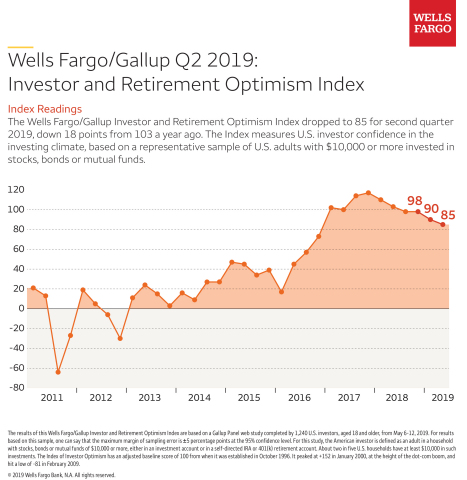
Investor Optimism Drops 18 Points from a Year Ago, According to Wells Fargo/Gallup Study (Graphic: Business Wire)
The Wells Fargo/Gallup Investor and Retirement Optimism Index measures U.S. investor confidence in the investing climate, based on a representative sample of U.S. adults with $10,000 or more invested in stocks, bonds or mutual funds. More than half of investors — 61% — say the stock market’s recent performance makes them concerned that the market is “peaking.” The latest poll was conducted May 6–12, 2019.
More than half of investors (61%) describe the economy as “booming” or “solid,” but there are concerns that a recession is nearing: 51% of investors say a recession will begin either later in 2019 (11%) or in 2020 (40%). However, a clear majority — 66% — say they are “prepared” for how they will handle their investments in the event of a recession. This includes 72% of retirees and 64% of nonretirees.
“It is good to see that two-thirds of investors feel they are prepared to handle their investments during a recession,” said Tracie McMillion, head of global asset allocation strategy for Wells Fargo Investment Institute. “While we do not see a recession in the near term, in many ways we are still recovering from the last one — which left a deep scar on many investors. This sense of preparedness is a positive sign.”

Investors plan more for retirement than their working years
The study found that three in four investors (75%) say they have put “a lot” or “a fair amount” of thought into achieving their financial, family and lifestyle goals in retirement. In contrast, fewer than half of investors — 46% — say they have given the same thought to planning their life in their working years.
“It’s fascinating that investors have given so much more thought and planning to their retirement years than to their working years. Those working years are the ones when people are making lots of decisions about work, raising families and buying homes, and planning could be helpful,” said McMillion.
The poll found a gender gap in planning the working years: 52% of men versus 38% of women say they have given “a lot” or “a fair amount” of thought since the start of their working years to how they would achieve their work, financial, family and lifestyle goals during this phase of life. By contrast, there is no significant difference between men and women in planning for retirement, with 77% of men and 73% of women giving it considerable thought.
Greatest retirement curveball? Healthcare looms large
The poll asked nonretirees which of five possible factors causes them the most difficulty when planning for retirement. Not knowing how much money they will need to maintain their standard of living (29%) ranks No. 1, nearly a tie with No. 2 healthcare (26%). Not knowing how long they will live (20%) came in third.
Twenty-one percent of investors say they are “highly confident” they will have enough money to maintain their preferred lifestyle in retirement. Just over half, 53%, are “somewhat confident” about their retirement, and 26% are “not too confident” or “not confident at all.”
Notably, healthcare is investors’ top issue when looking ahead to the 2020 elections, with 76% saying the candidates’ positions on this topic will be “very important” to their vote. Social Security (70%) and the economy (69%) are close second and third election issues.
“Healthcare is an unknown cost for many, and it becomes even more of a concern as people age and try to factor those costs into retirement planning,” said McMillion.
How investors use “catch up” strategies to enhance retirement savings
The most common step non-retired investors say they are doing to catch up on their retirement savings is paying off high-interest debt (80%). A little more than half of investors (54%) say they are increasing the amount they are saving, roughly tied with deciding to retire later than their preferred retirement age (52%). Less common actions are cutting way back on daily expenses (38%), making catch-up contributions (32%), downsizing their home (13%) and working a second job (12%).
Four in five non-retired investors report having a 401(k)-type retirement savings plan. However, when this group is asked how much they plan to save this year, they fall far short in deferring the allowable maximum savings. Across all age groups, 18% of investors surveyed plan to save the maximum allowed savings for their age. On average, investors under 50 are planning to save $8,969 in their 401(k) this year, just under half the maximum allowable amount of $19,000. Investors who are 50 and older are planning to save an average $10,761 in their 401(k) this year, less than half the maximum allowable contribution of $25,000.
Fewer than one in five investors under age 50 (19%) and 16% of investors 50 and older say they are planning to save the maximum allowable amount for their age group this year.
Investors say now is a good time to invest, but not to spend
Nearly two in three investors (65%) say that now is a good time to invest in the financial markets, consistent with the 64% to 68% range seen in the poll since the start of 2018. About half (53%) say the rise in markets makes them feel more confident about their retirement savings. Yet fewer than half report that the rise in markets makes them feel more confident about spending more money (44%) or making major purchases (40%).
Investors as a whole report having an average 44% of their savings invested in stocks. When asked to think ahead to their portfolio at age 80, investors estimate they will have just 26% invested in stocks at that time. Notably, there is virtually no difference between the estimates of current stock exposure given by retirees and nonretirees. Retirees estimate they currently have 46% of their savings invested in stocks and nonretirees estimate they have 44%. However, when looking ahead to age 80 or older, retirees estimate they will have 33% of their savings in stocks at age 80, and nonretirees estimate they will have 23%.
“Historically, investors have been advised to shift into a more conservative portfolio as they move into retirement because they have less time to recover from market corrections and are often withdrawing funds for living expenses,” noted McMillion. “With very low interest rates expected to persist in the bond market, it may be appropriate for retirees to maintain higher allocations to equities, but they need to assess the increased volatility risk that comes with holding equities. Meanwhile, nonretirees may not be taking full advantage of the growth potential of equities over time and may need to increase their exposure.”
Recession fears: Who is prepared, and what actions are they taking?
About half of investors (51%) predict that the next U.S. recession will occur either sometime later this year or next year. Two-thirds of investors say they feel prepared for how they would handle their investments in the event of a recession, but there are differences by subgroup:
- 77% of men versus 55% of women feel prepared.
- 72% of retirees versus 64% of nonretirees feel prepared.
- 74% of higher asset ($100,000+) investors feel prepared versus 57% of lower-asset investors (less than $100,000 invested).
Nonretirees are not taking major precautions to guard against a future recession, as only 18% plan to delay a home purchase and 23% plan to delay retirement. But slight majorities say they are preparing by taking actions that are good financial practices at any time. These include increasing their savings (59%) and cutting back on spending (52%). Some are reducing their stock holdings (22%) and increasing their bonds (15%), while about half say they are diversifying their portfolio more and half say they are increasing their cash holdings.
For retirement insights for every generation, view Wells Fargo’s digital report Reimagining Retirement.
About the Wells Fargo/Gallup Investor and Retirement Optimism Index
The results of this Wells Fargo/Gallup Investor and Retirement Optimism Index are based on a Gallup Panel web study completed by 1,240 U.S. investors, aged 18 and older, from May 6-12, 2019. The Gallup Panel is a probability-based longitudinal panel of U.S. adults who Gallup selects using random-digit-dial phone interviews that cover landline and cellphones. Gallup also uses address-based sampling methods to recruit Panel members. The Gallup Panel is not an opt-in panel. The sample for this study was weighted to be demographically representative of the U.S. adult population, using the most recent Current Population Survey figures. For results based on this sample, one can say that the maximum margin of sampling error is ±5 percentage points at the 95% confidence level. Margins of error are higher for subsamples. In addition to sampling error, question wording and practical difficulties in conducting surveys can introduce error and bias into the findings of public opinion polls.
For this study, the American investor is defined as an adult in a household with stocks, bonds or mutual funds of $10,000 or more, either in an investment account or in a self-directed IRA or 401(k) retirement account. About two in five U.S. households have at least $10,000 in such investments. The sample consists of 71% nonretirees and 29% retirees. Of total respondents, 42% reported annual incomes of less than $90,000; 58% reported $90,000 or more. The Wells Fargo/Gallup Investor and Retirement Index is an enhanced version of Gallup’s Index of Investor Optimism, which provides the historical trend data. The median age of the non-retired investor is 46 and the retiree is 68.
The Index of Investor Optimism has an adjusted baseline score of 100 from when it was established in October 1996. It peaked at +152 in January 2000, at the height of the dot-com boom, and hit a low of -81 in February 2009.
About Gallup
Gallup delivers analytics and advice to help leaders and organizations solve their most pressing problems. Combining more than 80 years of experience with its global reach, Gallup knows more about the attitudes and behaviors of employees, customers, students and citizens than any other organization in the world.
About Wells Fargo
Wells Fargo & Company (NYSE: WFC) is a diversified, community-based financial services company with $1.9 trillion in assets. Wells Fargo’s vision is to satisfy our customers’ financial needs and help them succeed financially. Founded in 1852 and headquartered in San Francisco, Wells Fargo provides banking, investment and mortgage products and services, as well as consumer and commercial finance, through 7,700 locations, more than 13,000 ATMs, the internet (wellsfargo.com) and mobile banking, and has offices in 33 countries and territories to support customers who conduct business in the global economy. With approximately 262,000 team members, Wells Fargo serves one in three households in the United States. Wells Fargo & Company was ranked No. 26 on Fortune’s 2018 rankings of America’s largest corporations. News, insights and perspectives from Wells Fargo are also available at Wells Fargo Stories.
General Disclosures
Equity securities are subject to market risk which means their value may fluctuate in response to general economic and market conditions and the perception of individual issuers. Investments in equity securities are generally more volatile than other types of securities.
Wells Fargo Investment Institute, Inc. (WFII) is a registered investment adviser and wholly owned subsidiary of Wells Fargo Bank, N.A., a bank affiliate of Wells Fargo & Company.
Opinions represent WFII’s opinion as of the date of this release and are for general information purposes only and are not intended to predict or guarantee the future performance of any individual security, market sector or the markets generally. WFII does not undertake to advise you of any change in its opinions or the information contained in this release. Wells Fargo & Company affiliates may issue reports or have opinions that are inconsistent with, and reach different conclusions from, this report.
The information contained herein constitutes general information and is not directed to, designed for, or individually tailored to, any particular investor or potential investor. This report is not intended to be a client-specific suitability analysis or recommendation, an offer to participate in any investment, or a recommendation to buy, hold or sell securities. Do not use this report as the sole basis for investment decisions. Do not select an asset class or investment product based on performance alone. Consider all relevant information, including your existing portfolio, investment objectives, risk tolerance, liquidity needs and investment time horizon.


Colorado Department of Regulatory Agencies-Division of Insurance: Innovative Auto Insurance Company Lands in Colorado
N.J. Assembly Members Zwicker, Murphy, Sumter Bill Protecting Women’s Rights to Healthcare Coverage of Contraceptives Under State-Based Health Exchange Approved by Full Assembly
Advisor News
- I started using AI, but what now?
- How to support an entrepreneur client with multiple businesses
- Could a narrower focus help grow your practice?
- U.S. debt hits $40 trillion: how to support concerned clients
- Flourish brings private-bank-like cash solution to MassMutual’s network
More Advisor NewsAnnuity News
- MassMutual Expands Lending Options With New Secured Credit Line
- Corebridge Financial Introduces Progressive Trigger, a First-of-Its-Kind Index Annuity Strategy Designed to Turn Missed Years into Future Opportunity
- Insurer proposes $1.1M deal to resolve CA teachers’ annuity fee lawsuit
- IMOs get frustrated with slow carrier adoption of faster technology
- New class-action lawsuit targets Delaware Life over annuity disclosures
More Annuity NewsHealth/Employee Benefits News
- Half the Coverage: What the TLC's Rideshare Insurance Cut Means for Queens Riders
- Answering questions on Medicare open enrollment
Terry Savage: Your questions answered on Medicare open enrollment
- Make sure your Medicare coverage makes sense
Jill On Money: Medicare on my mind
- RESURFACED AUDIO: MIKE ROGERS SAYS HE WANTS TO KICK SICK PATIENTS OFF HEALTHCARE, SUPPORTS NEW COPAYS – MICHIGAN DEMOCRATIC PARTY
- It's 5 a.m. at a Princeton Fitness Center – What Do You Say to the Early Arrivals?
More Health/Employee Benefits NewsLife Insurance News