

Health Plan Cost Trend Has Declined for the First Time in 25 Years, Segal Survey Unveils
For the first time since the Segal survey was launched, U.S. health plan trend costs decreased. While health plan cost trends have increased between 5-7% each year for the past 10 years, open-access PPOs/POS plans reported that actual trend was -2.1 percent in 2020, though the projected trend was 6.8 percent. This significant decrease was due to suspended and eliminated care because of COVID-19. However, most forecasters expect costs trend increases to return to pre-COVID levels moving forward.
This press release features multimedia. View the full release here: https://www.businesswire.com/news/home/20211005006114/en/
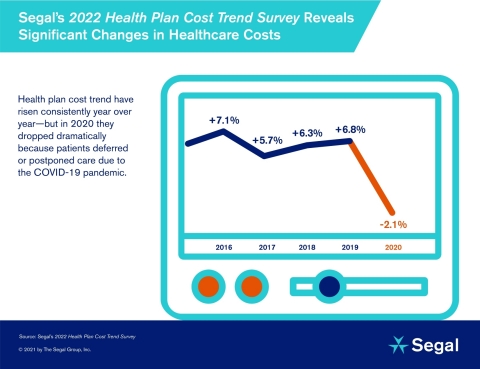
Segal Survey Reveals Dramatic Drop in Health Trend (Graphic: Business Wire)
The 2022 Segal Health Plan Cost Trend Survey includes trend forecasts for medical, prescription drug, dental and vision coverage and actual health cost trends based on group health plan experience. This survey on employer-sponsored health plans is recognized as a highly definitive survey.

“This is the first time in 25 years of Segal’s trend survey that we saw a negative trend in average costs for plan sponsors. This was driven by a significant drop in claim activity in Q2 2020, as the COVID-19 pandemic resulted in shutting down routine medical procedures to free up capacity,” said Edward Kaplan, Senior Vice President and the National Health Practice Leader at Segal. “Elective surgeries didn’t really come back in full force until September 2020. We can expect that 2022 will return to pre-pandemic cost trend levels.”
The cost adjustments for COVID-19 testing, treatment, and vaccinations are not anticipated to increase dramatically, and should have minimal impact on 2022 figures. In addition, the pandemic has substantially increased the use of virtual care visits and urgent care facilities which radically reduced emergency room (ER) visits, resulting in cost savings. The average cost of an ER visit can be close to $1,900 while a visit to an urgent care facility is closer to $165.
“We expect ER visits will continue to be down compared to previous years as people have made a shift to using Urgent Care centers, and that will continue to save health plans money. There will also be a higher use of telehealth services, it is here to stay,” said Eileen Flick, Senior Vice President, Director of Health Technical Services at Segal. “Americans are being smarter about where they are getting services. This year resulted in dramatic changes in the delivery of healthcare.”


Endowment Insurance Market Rewriting Long Term Growth Story with Chubb, ICICI Prudential Life Insurance, Assicurazioni Generali
The Financial Women's Association Relaunches it's Back2Business™ Return to Work Program
Advisor News
- CT governor’s candidates claims: What’s true, and what’s misleading
- Retaining clients by giving them a memorable experience
- Addressing the longevity paradox
- Employers shift focus from retirement access to financial outcomes
- Helping widowed clients navigate their new financial reality
More Advisor NewsAnnuity News
- National Life Group expands annuity portfolio
- AM Best to Join Life/Annuity Insurance-Focused Panel Discussion at Capitol Forum Event
- USAA Earns No. 1 Ranking in JD Power Individual Annuity Study for the Third Consecutive Year
- How flexible annuities fit today’s retirement portfolios
- Foresters Financial appoints Tom Ross as chief distribution officer for U.S. annuity sales
More Annuity NewsHealth/Employee Benefits News
- Reports Outline OBGYN and Reproduction Study Findings from Health Care Cost Institute (Hospital Bypass Among Rural Obstetric Patients With Commercial Health Insurance): OBGYN and Reproduction
- Madison Faces Higher Library and Health Insurance Costs as Officials Look Ahead to 2027 Budget
- The percentage of people without health insurance is growing
- MORE THAN 4 MILLION MEDICARE BENEFICIARIES WILL HAVE THEIR MEDICARE ADVANTAGE OR STAND-ALONE PRESCRIPTION DRUG PLAN TERMINATED AT THE END OF 2026
- Plans with cheaper premiums are risky business for Americans seeking lower healthcare costs
More Health/Employee Benefits NewsLife Insurance News