

When Term Life Insurance Scores A Touchdown
By David Szeremet
The University of Alabama’s head football coach, Nick Saban, is stockpiling success. He has led teams to five national championships – four as coach with the Crimson Tide and one when he coached at Louisiana State University. He has two AP Coach of the Year and four Southeastern Conference Coach of the Year honors to his credit. And there is even chatter about erecting a statue in his honor.
So what do you get for the coach who has it all? Term life insurance, of course.
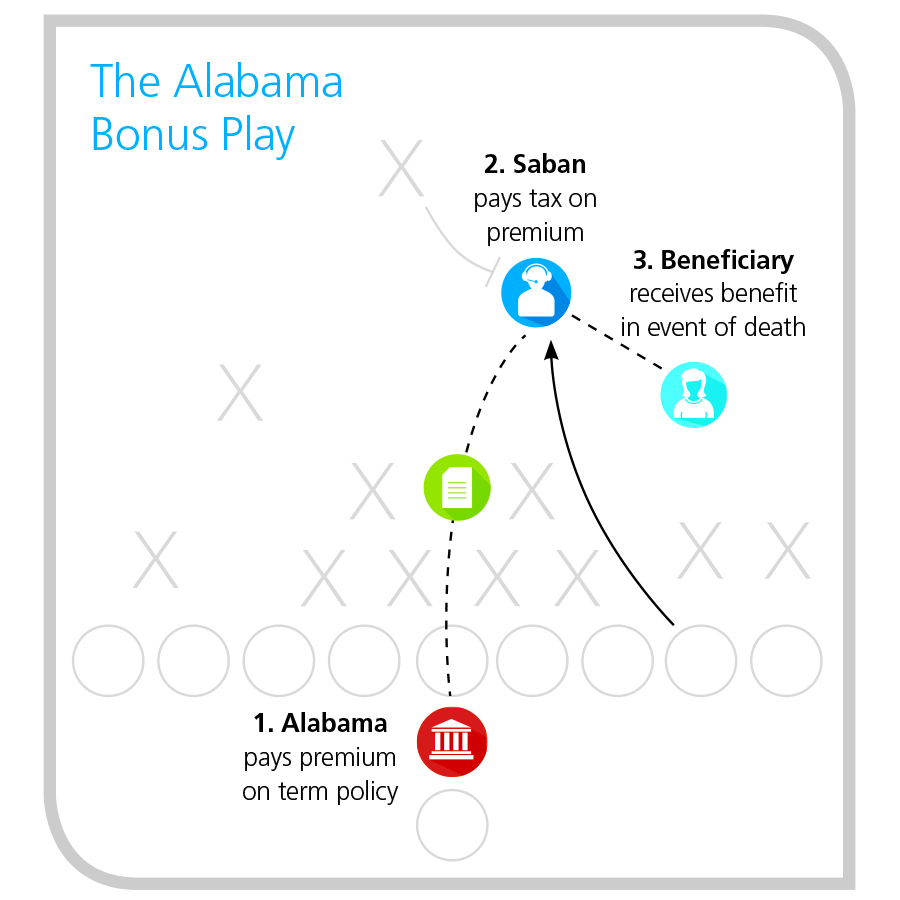
In June 2014, The University of Alabama and Nick Saban agreed to a contract extension which runs through 2020. Because he is an employee of a public university, his contract extension was made available to the public. It includes, among other things, a term life insurance fringe benefit. Here is how it works.
- The University of Alabama buys a $5 million term life policy on his behalf.
- Saban owns the life insurance policy and selects his beneficiary.
- While the employment contract is in effect, the university will pay each annual policy premium on Saban’s behalf.
- In the event of Saban’s death, the death benefit pays income-tax-free to his beneficiary.
The annual premium paid by the university is treated as taxable compensation to Saban. In essence, it is a retention bonus payment. The university is using the life insurance bonus as a compensation “sweetener” to retain and reward Saban.
Although the Saban case involves a college football coach, the term insurance bonus concept is commonly used in the business community. Think of Saban as a key employee of The University of Alabama’s football program. The term insurance bonus is one of his fringe benefits. This concept is appropriate for executives, officers, managers or key employees where a benefit above and beyond (or instead of) group term insurance is desired.

A term life insurance bonus delivers six primary benefits:
- An affordable fringe benefit (depending on age, health and other underwriting factors).
- Income tax-free death benefit protection.
- A portable benefit.
- Potential for a conversion feature to provide permanent, lifetime protection (depending on the policy.)
- The most death benefit protection at the lowest price (during the level term period).
- A simple concept to understand.
A term life insurance bonus can be established for a single participant (such as the Saban case) or for a group or class of employees. In a typical plan, select management-level employees are offered the term insurance fringe benefit.
Going for two
Because the term insurance bonus payment is considered taxable income, an employer may choose to offer a “double bonus.” Under a double bonus, an additional payment is made to cover the income tax exposure to the executive. This ensures that the executive does not have to reach into their own pocket (or the funding mechanism) to pay the tax.
What about permanent life insurance?
Permanent life insurance takes the bonus concept to the next level. Adding cash value to the equation gives the key employee another powerful reason to excel and stick with the employer for the long run. After all, cash is king. The cash value can be tapped as a tax-appropriate rainy day fund or retirement supplement.
Taking home the trophy
As the Saban case demonstrates, term life insurance can be an attractive fringe benefit. Virtually any business entity can benefit from the concept and it should not be overlooked. Business owners could learn from The University of Alabama and apply the same concept to their key employees.
Preparing for next season
Not to be outdone, Dabo Swinney, the coaching rival Saban lost to in the 2017 National Championship game, also has a $5 million term life insurance policy benefit as part of his contract with the Clemson Tigers (Swinney's contract was also made public.) Yet another winning reason to consider a term life insurance policy when looking to retain and reward key people.
David Szeremet, J.D., CLU, ChFC, is second vice president, advanced planning, at Ohio National Financial Services. He may be contacted at david.szeremet@innfeedback.com.


DOL Rule Confusion Leads to Wait-and-See Approach
eApps Make Inroads, Reduce Cycle Times
Advisor News
- A rising retirement challenge: The license to spend
- Financial stress leaves less room for retirement saving
- Giving while you’re living: 3 frequently asked questions about gifting
- Helping clients prepare for one of their biggest retirement expenses
- Important year-end financial conversations every advisor must have
More Advisor NewsAnnuity News
- A rising retirement challenge: The license to spend
- What lower interest rates mean to annuity payouts
- AM Best downgrades A-Cap insurers amid financial and regulatory troubles
- Lawsuit claims Delaware Life hid billions in insurer-linked investments
- AM Best to Deliver Presentation at 2026 ACLI Annual Conference
More Annuity NewsHealth/Employee Benefits News
Property and Casualty News
- What to know about flood insurance
- AM Best Affirms Credit Ratings of Enact Re Ltd.
- Governor signs landmark consumer protection package backed by Commissioner Lara
- The 48-hour service rule driving commercial account retention
- Consumers don’t trust AI as much as insurers think they do
More Property and Casualty News