

Principal vision — With Deanna Strable

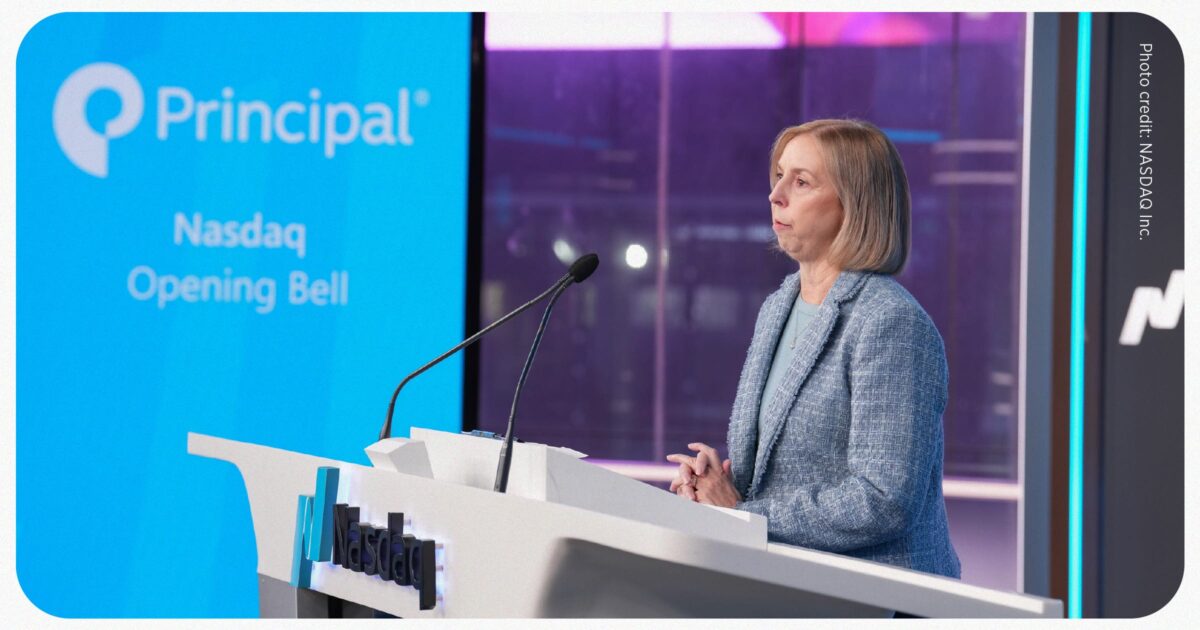
Deanna Strable stepped into a role as an intern at Principal Financial Group 36 years ago. After she headed up a number of areas in the business — ranging from dental to life to benefits — her path led her to the corner office last year, where today she is building on the company’s success.
“Our focus is around retirement, it’s around asset management, it’s around benefits and business owner solutions, with a keen focus on small- to medium-sized businesses,” she said. “That’s where we’re leaning in, from a growth perspective, to focus on those areas where we have differentiation and ultimately bring our solutions together to be there for our customers worldwide.”
For Strable and Principal, although developing needed financial products is important, “we really think in terms of solutions,” she said.
In this interview with InsuranceNewsNet Publisher Paul Feldman, Strable talks about the many product areas of Principal Financial Group and what she sees in the company’s future.
Paul Feldman: Tell us a bit about Principal Financial Group and tell us about yourself, because you have a fascinating story. You started in the industry basically as an actuarial assistant and went from that to CEO of a major insurance company. Tell me about your journey.
Deanna Strable: It’s something that I never would have anticipated. I stepped in as an intern here at Principal 36 years ago. I started in the actuarial realm and spent about five or six years focused on those more technical roles. For the lion’s share of my career, I ran different parts of our business, all focused on our insurance business. I started out focusing on dental, then I ran our group benefits business, and that expanded into disability and life insurance, and then I ran our affiliated advisor channel. Then about seven or eight years ago, I was asked to move into our chief financial officer role. Beginning in 2017, I supported Dan Houston, our CEO, as his CFO. In November 2024, I moved into this role. This has been a fascinating journey, 15-plus roles while I’ve been here at Principal. Each of them gave me an incredible background that positioned me for this role.

Feldman: What do you love most about your job?
Strable: The challenges, the people, the culture of this company. It’s the incredible work this company — but also this industry — does. Des Moines, where we’re headquartered, is somewhat of a small town. A lot of people know Principal, and so I can’t go anywhere without people coming up to me, and ultimately, thanking me. I meet retirees who say things like, “Every day or every week or every month, I’m getting a check from Principal. And that makes my life and my retirement much more secure and gives me the ability to do the things I want to do.” I run into people who have benefited from our ability to give them a life insurance benefit, a disability benefit. That’s great, because the people are important, that’s what usually keeps you at a company. But when it comes back to the incredibly important work that we do as a company and as an industry, that’s what makes it all worthwhile.
Feldman: Over the years, Principal has evolved. What’s your big focus today?
Strable: We started 145 years ago as a life insurance company, here in Des Moines, Iowa. Fast-forward to today, we’re a global financial services company. We have customers in 80 countries. Our focus is around retirement, it’s around asset management, it’s around benefits and business owner solutions, with a keen focus here on small- to medium-sized business. That’s where we’re leaning in, from a growth perspective, to focus on those areas where we have differentiation and ultimately bring our solutions together to be there for our customers worldwide.
Feldman: What are your most exciting products? And what about heading into the future?
Strable: It’s funny, because you ask about products and, honestly, we really think in terms of solutions.
They are around three areas: First, retirement. We are a leader in the U.S. retirement business. A lot of that is seen in our presence around 401(k)s, but we are also very strong in defined benefit, employee stock ownership plans, nonqualified, pension risk transfer. We’re thinking about all that we can do for a customer — both an employer and an employee — around retirement. That includes recordkeeping, asset management, income solutions and creating a relationship with those employees who don’t have an advisor helping them — and making sure that we’re there for them to help them on their retirement journey. That is a keen focus of ours here in the U.S. and in a couple of locations outside of the U.S. in emerging markets.
Our focus is on the small- to medium-
sized businesses. Think of that as employers with up to 1,000 employees, but, in particular, for our benefits business, our average customer could have 40, 50, 60, 75 employees. A lot of times, smaller companies don’t have human resource professionals focused on benefits and so they look for their provider as well as their advisors to help them with that. We offer so many solutions for them, whether they are retirement focused, whether they are employee benefit focused or whether they are life and disability solutions that help a business owner — think about succession planning, think about key person.
And then, the final area that we’re focused on is asset management. A keen focus in asset management is on solutions around retirement. What are the suitable options for people thinking about saving for retirement? Then it’s trying to leverage that to customers around the globe, through our joint ventures, as well as directly.
Feldman: What are your strategies for the next five years? Where do you see some of the biggest opportunities in today’s crazy market?
Strable: To me, it’s a lot about focus. You can chase hot products, you can create hot solutions, but it really is about where you have differentiation. Where do you have the capabilities to win? I think we’ve proven in a number of our businesses that we’re outpacing the market, relative to growth, by focusing on those places where we have the ability to win. Real estate is one business that, specifically within asset management, has always been core to our strategy. Now we’re trying to build beyond real estate, to areas like infrastructure, like private credit, that are attractive to institutional investors but also to retirement investors as well.
If you think about 401(k)s, leaning into places where we can leverage our entire retirement suite, whether it is defined benefit, employee stock ownership plans, nonqualified. A lot of our nonqualified is funded by life insurance and PRT. Pension risk transfer will continue to be a growth area for the industry, as well as for Principal. We’ve been in that business for 50-plus years; we have recordkeeping, we have actuarial services, we have asset management and we can meet the needs of retirees as they go through their retirement journey.
Feldman: Would you say that your business is mostly employee benefits on the group side, or are you into the independent distribution for individual products?
Strable: I’d say that we’re business focused here in the U.S. both on retirement and benefits. We do have a proprietary advisor force, about 1,200 to 1,300 of those who offer our insurance products, our employee benefits products, our retirement products, our asset management. But beyond that, we work with third-party distribution, we have wholesalers. And ultimately, they work with advisors and consultants around the globe to offer our products to them.
I would say that our employee benefits business is a key focus for us, it’s about 20-some percent of our overall earnings; it has been growing faster than the industry. We’re keenly focused on that target market of the small to medium-sized businesses, and we’re designing everything around that. Whether it is our underwriting process, our product design, our distribution, our technology strategy, it’s all focused on being able to drive higher top-line growth, because those are resilient and growing parts of the market. But it’s also ensuring that we have the claim experience and loss ratio experience that allows us to have very market-leading and stable margins as well.
Feldman: Principal has a number of different products, and one that stood out to me is your registered index-linked annuity, which has gone from almost nothing to well over $1 billion in sales. Do you see that as a growth opportunity?
Strable: Whether you look at Principal and our success that we’ve had over the last few years in RILA, or whether you look at the industry overall, RILA has been big from a growth perspective.
If we look at where we are in the annuity business — either in group annuity or more on an individual basis — it’s in the variable annuity or the RILA space. We did exit the retail fixed annuity business a couple of years ago.
We see some great demand for that product, and we’ve spent some time the last few years working on product development as well as how to focus on going to market there. We built our first product in 2023, and we added to that in 2024, when we added a guaranteed lifetime withdrawal benefit.
I think the need is big. Obviously, annuities and RILA are wonderful products for those who are thinking about income through retirement, and RILA fits in there. We primarily focus our RILA offering either through our affiliated advisors or as a component or a solution for the participants of our retirement plan, so our 401(k) benefits. We have 14 million retirement participants, and we’re continuing to focus on offering that product to them as well. So we do see some great trends that will continue to drive growth, and we’ll continue to focus on that as well.
Feldman: How do you see annuities moving into 401(k) plans?
Strable: That’s something that has been talked about for a while and I think it will get traction, but the industry needs to figure out how to make it easier. And to make it easier, it needs to be part of the target date. So it’s not a separate selection, it’s actually embedded in how people think about saving for their retirement. And then at some point it automatically starts to buy annuity solutions that can pay out after they’ve retired.
I think what’s difficult is that it’s a three-part sell. You must sell the advisor that this is something that they want to promote to their employer customers. Then you must sell the fiduciaries at the employer that this is a product that they want within their retirement plan. And then, ultimately, unless you can make it easy within the target date or the other qualified default options, you must sell the participants that it’s where they want their money to actually go. And that’s a complicated process.
Feldman: Is the annuity side of the business taking place mainly with the older generation?
Strable: That’s where it will have the biggest impact in the shorter term, but ultimately, it’s a solution that every individual needs. A 21-year-old doesn’t need to put any of their 401(k) balance to an annuity, but once they hit 50 or 55, a portion of their balance can start to buy annuity options that then over time will benefit them as they move into retirement. So that will take time; that’s why we say it is an important benefit, but it’ll be a slower one to grow, because you need demographics to ultimately help that as well.
Feldman: Principal has a full portfolio of life insurance products. Is that something you do on the retail side or is it mostly through the employee benefit side?
Strable: We refocused our life insurance strategy a couple of years ago. We exited the more pure retail life insurance product. Our focus now is on the employee benefit side, using the same type of products; it’s using term, it’s using variable life, it’s using indexed life. But we’re less about selling the product and we’re more about selling a solution for a business owner or a business.
The largest portion of our life insurance sales funds nonqualified deferred compensation. And so that is a part of our overall retirement solution sleeve, and we’re just having to fund it — a portion of it — with life insurance.
We also offer key person or succession planning. How do you go to a company that is owned by a family and help the owners to figure out how to solve the problem of business succession, whether it’s to their next generation of family members or to those employees who could be in that succession path? Our focus is much less on the pure individual retail market, and we are laser focused on offering solutions for the employer, the business owners and their key executives.
Feldman: Tell us a little bit about what Principal is offering in technology and where you see that going, especially in regard to artificial intelligence.
Strable: I think if you look over our long history, technology has always been a piece of that. Whether it’s how you interact with your customers, how you interact with your advisors or how you allow your employees to be the most productive that they can be, technology is key.
Ultimately, technology’s focus must be solving business problems. When I think about AI and generative AI, there are so many places that it can help our employees, our customers, our advisors, and we are focused on making sure that we do that.
We were a pioneer in accelerated underwriting, and over the last six or eight months, we’ve rolled out our 2.0 version of accelerated underwriting. That allows 50%, 60% of our applicants to go through the underwriting process quickly and seamlessly.
AI also allows us more ways to interact with our customers, whether it’s using chat or eliminating the need for the call. Or whether it’s making our engagement center associates more productive by giving them — at their fingertips — all the tools and information they need to meet the needs of that customer effectively. Or how you use AI to make our technology professionals more effective, for example, by providing that first draft of code that they can then make more functional using their expertise. That can significantly increase the productivity of the information technology professionals we have around the globe.
And the last example is around claim management. Whether it’s regarding dental, disability or life, there are very smart AI solutions that can help us be much more efficient and effective, to ensure that we are paying the right claims in the fastest manner that we can.
There is so much art of the possible relative to technology, but it comes back to business focus. Not technology for the sake of technology, but technology to solve customer needs. And then making sure you’re focused on the places where it will have the greatest impact.
Feldman: I’m asking you to take out the crystal ball. What do you see as the biggest opportunity for advisors and agents in today’s market?
Strable: People need advisors and agents. Whether I talk to people who make $50,000 a year or people who make much more than that, the products and how they can save for their retirement and plan for everything that could happen to them are complicated. And in a lot of situations, people don’t want to spend the time needed to be an expert, which then continues to reinforce the importance of advisors in that process.
But the other thing I would say is that advisors must react to working differently with their customers. That will mean using technology, using digitization, using personalization and making that interaction more relevant to not just the customers they’re working with today, but the customers that they will want to work with tomorrow. It’s up to carriers like Principal, but also advisors, to figure out the way to meet those customers where they are and in the way that they want to interact.
Feldman: Because our federal government is not going to fund our retirement very well.
Strable: We’ve been talking about personal responsibility for decades.
We’re seeing that come to life, because people are wondering about retiring without the safety net of Social Security. And from a retirement perspective, they see the need for products offered by their employer, but also their ability to save along the way, as well as individual retirement accounts and those types of things. Because it will take all of those resources to allow individuals to retire successfully.
Feldman: Is there a question that I didn’t ask that I should have?
Strable: One of the things that I get asked a lot is what competitor I worry about, or what keeps me up at night relative to our ability to be successful. And one of the things I always say is, it’s not a competitor that worries me, it’s how do we continue to make what we do relevant to customers? No one wakes up and says, “Today I’m going to prioritize buying a life insurance product or saving more in my retirement.” It’s just not front of mind. If we can’t figure out how to make it relevant, how to make it easy, how to make it personalized, that is going to cause the demise of this industry. And so that must be my focus it must be my team’s focus, and it must be our industry’s focus, because that’s what’s going to continue keeping this industry alive and successful.
Feldman: To build on that answer, what are some of the biggest threats that we face as an industry? For example, how do we convince new people to come into this business?
Strable: The biggest concern is how we continue to attract talent to this industry. Advisors are, in some situations, a declining group. How do we make it exciting for people to understand the impact that advisors can have not only on this industry, but also on people’s lives? To be able to continue to attract and retain top talent would allow this industry to be successful. How we make it relevant and how we continue to support and encourage a growing advisor population are the biggest challenges that this industry has.
Feldman: How do we fix that?
Strable: We must ask, “How do you make it easy?” We must look at how you embed yourself into university programs, to help students understand that this is a career that is important, that uses skill sets that they’re learning, but allows them to make a difference. And in some situations, it allows them to do it in a very entrepreneurial way. It will take all of our efforts to make sure that’s a priority for this industry.



Planning in the key of life — with Preston Cherry
Social Security at a Crossroads
Advisor News
- Gen X and millennials seek new retirement model
- Are families ready for the costs of aging at home?
- When a client moves, their insurance plan needs to move, too
- A rising retirement challenge: The license to spend
- Financial stress leaves less room for retirement saving
More Advisor NewsAnnuity News
- Gen X and millennials seek new retirement model
- Global Atlantic names Dan Farrelly head of IMO and IBD channels
- A rising retirement challenge: The license to spend
- What lower interest rates mean to annuity payouts
- AM Best downgrades A-Cap insurers amid financial and regulatory troubles
More Annuity NewsHealth/Employee Benefits News
Life Insurance News