

My Best Day in Life Insurance

Selling life insurance includes a lot of dry and technical things, like getting licensed and learning about the do’s and don’ts of compliance.
And then there are the products, which can veer into arcane territory. Agents have to learn the details about so many aspects of sales and products, including popular features like riders and index returns.
And, finally, there are the book-building things. The painstaking process of getting leads, making contacts and building a book of business to underpin a career.
Are you fired up to be an agent yet?
We cover all of those issues and many others in InsuranceNewsNet Magazine because they fall under “information our readers need to know.”
But there’s another side to selling life insurance: the private and personal reward — the feeling of helping individuals, couples and families with life insurance products that provide security — and, sometimes, a lifeline.

There are those moments that make all the hours and all the legwork worthwhile. Maybe it doesn’t happen every day, but agents have the unique opportunity to make a tangible difference in people’s lives.
It might be helping a family protect their financial future, guiding a business owner through risk management or ensuring someone’s loved ones are secure no matter what happens. The job isn’t just about selling policies; it’s about building trust, offering reassurance in uncertain times and providing peace of mind.
Agents often develop long-term relationships with clients, becoming trusted advisors over decades. Frequently, that tight bond either starts with or includes a crucial moment when the agent and the life insurance policy rescued a family from a difficult situation.
We asked our readers to share some of those moments so we can celebrate Life Insurance Awareness Month in style. The strong response we received is further evidence that the human-to-human aspect makes selling life insurance worthwhile.
Bob Chitrathorn: Benefits rider to the rescue
One experience that stands out is with a client I’ll call Cheryl. She was retiring from the school district and came to me for help with her retirement planning.
As we worked together, she mentioned that she was planning to let her term life policy lapse. Her children were grown, and she didn’t think she needed it anymore.
That’s when I introduced her to a life insurance policy that included living benefits. She saw the value and decided to move forward, getting approved for a $150,000 policy. Her premium was around $1,800 a year.
Roughly a year later, Cheryl experienced a significant health issue. She could still enjoy life, but she wasn’t able to afford full-time care — either in a facility or at home. I reminded her about the accelerated benefit rider included in her policy and helped her file a claim.
To her surprise and relief, the insurance company approved monthly benefit payments of about $2,300. She was overjoyed. That income allowed her to move in with her sister, contribute to the household financially and maintain her dignity and quality of life. It not only helped her — but gave her sister the support she needed as well.
That experience reinforced a simple truth: Life insurance isn’t just about death benefits, it’s about protecting quality of life while you’re still living.
— Bob Chitrathorn, CFO/vice president of wealth planning at Simplified Wealth Management and a Forbes Finance Council Member
Noel Anderson: Responding to a 9/11 need
In the beginning days of my career in the life insurance industry in the early 2000s, I was struggling to find purpose in my career. I was considering leaving the industry altogether until I had a life-changing (and career-changing) experience by helping beneficiaries of life insurance policies in the aftermath of the 9/11 attacks.
My company at the time had a client in the World Trade Center, and we ran a life insurance split-dollar program for the client’s top key people. The individual would get a death benefit paid to their beneficiary, and the employer would also receive a death benefit if the person passed away while working.
I regularly visited their offices to explain the plan to new hires and help with onboarding, which involved lots of tedious form filling and back and forth. I built real relationships with these people.
Most of the employees accepted this special benefit, but not all of them saw immediate value in the plan.
When Sept. 11 happened, my company was as shocked as the rest of the world. Given that I had relationships with real people who worked in the World Trade Center, I felt intensely passionate about what the outcome would be and how I could play a role in helping some of the victims’ families.
After 9/11, I feared insurers like my own company might deny claims for World Trade Center employees, labeling the attack as war or terrorism, grounds at the time for only refunding premiums. (That tragic event ultimately led to policy changes covering such acts.)
I called the CEO’s office to ask if benefits would be paid, and to my surprise, he called me back. Not only were claims being honored, but they were paid out by late October, far earlier than the industry norm. The company even set up sites near Manhattan where beneficiaries — both companies and individuals — could collect checks in person. It was an extraordinary response, and I felt proud to be part of something so meaningful during such a tragic time.
That really gave me purpose.
Life insurance is important, and we have to explain that. Both the company’s and the families’ paths would have changed had this plan not been put in place.
Like I said, I’d been thinking about leaving the industry prior to this. Of course, I never ended up leaving. Now, I work with planners to help their clients understand how life insurance helps their families, their companies and their key employees.
— Noel Anderson, vice president of executive benefits at Vanbridge
Matt Schmidt: A lifeline following a heart attack
In my 21-year career as an insurance agent, my favorite experience was letting a long-time client know that he could accelerate part of his life insurance policy via living benefits.
Most clients tend to forget the specifics of a policy that we provide for them. In this case, the client initially opted for a policy that was $7 a month less expensive than the one I initially proposed.
After explaining that I felt having a policy with living benefit riders would provide better protection, he reluctantly agreed. Fast-forward seven years, this client contacts me about possibly canceling the policy.
After I asked if there was a specific reason for the request, he explained that he can’t afford it due to having a heart attack and being unable to work for an extended amount of time.
I then proceeded to explain that it might be possible to accelerate a “large” amount of his policy, to help him out with his difficult situation. A few weeks later this client received over $200,000 from the carrier. This client has sent us several referrals and is probably our biggest advocate of what we do for families.
While I never want any client to experience an adverse health issue, this story had a very happy ending and reminds me to this day of how our recommendations impact families in the future.
— Matt Schmidt, CEO of Diabetes Life Solutions
Robert Cullen: A convincing argument saves the day
I’ve been in the insurance world since 2007, and there’s a saying that you never forget your first check that you deliver to a beneficiary. And my first one happened to be a big one.
I live in a rural area of California, a small town of about 13,000 people. And I had been talking to the wife of a man who was the primary breadwinner for the family. The couple had three young kids between the ages of about 3 and 9.
I learned from talking to the wife that they did a needs analysis and that they had a mortgage on their very, very nice home on a big ranch. The home was worth about $1.5 million, and they had a $1.2 million mortgage on it. The husband had plenty of money to pay for it, but I told the wife, “Man, if something happens to your husband, you don’t have the capacity to make as much money as he does. What are you going to do?”
So, we engaged with the husband, and he was resistant at first. It took almost a year for him to finally agree to life insurance. We ended up doing a $2 million life policy, and then he tragically ended up dying less than a year after the policy was written.
The carrier did pay and the widow received $2 million, and with that, there were several benefits involved. She paid off the mortgage, so now she had the home free and clear, plus had money to be able to put food on the table, and those kids were now able to stay in the home.
And being in a small town, I’m still in touch with the family, and it’s neat to see those kids are now having kids of their own. Just to see that family grow up, and to think that was a major fork in the road. Had the husband not gotten the life insurance, what would have happened to the wife and their home? Where would the kids have been raised? The life insurance money really set the family up for financial success, and it’s being passed to the next generation.
I think the key part of that was the first time that I talked to the husband about it. He said, “No.” The second time he said, “No.” It took several conversations, and that really was because I believe in life insurance.
I teach a lot of classes, and I talk at a lot of conferences, and I tell agents, “There’s going to be some point in your career when you’re going to have a customer die. And that customer is either going to have life insurance or is not going to have life insurance. And if that client doesn’t have life insurance, the last thing I want to be in your head is you thinking, “Oh, I never offered life insurance.”
That is the most awful feeling you’ll ever have.
— Robert Cullen, advisor, Farmers Financial Solutions
Joe Mallee: Taking care of the family
As the oldest of four children in a middle-class family of police officers, firefighters and nurses, I learned early that protecting the ones you love requires more than good intentions.
Early in my career as a financial advisor, my parents asked me to serve as guardian for my three much younger siblings should anything happen to them. I agreed on the condition that they complete comprehensive financial planning together.
With professional help, they established wills, trusts, disability insurance, and life insurance coverage — a decision that would prove life-changing.
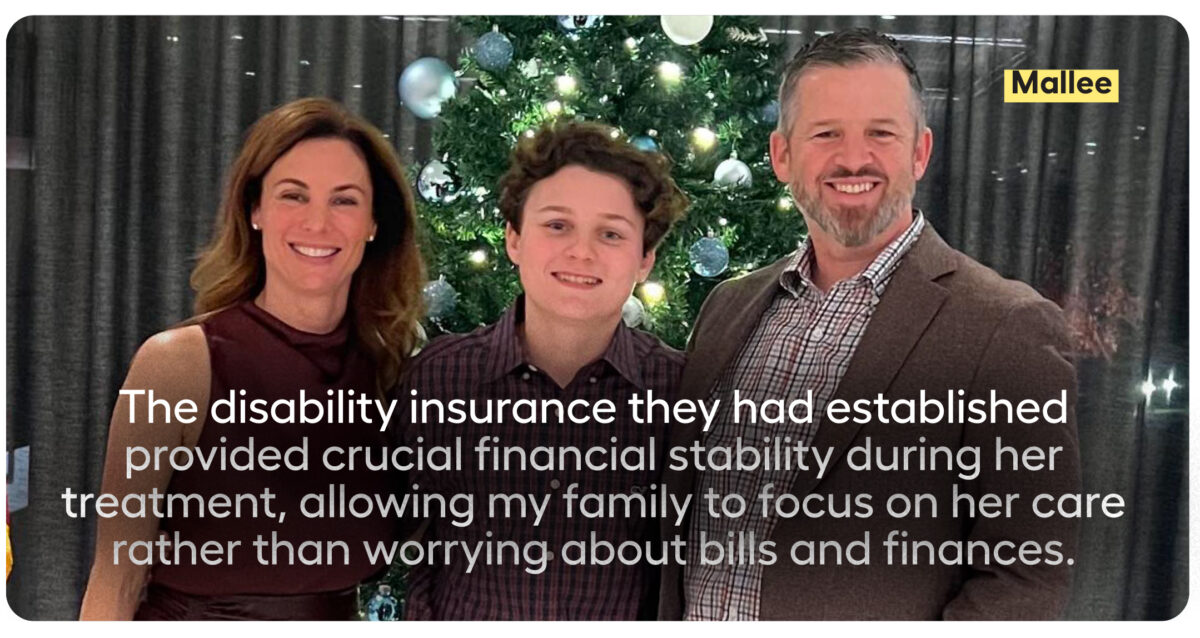
Five years later, my mother had risen to executive level at a home health care company, managing approximately 30 offices. Despite battling rheumatoid arthritis, she maintained excellent health habits and had never smoked. When what seemed like a routine cough turned out to be stage 4 lung cancer, our family faced an unimaginable shock. At 55, with an average prognosis of just six months, she was fighting for her life.
The disability insurance they had established provided crucial financial stability during her treatment, allowing my family to focus on her care rather than worrying about bills and finances. When my mother passed away, I found myself processing the first death claim of my career — to my own father.
The death benefit paid off my father’s mortgage and funded my younger siblings’ college education, providing the financial foundation that allowed Dad to grieve while maintaining stability for our family. This experience crystallized my understanding of MassMutual’s purpose and my role in helping people secure their future and protect the ones they love.
— Joe Mallee, head of MassMutual Financial Advisors at MassMutual Financial Group
Ian Freeman: Bringing security to the family of a fallen 9/11 client
One of the most defining moments in my career was delivering a life insurance claim following the 9/11 attacks. I was in Dallas that day, watching the events unfold on television.
I had spent a lot of time in those [World Trade Center] buildings with multiple clients. Ironically, many of my meetings happened to fall on Tuesdays, and 9/11 was a Tuesday.
As soon as I realized what was happening, I started calling my clients. I was able to reach all of them except one.
By Friday, with flights still limited, I flew into Philadelphia and drove into New York. I’ll never forget the smoke rising from the rubble as I crossed the Verrazzano-Narrows Bridge. That Sunday, I picked up my dad, who happened to be best friends with the victim’s father, and we drove to their home. When we arrived, there were more than 100 people gathered, but I was the only one asked to go into a separate room with his widow. It was in their children’s bedroom, which seemed so poignant.
She asked only one question, and it was the correct question and the only one that mattered: Am I going to be okay?
In moments like that, you are acutely aware of what this profession is really about — protecting lives, families and communities. The rest is noise. And you better have the right answer.
Fortunately, we did. And today, those children are our clients, too.
— Ian Freeman, founder and financial advisor at The Freeman Group, Northwestern Mutual
Todd Weiss: Two generations of security
One of my clients recently passed away in his mid-50s, leaving behind a powerful financial legacy for his family. When I first started working with him in 2015, he had $2.5 million in term insurance.
Through strategic planning and foresight, I was able to add another $7 million in whole life insurance and provide his family with absolute financial security if they ever faced a difficult time without him.
What’s truly inspiring about this case is the intergenerational impact of our planning. I helped the client set up policies for his two children, now in their mid-20s. One is building a career and is single, while the other is working and living with a significant other.
Both young adults have continued to fund their whole life policies, fully appreciating the legacy their father began and illustrating the versatility of life insurance planning. Our recent conversations have focused on explaining the policies’ benefits, including their use for liquidity events, and the importance of coverage for their partners or future families.
It’s a powerful reminder of how insurance can create financial security and leave a meaningful impact for generations to come.
This case also highlights the importance of staying vigilant with policy management. When I discovered the client was ill, we quickly converted an expiring term policy to a permanent one in his final months, ensuring his family wouldn’t lose crucial coverage.
This proactive approach not only secured the family’s financial future but also laid the groundwork for continued relationships and future potential opportunities with the adult children. It’s a win-win situation, demonstrating the long-term value of comprehensive insurance planning.
This experience reinforces my belief in insuring children at an early age — a strategy I’ve implemented with my own kids. I’m always considering adding juvenile policies for all my clients’ kids.
The only thing I ever hear from people who own whole life policies is “I wish I had done more and started at a younger age.” By thinking generations ahead with thoughtful life insurance planning, we can create an impact of financial security that spans generations.
— Todd Weiss, wealth management advisor at Summit Financial


Fiscal fitness — with Jeff Smith and Jennifer Scherer
2026 MDRT leadership promises enhanced member resources and connections
Advisor News
- Flourish brings private-bank-like cash solution to MassMutual’s network
- Majority of Americans concerned recent market highs are unsustainable
- GLP-1 users choose between medication and retirement saving
- Gen X and millennials seek new retirement model
- Are families ready for the costs of aging at home?
More Advisor NewsAnnuity News
- A client remarried: Does their annuity still fit?
- Gen X and millennials seek new retirement model
- Global Atlantic names Dan Farrelly head of IMO and IBD channels
- A rising retirement challenge: The license to spend
- What lower interest rates mean to annuity payouts
More Annuity NewsHealth/Employee Benefits News
Life Insurance News