

Public Overwhelmingly Wants Insurance Companies To Cover Emergency Care and To Be Transparent
"Provisions currently in the ACA that directly benefit emergency patients must be protected," said
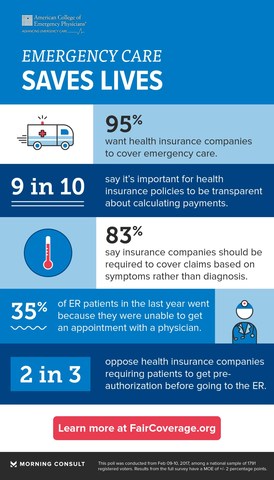
When asked if someone visited the emergency department because they believed they were having a heart attack, but were later diagnosed with a panic attack, more than 8 in 10 (83 percent) Americans said that patient's health insurance should cover that emergency visit. The principle of covering medical care based on symptoms that most people would consider potentially life-threatening, rather than the final diagnosis, is called the "prudent layperson" standard. This was codified into federal law, including the Affordable Care Act, following years of denials of coverage for emergency care by health insurance companies.
Nine in 10 registered voters said that health insurance companies should let patients know how they calculate coverage for emergency care; with a third (36 percent) saying those payments should be determined using a transparent, independent cost database and formula. This comes at a time when insurance companies are increasingly shifting more of the costs of health care onto patients and physicians by expanding high-deductible insurance plans with ever-narrowing networks of providers.
"Emergency physicians are advocating for transparency and use of independent databases, such as

Health insurance companies have a long history of devaluing emergency patients who seek care in emergency departments. For many years, they routinely denied claims based on the patients' final diagnoses instead of symptoms, leaving patients stuck with bills insurance should have covered. Emergency physicians successfully fought back against those policies, arguing that patients should never self-diagnose their own medical conditions because they feared financial repercussions. A federal law (EMTALA) guarantees that no one will be turned away from an emergency department because of lack of insurance or an inability to pay. Insurance companies have exploited that law to their advantage, ratcheting down payments to emergency physicians knowing they have no choice but to treat the patients who come to them for care. Recently, insurance companies have systematically reduced the number of physicians considered "in-network" while providing inaccurate reports and lists of who exactly is in their network.[i]
"Emergency physicians fought long and hard for the 'prudent layperson' standard on behalf of our patients," said
Nearly two-thirds (65 percent) opposed health insurance companies requiring patients to get pre-authorization from their insurance company before going to an emergency room. Currently, health insurance companies are not allowed to require pre-authorization from their customers.
Other findings include:
- Nearly one-third (31 percent) visited an emergency department in the last year because of a medical problem they were having.
- More than a third (35 percent) went to the emergency department because they were unable to get an appointment to see a physician.
- Almost two-thirds (62 percent) think health insurance costs will increase in the next year.
- More than a third (36 percent) believes their health insurance benefits will get worse, while 37 percent expect it to stay the same.
Emergency medicine is essential to America, providing lifesaving and critical care to millions of patients each year. Emergency physicians represent only 4 percent of all doctors, but provide care for 28 percent of all acute care visits, 50 percent of all
Poll Methodology:
This survey was conducted by Morning Consult with 1,791 registered voters as a national tracking poll on
[i] https://www.nytimes.com/2016/12/03/us/inaccurate-doctor-directories-insurance-enrollment.html
Follow
Video: https://www.youtube.com/watch?v=1pnrsA1gJ6g
To view the original version on PR Newswire, visit:http://www.prnewswire.com/news-releases/public-overwhelmingly-wants-insurance-companies-to-cover-emergency-care-and-to-be-transparent-300424869.html
SOURCE

Digital Transformation in US Insurance Industry Report 2017: IT Spending Trends of US Insurance Industry, 2014-2020 – Research and Markets
The Latest: ‘No palace intrigue,’ Ryan says of health bill
Advisor News
- Retaining clients by giving them a memorable experience
- Addressing the longevity paradox
- Employers shift focus from retirement access to financial outcomes
- Helping widowed clients navigate their new financial reality
- Navigating client communication in a digital age
More Advisor NewsAnnuity News
- Farm Bureau P&C insurers post first underwriting gain since 2021
- Legacy Marketing, Malibu Life launch two fixed indexed annuities
- Changing client priorities are reshaping annuity conversations
- Solen Software acquires annuity software provider Cooperative Technologies
- MassMutual Expands Lending Options With New Secured Credit Line
More Annuity NewsHealth/Employee Benefits News
- Terry Savage: Small business owners, now is the time to offer health insurance coverage
- Aldermen select employee medical insurance broker services provider
- Southwest Bridge Health focusing on insurance coverage gap in Berrien County
- HEALTHCARE SHOULDN'T REQUIRE A MAP
- BOSTON ENCOURAGES RESIDENTS TO APPLY FOR HEALTH INSURANCE DURING OPEN ENROLLMENT SEASON
More Health/Employee Benefits NewsLife Insurance News