

Navigating client communication in a digital age

Today, advisors have more ways than ever to stay connected with clients. Those options also create a greater need to be intentional about how and when you use each communication channel.
Recent research from Million Dollar Round Table found that nearly 70% of consumers prefer in-person or hybrid communication with their financial advisor. At the same time, 85% say advisors’ use of digital tools either increases their trust or has no impact.

Technology clearly has a place in the client relationship, but its value depends on how thoughtfully advisors use it. Digital channels can create consistency, accessibility and ongoing engagement, while personal interaction carries greater weight when clients need context, reassurance or guidance. Effective communication requires advisors to consider the purpose, timing, and stakes of an interaction when deciding which approach best serves the client.
Set the communication framework early
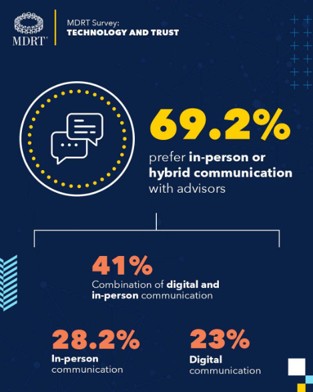 Client communication should reflect individual preferences, evolving needs and the significance of the conversation. Together, those factors shape the channel and level of interaction that best serve each client.
I establish a framework during onboarding. Some clients have relatively straightforward needs and are comfortable with an annual in-person meeting, supported by digital communication throughout the year. More complex relationships may require several conversations early on before settling into a cadence. The format can then vary based on the purpose of each interaction. A brief virtual meeting may be entirely appropriate for a general update, while a more consequential conversation deserves the time and attention of a face-to-face meeting.
The MDRT research reinforces the importance of that distinction: 31% of consumers say digital communication can be insufficient when beginning a relationship with a new advisor. I’ve found this to be true; early conversations do more than exchange information. They shape the client’s experience, establish expectations for the relationship and help demonstrate that their needs are understood.

Once that foundation is created, technology becomes a valuable way to maintain continuity between more substantive interactions.
Make every digital touchpoint worth receiving
Scale is one of technology’s greatest advantages. I can communicate with hundreds of clients in the time it would take to have one individual conversation, but that efficiency only matters if the communication itself provides meaningful value.
I regularly share educational content, such as articles I have contributed to, with clients via e-mail. Clients often respond with follow-up questions or requests for additional information, creating small but meaningful touchpoints for engagement between scheduled meetings. The content also gives them a useful resource to revisit or share with others.
Digital communication can quickly lose value when frequency replaces relevance. The survey found that 27% of consumers cite generic or automated messages as a reason digital communication is ineffective, while 19% cite being inundated with messages. The measure of a valuable digital touchpoint should be whether it leaves the client better informed, more confident or provides the advisor with greater insight into the client’s needs.
Know which moments require more
The stakes of communication rise when clients face uncertainty or a consequential financial decision. MDRT found that 45% of consumers say additional in-person conversations during market volatility or financial stress would strengthen their trust in their advisor. Thirty-one percent say digital communication was also considered insufficient when making major financial decisions, and 29% say it is insufficient when resolving complex or technical confusion.
During volatile markets, I can use email to quickly provide context across my client base. The critical next step is identifying who may benefit from an in-person conversation. That depends on what I know about the client, including their portfolio, previous reactions to volatility and their understanding of the strategy we built together. A client experiencing volatility for the first time may need a different level of communication than someone who has been through several market cycles with me.
That judgment also depends on remaining attentive to clients' needs between conversations. I use quarterly digital check-ins to surface concerns clients may not raise on their own. Their responses can reveal when a client needs additional context or reassurance, prompting me to follow up with a phone call or in-person meeting when appropriate.
Meet clients where they are
The strongest communication strategies evolve as the client relationship grows. A routine update today may call for a deeper conversation tomorrow, and each channel's value depends on how well it serves the client in that moment. That adaptability is what makes a hybrid communication model effective. Advisors can use digital channels to maintain a consistent presence while reserving more personal interaction for moments that require deeper conversation, context or reassurance.
When advisors understand the purpose, timing and stakes of each interaction, we can make more deliberate communication choices and ensure our approach remains aligned with clients’ needs as they evolve.
© Entire contents copyright 2026 by InsuranceNewsNet.com Inc. All rights reserved. No part of this article may be reprinted without the expressed written consent from InsuranceNewsNet.com.


Patients demand access to prescription drugs but need support
California’s insurance reforms: What they mean for agents and clients
Advisor News
- CT governor’s candidates claims: What’s true, and what’s misleading
- Retaining clients by giving them a memorable experience
- Addressing the longevity paradox
- Employers shift focus from retirement access to financial outcomes
- Helping widowed clients navigate their new financial reality
More Advisor NewsAnnuity News
- Foresters Financial appoints Tom Ross as chief distribution officer for U.S. annuity sales
- Symetra and TIAA Announce Launch of Mariner Re
- Jackson Launches Suite of Fixed Index Annuities Focused on Accumulation
- Farm Bureau P&C insurers post first underwriting gain since 2021
- Legacy Marketing, Malibu Life launch two fixed indexed annuities
More Annuity NewsHealth/Employee Benefits News
- Studies from Northwell Health Describe New Findings in Managed Care (The Relative Value Scale Update Committee: Understanding How Dermatologists’ Work Is Valued): Managed Care
- Hofstra University Details Findings in Managed Care (A University and Community Partnership to Address Diaper Insecurity Among Infants in Suburban Communities Through Home Visiting Services): Managed Care
- Reports Outline Managed Care Study Results from Brown University School of Public Health (Organizational Perspectives on Access to Care Among Persons With End-Stage Kidney Disease After Enrollment in Medicare Advantage): Managed Care
- Reports Summarize Managed Care Study Results from Marquette University (Nontraumatic Dental Emergency Department Visits and Follow Up Dental Care Among Wisconsin Medicaid Beneficiaries): Managed Care
- Carson Tahoe Health reaches deal with UnitedHealthcare
More Health/Employee Benefits NewsLife Insurance News