

Trump 2.0: Financial chains unleashed or unraveled?

April showers may bring May flowers, but for advisors and clients, they also bring a torrential downpour of forms, figures and that age-old question: “Is my dog finally tax-deductible?”
Rest assured that Fido remains off limits. Still, taxing questions remain as the Trump administration’s economic program continues to take effect.
Of course, the centerpiece of the Trump return was signed in a July Rose Garden event: the One Big Beautiful Bill Act, a landmark piece of legislation that permanently extended many of the 2017 Tax Cuts and Jobs Act provisions while adding highly visible, targeted benefits.
On the economic front, the administration’s second term has been defined by aggressive deregulation and protectionist trade policies, which contributed to a period of robust growth. Real gross domestic product rose by 4.3% in the third quarter of 2025. The Dow Jones Industrial Average hit a historic high of 50,000 in February.
The long-term fiscal and distributional impacts of Trump’s policies remain a point of significant debate. While the administration touts “the largest tax refund season in history” and rising blue-collar wages, critics point out that the OBBBA is projected to increase the federal deficit by $3.4 trillion over the coming decade.
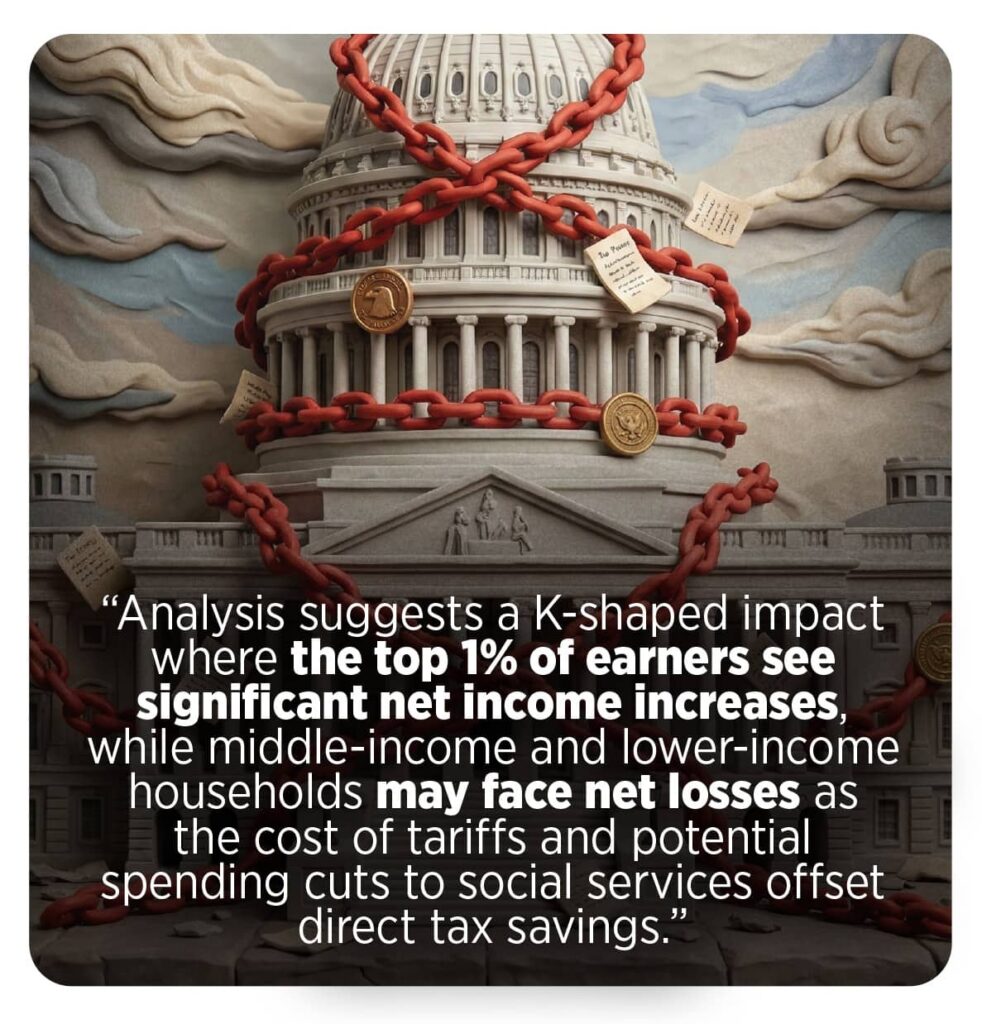
Analysis suggests a K-shaped impact where the top 1% of earners see significant net income increases, while middle-income and lower-income households may face net losses as the cost of tariffs and potential spending cuts to social services offset direct tax savings.

One certain thing is that financial advisors and retirement planners will earn their fees. Advisors will want to pay particular attention to the following three areas.
1. Fiscal stability and the 2028 sunset
The OBBA provided immediate tax relief, but it carries long-term fiscal risks.
» Debt and yield pressure: The OBBBA authorizes a $5 trillion debt limit increase, which may flood the market with Treasurys, lowering bond prices and putting upward pressure on yields.
» Sunset planning: Although many TCJA provisions were made permanent, others are still slated to expire after 2028. Advisors are warning clients to consider Roth conversions now to lock in today’s lower tax rates before potential increases in 2029.
The most important thing the OBBBA did for advisors and their clients was to bring stability to their financial planning, said Dennis Bielik, executive vice president and managing director at Hub International.
“The new standard deduction is $15,750 for individuals and $31,500 for couples, while the state and local tax cap expands to $40,000 for the next five years. Combined with higher income thresholds for the alternative minimum tax exemption and continued limits on itemized deductions, these provisions favor income and liquidity management over estate tax planning,” Bielik wrote in a recent column for InsuranceNewsNet.
“For high-net-worth clients, that means shifting attention from legacy transfers to active income timing, Roth conversions and charitable strategies,” he added.
Among the many changes ushered in by the OBBBA, how charitable deductions are handled is among the biggest. These changes reduce the tax value of charitable giving for many high-income individuals and introduce new limitations on itemized deductions. The changes are significant, tax experts say, and not favorable to the taxpayer.
There are strategies to maximize charitable giving. But first, the changes.
For starters, a new 0.5% “floor” on charitable deductions means that only the portion of total charitable contributions that exceeds 0.5% of adjusted gross income will be deductible.
The OBBBA also reduces the marginal value of charitable deductions for top-bracket taxpayers. Under current law, donors in the highest bracket receive a deduction that offsets tax at about 37%. Beginning in 2026, the value of that same deduction will fall to roughly 35%, modestly increasing the net after-tax cost of each dollar given.
Future charitable giving and the tax impacts of that giving were the main topics of a recent webinar hosted by the National Association of Insurance and Financial Advisors.
Steve Gorin is a trust and estate lawyer and partner at the law firm Thompson Coburn. Business owners can convert charitable contributions into business expenses if they receive a financial return commensurate with the payment, he explained.
Examples include paying for an advertisement in a charity’s program, or a restaurant donating a percentage of sales on a specific night.
“There’s a direct correlation between the sales and the charitable payment,” Gorin noted. “That restaurant can deduct that charitable payment as a business expense relating to the sales.”
For wealthy clients, the OBBBA brought relief by increasing the federal estate tax exemption and making that increase permanent. The federal estate and gift tax exemption was scheduled to drop to $7 million but instead rises to $15 million per person and $30 million for married couples.
The worry now is complacency, the NAIFA panel agreed.
Michael Tessler is president of Brokerage Unlimited, where he assists financial professionals with wealth transfer and wealth protection strategies.
A common mistake with the estate tax is taking the word “permanent” too literally, he said. The law can very easily change again next week. Tessler gave the example of a fictional couple who put a life insurance policy in an irrevocable trust with the idea that it would provide liquidity for their estate. After the OBBBA, the couple removed the life insurance, assuming the estate tax exemption would be $30 million forever.
“If things change, one, they’re going to be older and it’s going to cost more,” Tessler explained. “And two, insurability is always in question. To have a strategy in place, completely ditch it and then wind up needing or wanting it back in place — when it comes to life insurance, not so simple.”
There certainly are clients who will want to surrender a life insurance policy in this situation, Tessler acknowledged. Advisors must consider many factors from a financial standpoint.
“What is the rate of return on that death benefit, depending upon how many years the client lives?” Tessler asked rhetorically. “And keep in mind that if the client’s health has deteriorated since the time they purchased the policy, that only makes the rate of return go up based on a shorter life expectancy.”
2. The ‘Trump Account’ structural risks
While the $1,000 government seed is an attractive “free money” entry point, these accounts have significant planning drawbacks compared to traditional 529 plans:
» Sequence of returns risk: Unlike 529s, Trump Accounts lack age-based “glide paths.” A 17-year-old’s account is 100% invested in U.S. stocks, exposing the entire balance to a market crash right when it’s needed for college.
» Tax friction: Withdrawals are taxed as ordinary income rather than being tax free like a 529, which can push students into higher tax brackets and reduce the usable value of the savings.
» The “public benefits trap”: Assets in these accounts are currently not exempt from eligibility tests for Medicaid or Supplemental Nutrition Assistance Program, potentially disqualifying low-income families from essential aid.
Chris Gandy, NAIFA president, is a big fan of the Trump Accounts.
Part of the OBBBA, the tax-deferred savings accounts provide $1,000 from the U.S. Treasury as investment seed money. Children eligible for the $1,000 seed money are those born to U.S. citizens between Jan. 1, 2025, and Dec. 31, 2028.
An initial $1,000 investment in a low-cost stock index fund can grow meaningfully over 18 years, Gandy noted in a recent column for InsuranceNewsNet.
“But the true promise of Trump Accounts lies in steady contributions from parents, grandparents, employers and even community organizations,” he wrote. “These accounts can support long-term objectives such as college, first-home savings or early investing habits that compound over a lifetime.”
Parents and relatives can each provide up to $5,000 annually to the account, while employers are limited to a $2,500 annual contribution. The funds will be invested in the stocks of “American companies” through what is described as a “broad stock-market index.”
At least 28 companies have pledged a $1,000 match, including Bank of America Corp., JPMorgan Chase & Co. and Wells Fargo & Co.
But some economists doubt the true effectiveness of the accounts beyond the seed money given investment limitations, compared with a state-sponsored 529 plan. Likewise, critics say the realistic inability of low-to-moderate-income parents to contribute funds on a consistent basis will serve to widen the wealth inequality.
With one-third of American households having less than $2,000 in emergency savings, “it makes them unlikely to contribute to their children’s Trump Accounts,” the Urban Institute said.
The money in Trump Accounts can grow tax deferred, but any withdrawals — even for the approved uses of college tuition, a first home or starting a business — are taxed at capital gains rates. Only half of the money can be withdrawn at age 18, and the rest at age 31.
Many financial experts believe 529 plans are a better option for committed savers. A 529 plan is a state-sponsored, tax-advantaged investment account designed to save for future education costs, including college, vocational school and up to $10,000 annually for K-12 tuition.
Earnings grow tax free, and withdrawals are tax exempt when used for qualified education expenses. Anyone can open a 529 account, and the plans offer high contribution limits with no income restrictions.
At the very least, Trump Accounts give those less-motivated savers something to get started.
“For many middle-income families, a structured, tax-advantaged, early-start investment vehicle is something they’ve wanted but never had the infrastructure or guidance to use,” Gandy said.
In late-February comments to the IRS on establishing the accounts, NAIFA recommended that the Treasury Department work with Congress to amend current investment restrictions that limit Trump Accounts primarily to index funds and exchange-traded funds. Although these investments can be appropriate in many circumstances, NAIFA cautioned that overly restrictive investment menus could limit customization and long-term performance.
“Restricting access to broader investment options limits customization and prevents advisors from tailoring strategies to the specific needs of the individual,” Gandy said. “Financial experts are positioned to responsibly advise their clients on the multitude of investment options available to them and then use that knowledge to maximize value and returns over time.”
3. Weakened fiduciary protections and ‘buyer beware’ advice
The Trump administration has actively moved to roll back the Retirement Security Rule (fiduciary rule), dropping legal defenses as of November 2024 and planning a new deregulatory framework by May 2026.
» Conflict of interest? Deregulation may prioritize sales over fiduciary duty, making it harder for clients to know whether an advisor is acting in their best interest or chasing commissions. Industry officials say the best-interest framework created by the National Association of Insurance Commissioners and adopted in nearly every state is fair and thorough.
» Risky assets in 401(k)s: New executive orders aim to “democratize” access to private equity and digital assets in retirement plans. Advisors warn that these are often illiquid and hard to value and could lead to “life-altering losses” for ordinary savers.
All eyes are on the Department of Labor and its May regulatory agenda. It could contain a resolution to a more than 10-year pursuit of an extension of fiduciary duties to a broader range of financial professionals.
With Trump’s return, the DOL has effectively abandoned its defense of the Biden-era Retirement Security Rule, essentially a rerun of the fiduciary rule published during the Obama administration.
On Nov. 28, 2025, the Court of Appeals for the Fifth Circuit granted the DOL’s motion to dismiss its own appeal of lower court rulings that had blocked the rule. Because the government stopped defending the rule, nationwide stays issued by Texas district courts remain in place, preventing the expanded fiduciary definition from taking effect.
The industry has returned to the “five-part test” established in 1975 to determine fiduciary status, supplemented by existing exemptions like PTE 2020-02.
But while it might seem a sure thing that a Trump DOL will pursue light regulation, history tells us a different story. The first Trump administration left us with PTE 2020-02, which allows investment advisers to receive compensation for retirement advice, aligning with the Securities and Exchange Commission’s Regulation Best Interest.
The exemption mandates that advisors adhere to “Impartial Conduct Standards,” which include acting in a client’s best interest, providing written fiduciary acknowledgment, documenting rollover advice and conducting annual reviews.
Lawsuits challenged PTE 2020-02, and a federal court tossed portions of the preamble that allowed one-time rollover advice to trigger fiduciary status.
Recent Supreme Court rulings, specifically Loper Bright Enterprises v. Raimondo, have weakened the DOL’s ability to broadly interpret its authority under the Employee Retirement Income Security Act, making a return to the Biden-era expansive definition unlikely.
Meanwhile, a best-interest model law compiled by the NAIC has been passed in all 50 states. More recently, regulators signaled that they are looking at more active monitoring of compliance issues.
In March 2024, Iowa Insurance Commissioner Doug Ommen first noted that reviews of compliance with the best-interest regulation turned up “deficiencies” in producer monitoring. Ommen chairs the Annuity Suitability Working Group, which is behind the draft guideline.
After more than 18 months of discussion, the NAIC approved the Annuity Suitability Safe Harbor Guidance document during its 2025 fall meeting.
“To meet safe harbor requirements, insurers must monitor the insurance producer or their supervising entity,” the guidance reads. “An effective monitoring program involves the insurer taking active steps to assure itself that the supervising entity is complying with its obligations. Simply awaiting complaints or regulatory actions after regulatory exams are passive approaches that are inadequate in and of themselves.”
Regardless of what happens on the regulatory front, annuities should continue selling strongly, said Tim Walsh, president and CEO of American National Insurance Co.
“We expect demand for some fixed-rate products may cool. But annuities that pair growth potential with downside protection — like fixed indexed options — should hold firm," he said. "Demographics will keep fueling demand for guarantees due to the growing need for retirement security."


Coach Pete for the Win — with Pete D’Arruda
‘I get confused:’ Regulators ponder increasing illustration complexities
Advisor News
- A rising retirement challenge: The license to spend
- Financial stress leaves less room for retirement saving
- Giving while you’re living: 3 frequently asked questions about gifting
- Helping clients prepare for one of their biggest retirement expenses
- Important year-end financial conversations every advisor must have
More Advisor NewsAnnuity News
- A rising retirement challenge: The license to spend
- What lower interest rates mean to annuity payouts
- AM Best downgrades A-Cap insurers amid financial and regulatory troubles
- Lawsuit claims Delaware Life hid billions in insurer-linked investments
- AM Best to Deliver Presentation at 2026 ACLI Annual Conference
More Annuity NewsHealth/Employee Benefits News
Life Insurance News