

The missing piece in most retirement plans
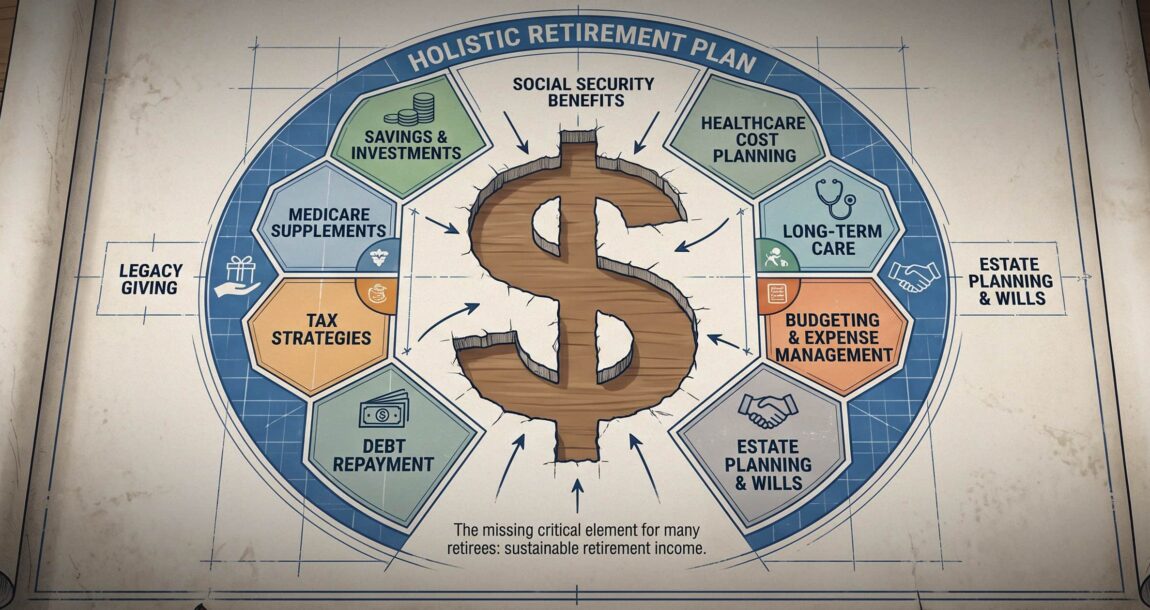
Most retirement plans are built for market risk. Very few are built for life risk. That is why so many of them fail.

A portfolio can be diversified, an income strategy can be carefully modeled and a retirement projection can look solid on paper — but if the plan cannot absorb a care event, it is not truly complete.
Markets create volatility. Life creates the real stress test.
For too many advisors and agents, retirement planning still centers on returns, allocation and withdrawal rates. Those elements matter, but they are not the whole story. A plan also must survive longevity risk, inflation, taxes, healthcare costs, cognitive decline and the possibility of extended care needs. When those risks go unmodeled, even a well-designed plan is fragile.
The long-term care blind spot
One of the biggest gaps in our industry has long been long-term care. Many advisors and agents avoid the conversation entirely — some because they don’t fully understand the planning, the products or the tax implications; others because they worry about upsetting a client with an uncomfortable topic.
But avoiding the discussion doesn’t avoid the risk. It only postpones the consequences. The stronger frame isn’t “long-term care.” It’s future independence — helping clients maintain dignity, control and autonomy throughout retirement, no matter what life brings.

An unplanned independence event rarely announces itself. It starts small: a little more help at home, then part-time support, then full-time assistance.
According to Milliman’s 2026 Long-Term Care Index, a 65-year-old should set aside roughly $135,000 to cover expected lifetime costs of formal paid care at commercial rates — $171,000 for a woman, $98,000 for a man. Needs typically run three to five years, but the range stretches from less than $30,000 to more than $660,000.
That range is the real warning. An extended care event isn’t a single expense; it’s a spread of possible outcomes, and the tail end can overwhelm a plan built only for market movement. A 3- to 5-year event can accelerate withdrawals, force tax-inefficient liquidation, disrupt income strategy and put adult children in the position of making decisions under pressure. By the time a family grasps the scope of the problem, control is already slipping away.
From reaction to preparation
This is why the future independence conversation belongs in every retirement plan, not as an add-on but as a foundation. It isn’t only about products. It’s about deciding in advance how support will be funded, managed and integrated so a client’s independence is protected before a crisis forces the issue.
Complex care planning benefits from the same logic that governs complex medical care: A primary care relationship is essential, but a specialist brings depth the generalist conversation can’t. For advisors and agents alike, bringing that specialized expertise into the room — whether through a formal partnership or a referral relationship — changes the quality of the plan.
A few starting points for any advisor or agent ready to build this into their practice:
- Open with empowering questions, not scare tactics. “How do you envision maintaining your independence if you or your spouse needed help with daily activities for several years?”
- Model a baseline 3- to 5-year independence event in planning software, using current market rates.
- Explore layered solutions — self-funded reserves, hybrid life insurance with independence benefits, annuities with care riders — matched to each client’s values, not a single default product.
- Document the client’s independence priorities in writing, and revisit them annually or after major life events.
Building plans that endure
Too many retirement plans assume life will stay orderly. It doesn’t. Spending changes, health changes, family roles change, taxes change, markets change — and independence needs, once they emerge, are impossible to ignore.
The right question was never whether a client will face an independence risk. It’s whether the plan is ready when they do. That distinction — a plan optimized for assumptions versus a plan built for life — is what separates advisors and agents who protect their clients’ autonomy from those who simply manage their clients’ money.
Read more from Chuck Greenblott on InsuranceNewsNet: https://insurancenewsnet.com/innarticle/ltci-innovations-that-protect-your-clients-independence
© Entire contents copyright 2026 by InsuranceNewsNet.com Inc. All rights reserved. No part of this article may be reprinted without the expressed written consent from InsuranceNewsNet.com.


Clients are bringing TikTok insurance advice into advisor meetings
‘You’ll never get that information’: Inside the brutal PBM exam process
Advisor News
- CT governor’s candidates claims: What’s true, and what’s misleading
- Retaining clients by giving them a memorable experience
- Addressing the longevity paradox
- Employers shift focus from retirement access to financial outcomes
- Helping widowed clients navigate their new financial reality
More Advisor NewsAnnuity News
- Farm Bureau P&C insurers post first underwriting gain since 2021
- Legacy Marketing, Malibu Life launch two fixed indexed annuities
- Changing client priorities are reshaping annuity conversations
- Solen Software acquires annuity software provider Cooperative Technologies
- MassMutual Expands Lending Options With New Secured Credit Line
More Annuity NewsHealth/Employee Benefits News
- Centene sues feds over low ratings for senior health plans
- Terry Savage: Small business owners, now is the time to offer health insurance coverage
- Aldermen select employee medical insurance broker services provider
- Southwest Bridge Health focusing on insurance coverage gap in Berrien County
- HEALTHCARE SHOULDN'T REQUIRE A MAP
More Health/Employee Benefits NewsLife Insurance News