

Pandemic Aid Has Worked Well, Fed Says, But Missed Some People
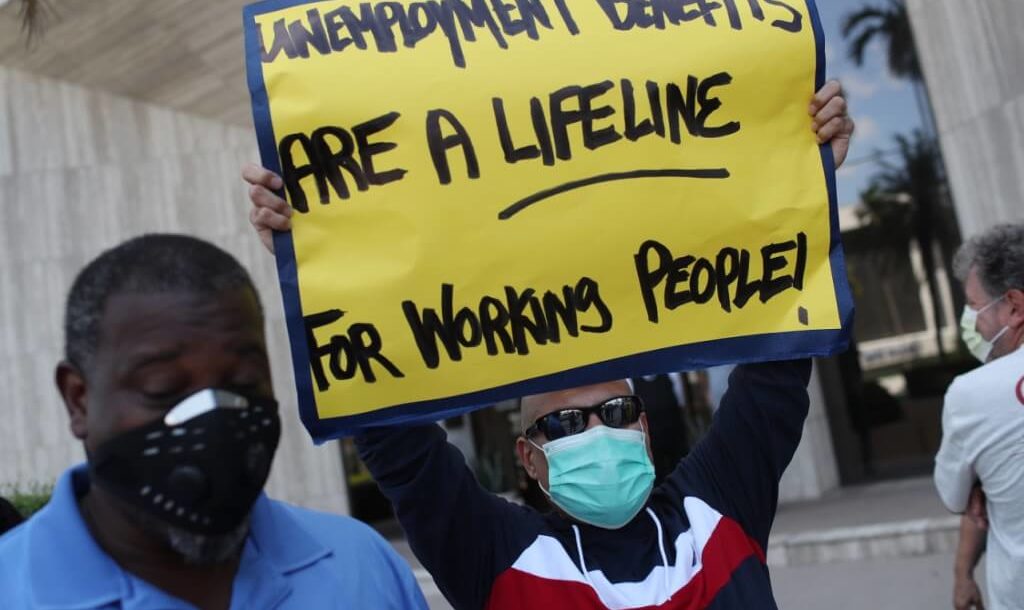
The coronavirus pandemic was unprecedented in how quickly and deeply it damaged the U.S. economy, as well as in how significantly the federal government responded.
The $5 trillion in COVID-19 relief spending lawmakers have passed in the last year has far eclipsed how much they doled out during the Great Recession and in previous downturns.
So how effective has all this aid been so far?
Economists from the Federal Reserve Bank of Minneapolis tackled that question by examining the research and data available from the first round of relief funding that went out last year. They focused on programs aimed at workers and households such as expanded unemployment insurance, direct payments, the Paycheck Protection Program and the eviction moratorium.
In a working paper they recently presented at a Brookings Institution conference, Krista Ruffini and Abigail Wozniak concluded that while not perfect — and they offered many ideas for improvement — the aid largely worked in terms of reaching the intended recipients.
"Across these programs, they were all really successful for the most part in getting large amounts of money out the door really quickly," said Ruffini, a visiting scholar at the Minneapolis Fed.

One of the reasons why it was so effective, she added, is that the government was able to use existing infrastructure, such as funneling stimulus payments through the Internal Revenue Service, which already has contact and income information for many Americans.
However, they also identified several shortcomings, including the fact that the broad-based relief likely missed some marginalized populations, such as people with incomes below the amount required to file federal income taxes. While the IRS tried to identify those people, the researchers suggest that using Medicaid enrollment information could be a way to find those people who might otherwise fall through the cracks.
Wozniak, director of the Minneapolis Fed's Opportunity and Inclusive Growth Institute, offered an analogy of the relief efforts to a lawn sprinkler. While it can soak most of your yard, it still might miss a corner of the lawn no matter how long you run it or how much water you use.
"We soaked a lot of households with support," she said. "Many of them needed it. That was absolutely necessary. But there still is this set of people who are not being reached by it."
At the same time, the researchers also suggest the aid efforts could be better targeted to those who need it most. In the early days of the pandemic, policymakers decided it was better to get a lot of aid out quickly rather than taking more time and effort to make sure it was directed to those hardest hit.
"That was certainly right in the first phase of the response," Wozniak said.
But as time has gone on, she said there has been an opportunity to better direct those payments. The latest relief package, which lowered some of the thresholds to qualify for relief checks, did this to some extent. But she offered that there could be even better and relatively easy ways to do this, such as using IRS data to target relief payments to households that saw significant drops of income from 2019 to 2020.
"In our view, that's a piece of low-hanging fruit," she said.
Christina Romer, an economics professor at the University of California, Berkeley, who also presented at the Brookings conference, asserted even more strongly that the direct payments, while helping some households that needed it, went mostly to people who weren't economically hurt by the pandemic.
So Romer argued that while some parts of the relief such as public health spending and the expansion of unemployment insurance were quite useful, she wrote that other parts were "ineffective and wasteful."
The Minneapolis Fed researchers said it's too early to gauge the success of some programs such as the eviction moratorium, a restraint on landlords toward renters that they call a "big wild card." It's the first time something of its kind has been tried on such a large scale and it's unknown how many people have been relying on it.
"Once it expires, what happens to people who might be covered by it is a big outstanding question that will only become apparent in the next couple months," Ruffini said.
The researchers also recommend that some relief programs such as extended unemployment benefits are phased out based on economic indicators, instead of having them expire on somewhat arbitrary dates. The latter approach set up cliffs last year that led to a lot of uncertainty for households as they wondered if those programs would be renewed. And from the perspective of stabilizing the economy, they said it makes more sense to tie the end of those programs to how well the economy is doing.
In terms of longer-term relief, they suggest other areas for expansion such as extending aid for summer remedial programs to help make up for the school disruptions in the last year, expanding disability insurance programs to support people with long-haul COVID-19 and increasing access to mental health services.
They didn't directly wade into the topic that has divided lawmakers — if the relief packages, particularly the most recent one, have been too big.
But Ruffini noted that survey data show there are still many people who have been having difficulty affording food and rent.
"For some people that relief may not have been needed, but there's also a population for which that additional relief was very necessary," she said.
Kavita Kumar • 612-673-4113 Twitter: @kavitakumar
___
(c)2021 the Star Tribune (Minneapolis)
Visit the Star Tribune (Minneapolis) at www.startribune.com
Distributed by Tribune Content Agency, LLC.


Change Starts From Within
Vaccine Reluctance Is Waning, But Still Significant, New Poll Finds
Advisor News
- Navigating client communication in a digital age
- Can your advisory firm survive without you?
- I started using AI, but what now?
- How to support an entrepreneur client with multiple businesses
- Could a narrower focus help grow your practice?
More Advisor NewsAnnuity News
- Solen Software Group Acquires Cooperative Technologies, Provider of 1035 Exchange and Annuity Replacement Software
- MassMutual Expands Lending Options With New Secured Credit Line
- Corebridge Financial Introduces Progressive Trigger, a First-of-Its-Kind Index Annuity Strategy Designed to Turn Missed Years into Future Opportunity
- Insurer proposes $1.1M deal to resolve CA teachers’ annuity fee lawsuit
- IMOs get frustrated with slow carrier adoption of faster technology
More Annuity NewsHealth/Employee Benefits News
- REPS. CLARKE, GRIJALVA LEAD 63 MEMBERS OF CONGRESS IN URGING USCIS TO ADDRESS PROCESSING BACKLOG COSTING LAWFULLY-PRESENT IMMIGRANTS THEIR HEALTHCARE
- Pennsylvania sues pharma and PBMs over insulin prices
- Seniors can get help wth Medicare sign-ups
- Oscar Introduces a New Wave of Consumer Health Products
- MAYOR MAMDANI LAUNCHES OUTREACH TEAM TO HELP NEW YORKERS KEEP MEDICAID AS FEDERAL CUTS THREATEN COVERAGE
More Health/Employee Benefits NewsLife Insurance News