

Key person life insurance keeps small businesses afloat

Small-business owners are no strangers to risk. From the economy’s ups and downs to unforeseen operational challenges, the path to success in the world of small business can seem uncertain or even dangerous.
However, one often-overlooked risk is the potential loss of key employees or owners whose expertise, leadership or client relationships are difficult or impossible to replace. For advisors serving the small-business community, recommending key person life insurance isn’t only about selling an insurance solution; it’s about protecting their client’s future.
The underused safety net
Despite its critical role, key person life insurance continues to be underused as a planning tool for small businesses. Many owners recognize the need for property, liability and cyber insurance, but they hold back when it comes to insuring their most valuable asset: their people.
This kind of unconscious resistance is certainly understandable. After all, insurance is an emotional transaction. The insurance conversation can force owners and employees to consider uncomfortable questions about mortality, health and other “what ifs” they would rather not think about. When we add concerns about HIPAA and personal privacy (for example, employees might worry about sharing their own sensitive health information for a policy they don’t directly benefit from), it’s no surprise this coverage is all too often put off for another day.
It’s clear, however, that procrastination and inaction can lead to less-than-positive, even dire, outcomes. For example, if a business relies on a founder, top salesperson or specialist whose sudden absence would negatively affect operations or revenue, the lack of a financial cushion could lead to layoffs, lost clients or even closing the business. As insurance professionals, our job is to help our clients see that planning for the worst is a sign of wisdom and strength. It’s not something to put off for another day.
Addressing complexity
Another barrier is the common but mistaken perception that buying key person life insurance is a complicated, drawn-out process. Plus, business owners might push this decision to the back burner because they don’t know where to start, or they worry about extra time and administrative efforts that might be needed to put the coverage in place.

In this situation, the agent’s role as a trusted advisor comes into play. By demystifying the process, explaining the underwriting steps and laying out the policy’s benefits, a smart producer can turn dithering and delay into decisive action. The message is simple: Securing key person coverage is more straightforward and affordable than business owners imagine.
Beyond death: The power of living benefits
Modern key person policies have evolved to address more than just the risk of death. Many now offer living benefits, including riders that include payouts in cases of critical or chronic illness, such as heart disease, stroke, cancer or cognitive impairment. This evolution is especially important for small businesses. It means the policy can be a financial lifeline, not only if a key person passes away, but also if they’re unable to work due to a serious illness or injury. This flexibility can be very appealing to clients that want protection against multiple risks beyond the ultimate one.
For example, a business that protects its owners and key employees with living benefits riders can access funds if someone is diagnosed with a qualifying illness. This helps cover lost productivity, recruitment costs or even temporary leadership gaps. This added layer of protection can mean the difference between weathering a storm and shutting down the business for good.
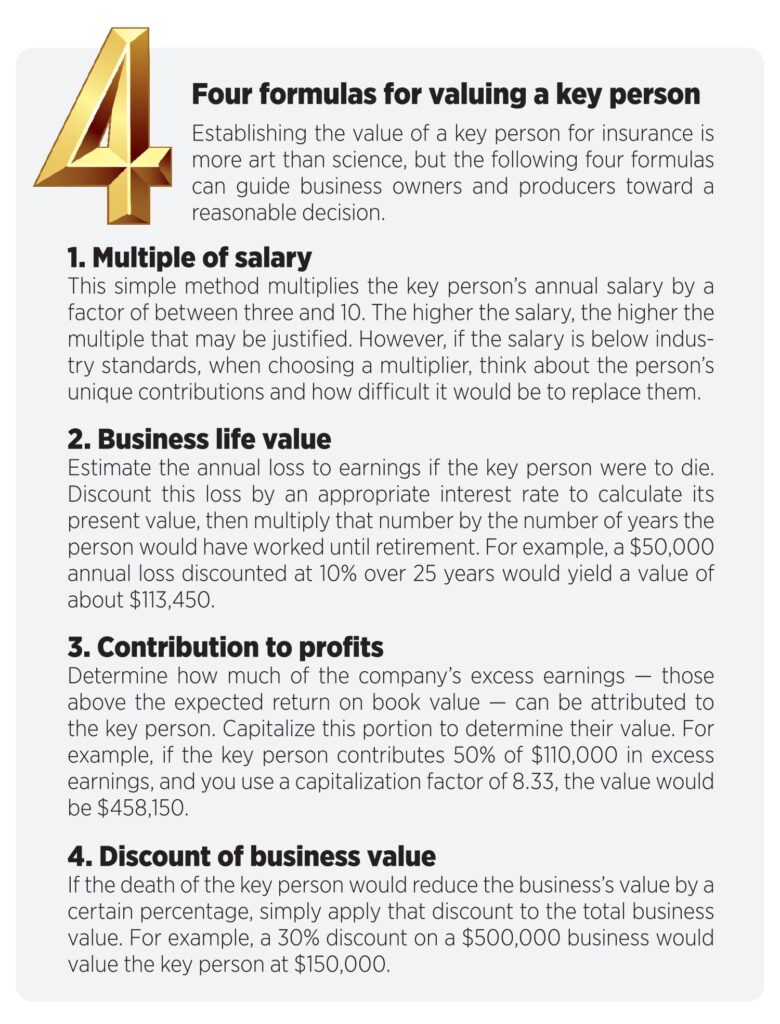
Real-world impact: Case studies
The true value of key person life insurance is revealed in the stories of businesses that have faced the unthinkable and survived. Here are some examples:
1. Staying afloat during transition
A local business, owned by a majority shareholder, purchased a $250,000 key person life policy insuring his own life. Five years later, the owner died from cancer. The tax-free proceeds allowed the business to stay afloat during a turbulent transition. The new owner had the necessary breathing room to refocus and adapt, retain customers, and eventually even grow the company. Without the policy, the business might have folded, leaving employees and clients in limbo.
2. The policy’s value as an asset
Another business owner secured a $2 million policy before retirement. Although she is no longer actively involved, her family continues to pay the premiums, recognizing the policy’s value as an asset. Now, the family is exploring the possibility of selling the policy to investors, which would unlock cash for new projects and strengthen the company’s balance sheet. This demonstrates how key person policies can serve as versatile financial tools, not simply emergency parachutes.
3. A comprehensive approach
One business owner took a comprehensive approach, purchasing key person life insurance with living benefits for three owners and the company office manager. They appreciate knowing they’re protected in the event of both death and critical or chronic illness, helping ensure that the company has resources to respond to a broad range of scenarios, not just the worst case.
4. Protecting all business partners
In another business, two partners were hesitant to include key person coverage in their portfolio. When their agent raised the topic during a discussion about commercial liability, they were relieved to know they had a trusted advisor who would guide them through the process.
The agent explained that without coverage, the death of either partner could result in the deceased partner’s shares going to a family member — potentially somebody with no interest or experience in the business. With key person insurance, the surviving partner can buy out the shares, keeping the company stable and relationships in place.
The agent’s role: Trusted advisor and educator
For agents, these examples are more than stories; they’re proof of the real-world effects of thoughtful planning. Our role as insurance professionals goes beyond quoting premiums. We also must educate our clients about the risks of delay, address their emotional and privacy concerns, and show them that key person insurance is a solid step toward ensuring business continuity.
Plan today for a secure tomorrow
Key person life insurance isn’t just another insurance product in our sales toolbox. It’s an essential risk management tool for small businesses. As insurance professionals, we have a responsibility to help our clients work past their discomfort and worries and guide them to make decisions that protect not only their employees and customers, but also their legacies.
Of course, the best time to plan for a crisis is before one occurs. By making key person insurance a vital part of every business owner’s strategy, we know that when the unexpected storm arrives, our clients are well prepared to guide their businesses through the rockiest of shoals and into a safe harbor.



Department of Labor proposes pharmacy benefit manager fee disclosure rule
The shift toward holistic retirement planning
Advisor News
- Flourish brings private-bank-like cash solution to MassMutual’s network
- Majority of Americans concerned recent market highs are unsustainable
- GLP-1 users choose between medication and retirement saving
- Gen X and millennials seek new retirement model
- Are families ready for the costs of aging at home?
More Advisor NewsAnnuity News
- New class-action lawsuit targets Delaware Life over annuity disclosures
- A client remarried: Does their annuity still fit?
- Gen X and millennials seek new retirement model
- Global Atlantic names Dan Farrelly head of IMO and IBD channels
- A rising retirement challenge: The license to spend
More Annuity NewsHealth/Employee Benefits News
Life Insurance News