

Keeping it simple — With Tom Bumbolow
American Life isn’t exactly a household word, and that’s exactly how Tom Bumbolow, head of distribution and business development, wants it.
The company, founded in 1960, partnered with FAST, a digital platform, in 2018. This made American Life the first insurance company to be entirely cloud based. This transformed the buying experience and allowed the company to continue its mission of providing simple, easy-to-understand products in an uncomplicated way.
Bumbolow joined American Life after a 20-year career at JPMorgan, where he helped build its credit business. He started in credit derivatives, which morphed into funds, structured credit and cap structure, statistical arbitration and correlation trading. He took what he learned at JPMorgan and applied it to American Life as the company’s leadership rebuilt the carrier.
In this interview with InsuranceNewsNet publisher Paul Feldman, Bumbolow talks about the need to keep annuities easy to understand and the importance of listening to agents and clients.
PAUL FELDMAN: American Life is a name that not everyone’s familiar with in the marketplace. Tell me about the formation of the company over the past several years and your vision for the future.
TOM BUMBOLOW: We took a different approach. There has been a lot of talk and a lot of activity around the convergence of asset management and insurance. We saw that opportunity a while back, and we thought about acting in a different way. For every large deal that was getting done, there were probably 20 or 30 other asset managers who were involved and wanted to access these liabilities but didn’t get the opportunity. They didn’t know if they wanted to start their own insurance company, so we saw that as demand for liabilities.
We saw the annuity space as a growing opportunity, somewhere we could come in and provide products that add value to retirees. If you think about it — and that’s a correlation back to my old life — it’s looking at risk on two different fronts: finding buyers of that risk and sellers of that risk, and finding unique ways to put them together.

As we started the company, we had an open investment infrastructure. We productized our liabilities through reinsurance. Asset managers were looking for these nonmarket long-term liabilities, and we, on the other hand, were just starting, building a company, and needed capital to continue to grow and scale. So we used reinsurance strategically to get our business up and off the ground.
FELDMAN: How does your trading background influence product development and crediting rates? I think that is a big part of American Life’s foundation.
BUMBOLOW: If you think about it, at the end of the day, carriers are borrowing money from retirees, right? That’s kind of what we’re doing, and you have two choices at that point. You go and invest that money — and hopefully you earn a rate that’s greater than the rate that you owe back to the retirees — or you can lend it out through reinsurance and bring in best-in-class institutional asset management. If you understand the way you can deploy capital, you can then turn around and be more mindful about how to procure that capital for the company.
A direct example is, as we were getting started and interest rates kind of took off back around 2021 to 2023, multiyear guaranteed annuities were really in favor. It wasn’t necessarily just the increase in interest rates; it was the velocity of the increase in interest rates. Multiyear guaranteed annuities were at 2 1/2%, and then all of a sudden they went up to 5% or 6%. That was kind of a perfect storm for us, in that the yield curve was also inverted at the same time.
If you think about being an asset manager and you’re getting compensated with more yield for shorter-term risk than you are for longer-term risk, and if you have a mindset around matching your assets and liabilities, it was a perfect storm. What we were selling was in three-year and five-year duration, and what those folks were looking for were liabilities with similar duration because all the assets that they were investing in the front end as well.
I’ve been a student of the space, and I will continue to be a student of the space. I’ve learned a lot in the years I’ve been involved here and hopefully will keep learning. That excitement is what drives me every day.
Understanding where the annuity market is, what retirees are looking to buy, what riders matter, what duration matters — that helps inform and set where we turn around and deploy the capital. Whether it’s private credit, structured credit, investment grade — all the different kinds of asset classes that pertain to any insurance space — the better we understand both sides in a model like ours that uses around 70% reinsurance, the better we can create a product and then match it with someone who’s looking to take on that risk, and mitigate as much of the risk as possible.
FELDMAN: Your company started in the MYGA space, then you started developing indexed products. What about registered index-linked annuities? Are you into that at the moment, or do you plan to be?
BUMBOLOW: That’s one of the fastest-growing products out there, and we’re certainly watching it. But I think we’ve been intentional with our growth, and I would say a lot of new carriers have hit the market over the past couple of years and there are probably more to come right behind them.
We’ve been thoughtful with our growth. We’ve chosen our independent marketing organization partners carefully. We’ve stuck with those partnerships for the past five or six years. We’ve been thoughtful about slow but steady progression and the idea that we’re here for the long haul. I’m not interested in premium for one or two years. I’m not here to flash a fancy crediting rate and then next year drop rates down by a ton.
We’ve been focused on service, we’ve been focused on renewal rates, and we’ve been focused on really thoughtful and intentional growth so we don’t outrun our capital.
Right now, we offer a MYGA and we’re in accumulation fixed indexed annuities. There are a number of things that we can do to continue to grow. We’ve been committed to our financial strength, and you know the progression of rating for with AFS and to be moving in a positive light in that regard too. So it’s not just about writing as much premium as you can in a given year. It’s about profitability. It’s about capital. It’s about building sustainable business.
We’re excited about the opportunity in front of us. We have states we can launch into. We’re in only 31 states right now. We have new products we can launch and potentially expand our distribution into new channels as our ratings continue to progress. So the future is bright. Last year, we wrote about $1.5 billion in 25 states with nine IMOs.
It shows what could be accomplished, but we’re not going to run out after that. We’re going to be thoughtful. We’re going to work with our distribution partners, our agents, our IMOs, and understand where they believe the puck is moving. Think about the asset allocation strategy and how that may or may not fit with the liabilities that we’re bringing in, and pick our spots and try to be as consistent as humanly possible.
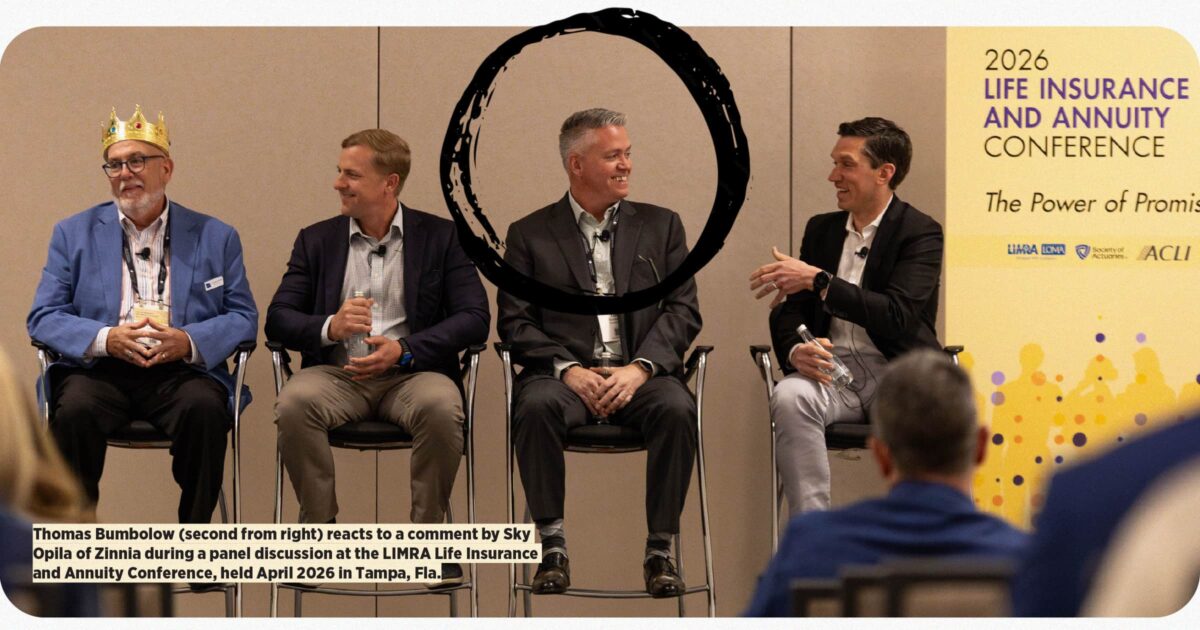
FELDMAN: What would you say to an advisor who may not be familiar with your portfolio? Why should they choose you, and why does that make sense for their clients, because everyone’s trying to do the best for their clients?
BUMBOLOW: We have a fiduciary responsibility, and we take that responsibility seriously. Our business has grown, and our success has been driven first and foremost by service. We focus on that experience that the agent has when they come into a carrier — whether that’s around things such as policy administration, suitability, regulation — or if it’s around crediting rates. As I said earlier, we’ve tried to be thoughtful about renewal rates and to maintain that integrity as best we can.
It’s about listening to and connecting with our agents and our IMO partners to understand what that process is all about.
We didn’t go guns blazing into the annuity space. We were slow and steady and thoughtful. We wanted to understand what drove buyers, the things they cared about, what agents cared about, and we founded our company based on that.
Imagine having that conversation and having to go back to that kitchen table and explain why your F rate just dropped four points, or why you know you might want to shift out of this company because you know they outran their capital or their ratings are going down or all these different things that can happen.
So again, we wanted to have simple products. We wanted a lot of embedded value. We think that we uniquely attack the insurance value chain by aligning asset managers that are specialized in their areas of expertise. That’s going to create a little bit of alpha to it. Fewer defaults, better returns over time. In that, we can provide better rates to our annuity holding, so aligning those two, explaining how we’re growing, explaining the pace at which we’re growing and listening because we’re not going to get it all right on Day 1. This idea of connection is strong with us: the connection with our asset management partners, the connection with our capital partners and their connection with our distribution partner.
FELDMAN: Someone told me recently that carriers don’t understand what the consumer wants, what the buyer wants. They said most of the carriers just ask what the IMO wants. And it doesn’t filter down as much to the agents because IMOs, to some degree, have a lot of control over product selection and other things. How do we as an industry communicate better with clients and prospects?
BUMBOLOW: There are a lot of competing interests out there. How do you make sure that you’re focused on the bottom line — which is the annuity holder — what they need and what’s available to them?
There’s a need for more education across the entire landscape, and that falls on the carrier, that falls on the IMO, that falls on the agent. I think we’ve made a lot of progress. But I think the education process must continue to improve. One product can’t be everything to everyone.
We built something into our products, which we describe as a kind of loyalty bonus. If I can give an asset manager more certainty of having that capital for the full duration, that’s valuable. They know that if I am able to guarantee that they have this capital for five, 10 years, that’s valuable. Because it’s not like a bank loan or some of these other things that go away or have to be refinanced every year or every six months.
If I can give them more certainty about that, then that’s valuable to them, and I need to find a way to give that back to the policyholder. So we’ve done that in a loyalty bonus. You buy one of our MYGAs, you go on to one of the crediting websites that are out there and you’ll see two different rates. You’ll see the liquidity rate and the nonliquidity rate. It’s the same product, but the idea when we created our MYGA product was that clients shouldn’t have to choose between liquidity and yield.
That’s the constant struggle in the annuity space. How much liquidity will I need? Well, it depends. Is COVID-19 going to come back? If everything is normal, I’m pretty sure I know what I’ll need. But what if? So the way our MYGA product works is, if you stay within your required minimum distributions for the duration of the period, you get a bonus at the end. Call it a loyalty bonus. Same thing with our FIA product. If you hold liquidity through the end, you get a bonus on the accumulated value at the end of the surrender charge period as well. So it’s trying to line that up and provide some flexibility within the contract.
Our clients say, “I don’t know what I’m going to need. I think this is what the outcome will be over the next five, 10 years, but I don’t know.” So we try to embed that within the product and give the client two paths, depending on whatever life throws at them, and explain that upfront.
We have another product that takes a lot of liquidity out of it, accrues the interest credit but pays a much higher crediting rate. So if there’s a client who wants to put a throttle down on the crediting rate but isn’t as concerned with liquidity, that fits them much better.
Again, we’re listening to the space and to the buyers out there. What do they care about? How can we offer your fantastic indexes to get to diversification? How can we create products around what they need while also meeting the asset management side?
FELDMAN: Tell us how you’re using technology and innovation at American Life.
BUMBOLOW: We’ve looked at technology since Day 1, and I think that’s been one value proposition we offer to our agents and clients. We are thinking about implementing artificial intelligence and how we can make the agent experience and the customer experience smoother.
That being said, we’re an annuity company and we don’t have the largest balance sheet in the industry. So we’re not going to be the first one out there that tries all these different things. Sometimes it pays to follow some of these things.
We’ve already implemented some artificial intelligence on the operations side. We’re also looking at using the app as a training tool for call centers. I think there are a lot of other opportunities to come.
I think the key to technology in the industry is connected to our partners. We take the approach of getting to know our clients as well as we can and building together.
FELDMAN: As a smaller company, how do you gain attention in the marketplace? Everybody’s fighting for shelf space, and there’s only so much bandwidth.
BUMBOLOW: Even though it’s a competitive landscape, this is still a relationship business. I believe consistency matters. And when you have a lot of new entrants to the space, understanding their motivation and what drives them is important.
We focus on simplicity. We focus on service. We focus on the connection and putting out value. We’re not here to write as much business as we possibly can but to listen to what customers need.
FELDMAN: Where do you think the puck will go in the next three to five years? Will we have new product categories?
BUMBOLOW: The only thing I can tell you is I don’t know. Again, it’s about listening. That connection is tantamount to our growth and our success.
When I listen to our partners, I see a distribution effort that is trying to sell more product to the same person. I see folks who are trying to maximize the number of contracts for households. I sell life insurance. Can I sell them an annuity? Can I move their exchange-traded fund money? What about their investments in retail private credit? But if I run out of things to offer, they’ll call someone else. Instead of having them call four different people for those products, why can’t they just call me? I see IMOs setting up that way. IMOs and insurance agents are becoming registered investment advisors; RIAs are becoming insurance agents. Those lines seem to blur every day.
FELDMAN: What do you think about direct-to-consumer channels for MYGAs?
BUMBOLOW: These products are sold; they’re not bought. People need to be educated about these products. They’re large chunks of an individual’s or a family’s earnings over their lifetime. To think about selling that with one click and not having a relationship with the customer and talking through risks and suitability — I find that hard to believe.
I see the value that our IMOs and our agents create for our clients, and it’s tremendous. So I don’t really see that going away.
But we have fee-based clients, and we want to be able to offer those products to our RIA-based agents as well.
FELDMAN: I think that using AI-enabled advisors is the best of both worlds.
BUMBOLOW: You have to embrace AI and use it as a tool. I think it is a tool and not a replacement for the advisor.
FELDMAN: Is there a question that I didn’t ask that I should have?
BUMBOLOW: I think about understanding who you’re doing business with. I don’t care if you’re rated A-plus or B-plus. We’re borrowing money for retirees and we’re investing it. You had better know what we’re investing it in and how we’re investing it, how much leverage we’re taking, how we’re protecting the capital, how much capital we’re reserving against it, you know, who we’re using on the asset management side to help. Those are all questions that I think are fair game for an agent to ask their carriers.
How are you attacking this space? Why should I be doing business with you? What’s your value proposition versus the other carriers out there? And how do I know you’re going to be around in five years? Those are all really valid questions.
At the end of the day, we’re trying to create products that benefit retirees. We’re trying to protect those retirees, and we’re trying to create new and innovative products that will be helpful to them. That will be here for the long haul. So it’s about understanding each part of the value chain: the provision, the asset management side, the carrier side, and making it as seamless as you possibly can between those three.
We’re doing it slow and steady, which sometimes is frustrating for a Type A personality who wants to go out there and just kill it. But we’re doing it in a way that is more thoughtful and more sustainable for years to come. That’s the plan.
We’re trying to build and grow together, and we’re really excited about what’s in front of us.



Nationwide marks 100 years as a modern mutual
Risk-control index innovation grows as regulators scrutinize complexity
Advisor News
- Could a narrower focus help grow your practice?
- U.S. debt hits $40 trillion: how to support concerned clients
- Flourish brings private-bank-like cash solution to MassMutual’s network
- Majority of Americans concerned recent market highs are unsustainable
- GLP-1 users choose between medication and retirement saving
More Advisor NewsAnnuity News
- Corebridge Financial Introduces Progressive Trigger, a First-of-Its-Kind Index Annuity Strategy Designed to Turn Missed Years into Future Opportunity
- Insurer proposes $1.1M deal to resolve CA teachers’ annuity fee lawsuit
- IMOs get frustrated with slow carrier adoption of faster technology
- New class-action lawsuit targets Delaware Life over annuity disclosures
- A client remarried: Does their annuity still fit?
More Annuity NewsHealth/Employee Benefits News
Life Insurance News