

Why the market doesn’t need more carriers
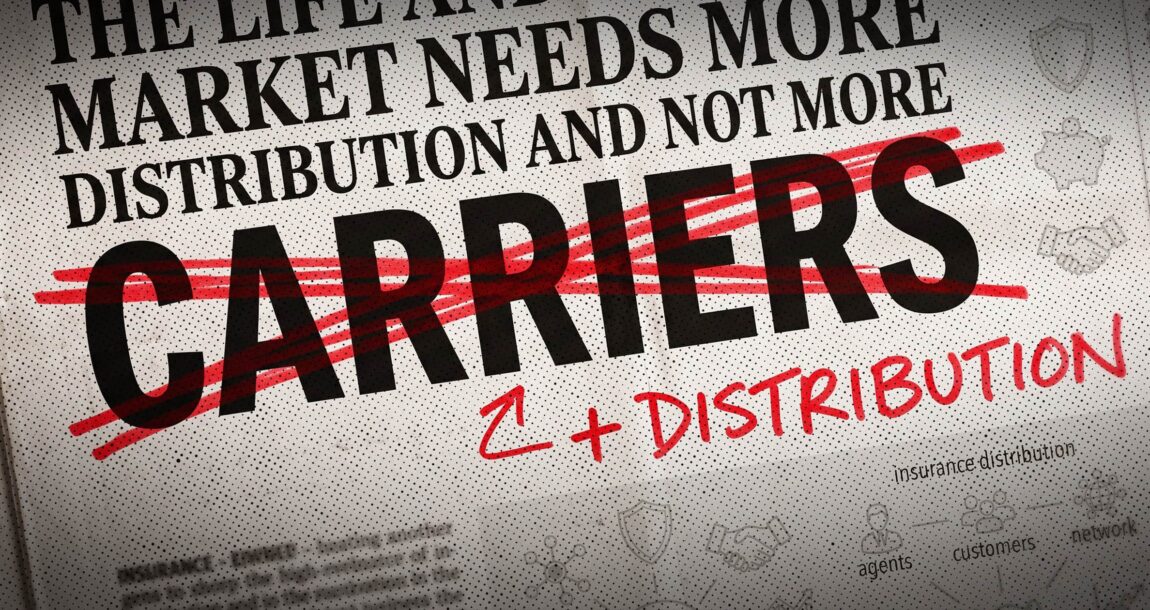
New carriers and platforms keep entering the market, typically promising transformation through product innovation, artificial intelligence capabilities or lower operating costs. Yet protection, income and supplemental gaps remain large despite crowded product shelves.

Annuity volume remains driven largely by exchanges (1035s, bonus chasing, free-withdrawal funding) rather than net-new buyers. Supplemental and simplified lines have not produced transformative penetration for most carriers even as underlying needs have grown.
If additional carriers and product shelves have not bridged the coverage gap, something else must be the constraint. The likely culprit is distribution.
For life and annuity carriers, the primary customer is the advisor, not the policyholder. Carriers compete for distributors and advisor placement. This advisor-centric model efficiently recycles existing relationships and moves money already inside the system, but it is structurally weaker at originating net-new coverage outside advisor networks and prospecting patterns.
Even within “served” segments (e.g., higher-net-worth households touched by multiple advisors, banks, or registered investment advisors), presence does not equal consistent effectiveness in advice quality, product fit, speed or coordination.
This creates two distinct opportunities for carriers:

- Already-touched segments with residual gaps. Priority customers sit within existing advisor or multi-channel relationships, but those channels aren't fully effective.
- Segments reached more efficiently by distribution nodes the carrier does not currently use. Institutional, workplace, banking, affinity or platform relationships can originate or place business without a full advisor-layer commission.
Reaching these segments requires explicit segmentation followed by model selection. Carriers must decide which priority segments remain advisor-centric, which justify a client-centric path and which are declined. Only then can they select and operate the distribution model whose reach, cost, persistency profile and conflict characteristics fit.
Why more distribution models, not fewer
Market trends are shifting toward consolidation, not proliferation. The number of independent distributors has diminished as firms grow through acquisition to gain scale. As consolidation continues, carriers become more dependent on fewer partners, reinforcing the advisor-centric model and concentrating originations in the same households. This raises the cost of relying solely on existing pipes and increases the value of additional specialized models that can reach segments current partners do not serve efficiently.
The alternatives have not fared well thus far. Pure direct-to-consumer and generic digital storefronts have largely failed for complex protection and annuity products — trust, education, underwriting friction and acquisition costs cannot be solved simultaneously. AI has breathed new life into some models' economics, but challenges remain in proving scale. Captive distribution has also faced headwinds since COVID-19.
No single model fits every segment. Advisor-centric, institutional, DTC, hybrid, and other scaled approaches have different reach, cost, persistency, and conflict profiles. Thin-margin, high-volume, simple-issue business often fails the fixed-cost test for any one carrier, but the economics begin to make sense when volume is aggregated across carriers or run through a shared node.
A wider set of workable models lets carriers match opportunities rather than force every opportunity through the same pipe.
Managing carrier distribution strategy
A carrier that wants to move beyond traditional distribution strategy must start with explicit segmentation: Determine which segments remain advisor-centric, which are client-centric or institutional, and which to decline. Underlying this is a clearer definition of the segment than simple demographics—for example, cash-flow stability, an existing noninsurance relationship or payment rail, sensitivity to lapse under financial stress, or a clear decision trigger. Carriers tend to focus more on selling to someone upmarket and less on understanding how they make purchase decisions.
With segmentation completed, the carrier identifies the correct model based on reach, acquisition cost, expected persistency and behavior, underwriting fit and channel-conflict exposure.
Operating and economic realism flow from these decisions. Carriers must calibrate product and process variants to the channel, align compensation and servicing to actual behavior, and establish governance that prevents one channel from contaminating another. A carrier must also accept different margins or slower growth in traditional channels when a new path is strategically justified, and it must show discipline by refusing to chase volume from clients whose profiles do not align with the product’s persistency requirements.
Key implications
Defaulting to current advisor or independent marketing organization placement will keep originations concentrated in the same households. Selective model-matching, with explicit conflict and economics management, is the higher-probability path to serving residual gaps profitably.
This requires the right distribution structure. For the market, additional specialized distribution capacity — whether built, partnered or shared — expands the option set without requiring more manufacturers. Carriers can lead by selecting and operating models that fit their priority segments, or partner where specialized capacity already exists or can be jointly developed. Most current Insurtech investment follows AI themes, but the more durable opportunity is in distribution nodes that solve access and economics for specific segments.
The risk of not acting is significant. Carriers already see volume without adequate persistency, internal channel conflict that hurts economics, and continued reliance on exchange-driven growth rather than net-new growth. Further concentration of existing advisor and IMO relationships only accelerates these issues by raising dependence and limiting new origination.
The industry has largely solved for product availability inside the advisor system. It has under-solved for matching the right distribution model to the segments it wants to serve.
More models in the ecosystem, combined with disciplined carrier selection and operation, offer a practical route to broader access without repeating known failure modes.
© Entire contents copyright 2026 by InsuranceNewsNet.com Inc. All rights reserved. No part of this article may be reprinted without the expressed written consent from InsuranceNewsNet.com.


Turning expanded eligibility into a better coverage plan for federal clients
Advisor News
- Turning expanded eligibility into a better coverage plan for federal clients
- Election 2026: Which of Berkeley's 7 ballot measures will pass?
- How advisors can help frugal retirees finally enjoy their savings
- Wealth planning vs. estate planning: Honoring your client’s wishes
- What to discuss during the first retirement planning meeting
More Advisor NewsAnnuity News
- Why the market doesn’t need more carriers
- Equitable, Corebridge steam toward merger with strong Q3 annuity sales
- Jackson Announces New Annuity Offering for AARP Members
- National Life Group expands annuity portfolio
- AM Best to Join Life/Annuity Insurance-Focused Panel Discussion at Capitol Forum Event
More Annuity NewsHealth/Employee Benefits News
- NO SURPRISES ACT ARBITRATION 'RUN AMOK' PROVIDER-DRIVEN ABUSE DRIVING UP AMERICANS' HEALTHCARE COSTS
- Hospital ending health plan amid industry's struggles
- Missouri Department of Commerce and Insurance releases health insurances rates for 2027
- Austin workers weigh health coverage as insurance costs are forecast to rise
- My unhappy day in small claims court | Letters to The Republican
More Health/Employee Benefits NewsProperty and Casualty News
- Election results: California insurance commissioner, Ben Allen vs. Jane Kim
- Nationwide Equities Introduces ReverseReach, a New Tool Designed to Help Brokers & Loan Officers Uncover Reverse Mortgage Opportunities Within Their Customer Database
- Horace Mann reports third-quarter 2026 results
- Premia Holdings Ltd. Completes the Acquisition of Cowen Reinsurance from TD Bank
- Severe storms drive $43B in U.S. insured losses as 2026 winds down
More Property and Casualty News