

Keep the transcript; Don’t delete the audio
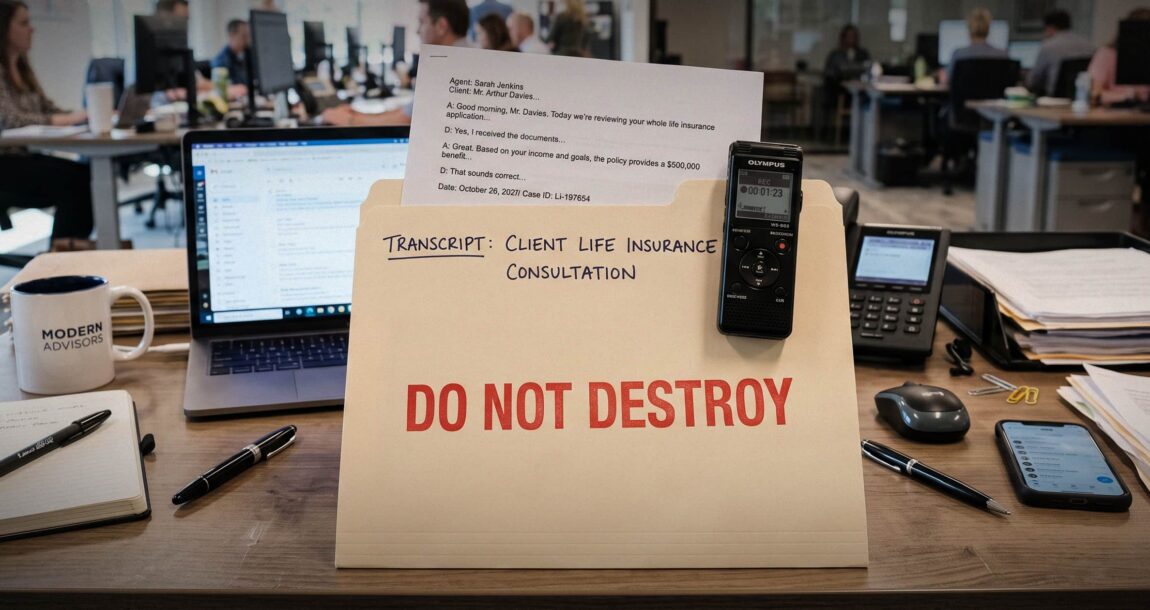
The Centers for Medicare and Medicaid Services is about to let you delete the audio recording from your marketing and sales calls after three years and keep a transcript instead. Take the transcript. Leave the audio where it is.

The change itself is straightforward. Retention times for both marketing and sales calls decrease from 10 years to six. The first three years must be audio, and the last three can be a complete, accurate transcript. Enrollment records didn't move and stay on their own 10-year clock. The new marketing policies apply Oct. 1.
CMS did the math on what deleting audio buys you and put it at roughly $67 a year for a typical agent, most of that storage. That is your prize.
Against that, consider what the recording does for you. CMS noted in its own analysis that call recordings provide a way to refute beneficiary complaints, and around 10.5 million beneficiaries discuss their plan options with an agent every year. Some of those conversations come back as complaints long after anyone remembers them. The agency also acknowledged that a transcript won't capture tone, which is usually the thing in dispute when a beneficiary says they felt pushed into something. Sixty-seven dollars is a thin price for the only recording of a conversation you're being accused of mishandling.
So keep the audio, and keep it because it's your evidence rather than because a rule tells you to.
Advantages of keeping the transcript
Keeping everything also avoids a problem that the rule left unanswered. Sales, marketing and enrollment discussions usually occur during a single phone call, and both sides operate on different time schedules. Agents raised that with CMS during the comment period and were told it fell outside the scope of the rule. If it doesn't get deleted, you don't need to fix it.

The transcript is worth having on its own merits, and that's the part most agents will skip past.
Once your calls exist as text, your whole book of business becomes searchable. The week a carrier changes a benefit, you can find every conversation where you described the old one and know precisely who you owe a phone call. You can check whether required disclosures were actually said across every call instead of pulling a handful at random. Text files are also small, so keeping it permanently costs close to nothing.
Most importantly, software can read it, which is the reason this option exists at all. Commenters told CMS they wanted transcripts partly because transcripts are far easier for artificial intelligence tools to ingest and review than audio is.
A folder of transcripts nobody opens is just cheaper storage. What makes the archive worth having is an AI assistant pointed at it, running the same review every week: did the required disclosures get said on every call, which conversations need a follow-up, and what are beneficiaries asking about over and over this season. That's a standing instruction and a schedule rather than a project.
The AI assistant reads the transcripts and hands you a short list. You work the list. It never touches the recordings, and it gets no vote on what you keep. Review is its job. The record stays yours.
Beware of using an AI assistant
One caution before you point an AI assistant at those files. The transcripts contain client health information, and the business associate agreement you signed with your carrier governs what's allowed to touch it. Plenty of well-known AI tools won't sign a BAA at all, which rules them out no matter how capable they are. For most agents, the straightforward path is whatever review features already exist inside the platform holding the recordings, since that vendor's agreement covers the data. Going outside it is a conversation with your upline before it's a software decision.
Which is the actual point. What AI is allowed near a beneficiary's file isn't a technology question, and it doesn't get settled by whichever tool someone in your office signed up for on a Tuesday.
That's the whole idea behind putting AI on your org chart. A defined job, with a defined boundary, given to software and owned by a person. A digital crew is what you get when you do that deliberately instead of letting whatever your recording platform ships with become your compliance policy.
It also means knowing what your software hands back. Transcription tools give you the full text. Meeting assistants and note-takers often give you a summary instead, and some products tidy the output on the way past by trimming filler or merging speakers. A summary is useful for your own recall, and it isn't a transcript. Only one of those is worth keeping for a decade.
One timing note. Every call carries its own clock, starting the day it was recorded, so calls from four annual enrollment periods ago reach the transcript window before the ones you record this season will. Nothing stops you from transcribing today, on every call, going back as far as your recordings do. The rule only governs when the audio is allowed to come down.
Which, if you take the argument above, is never.
© Entire contents copyright 2026 by InsuranceNewsNet.com Inc. All rights reserved. No part of this article may be reprinted without the expressed written consent from InsuranceNewsNet.com.



Life insurance sales rise across all product lines in Q2, Wink reports
Guidance, bulletin or reg? NAIC debates form of annuity illustration update
Advisor News
- Flourish brings private-bank-like cash solution to MassMutual’s network
- Majority of Americans concerned recent market highs are unsustainable
- GLP-1 users choose between medication and retirement saving
- Gen X and millennials seek new retirement model
- Are families ready for the costs of aging at home?
More Advisor NewsAnnuity News
- Corebridge Financial Introduces Progressive Trigger, a First-of-Its-Kind Index Annuity Strategy Designed to Turn Missed Years into Future Opportunity
- Insurer proposes $1.1M deal to resolve CA teachers’ annuity fee lawsuit
- IMOs get frustrated with slow carrier adoption of faster technology
- New class-action lawsuit targets Delaware Life over annuity disclosures
- A client remarried: Does their annuity still fit?
More Annuity NewsLife Insurance News
Property and Casualty News
- The next act for cyber insurance
- Proposed FEMA map could make some Howard residents get flood insurance
- Police investigating after explosion damages Tacoma business
- State insurance commissioner candidates clash over how to fix the system
- East Hartford woman charged with double-dipping from Medicaid caregiver programs
More Property and Casualty News