

Demystifying the index marketplace — With Sheryl Moore

In addition to being a key resource for the industry, Sheryl Moore has worked closely with the media as a fact-checking resource on life insurance and annuities, and she spent five years correcting every misleading or inaccurate article published on indexed products.
Developing her expertise has helped her form some very definite ideas on how advisors should think about and sell an indexed product.
“The advisor needs to feel comfortable talking about this product with their client. If they don’t understand a feature, they’re not going to feel confident going into that meeting and they may not explain it appropriately to their client,” she explained.
“The best advice that I can give insurance agents is that they need to go with something that they feel comfortable with so they can exude that confidence in the meeting with the client.”
In this interview with InsuranceNewsNet Publisher Paul Feldman, Moore talks about the past, present and future of indexed products, and the value they provide for advisors and their clients.
Paul Feldman: Tell me a little bit about your company, Wink.
Sheryl Moore: Wink is a third-party market research firm. We track all the life insurance and annuity products that are available for sale in the U.S. and condense them down into layman’s terms so that people understand the products, their features, rates and other details. And then we also track the sales of the products. We do so at a product-by-
distribution level, so I can tell you what the best-selling product for the No. 1 seller of indexed annuities is and how much they sold of it through every distribution channel that they work with.

Feldman: The data that you collect and make available to your members is very impressive. We’ve seen an influx of products coming onto the market from life insurance to annuities over the past several years. What are some trends that you’re seeing and why the upswing?
Moore: Rates really popped up at the end of the fourth quarter of 2022, making these products even more attractive than they already were during the low-interest rate environment, and that has really spurred a lot of interest in the products. The other thing is that there has been a flurry of replacement activity since rates came back up. We had a lot of in-force business that had really low rates from back before the market collapsed in 2008 and 2009.
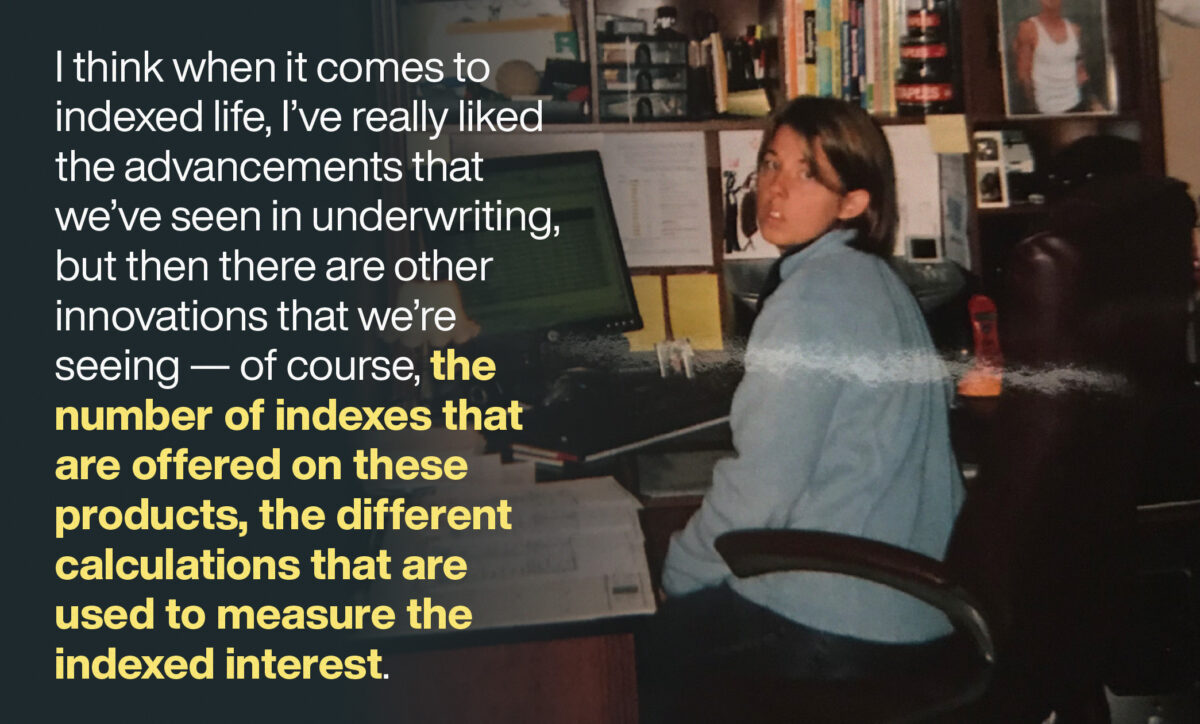
And so it was an opportunity for insurance salespeople to get their clients maybe a little bit better deal with current rates. Some of my favorite innovations that I’m seeing lately would be guaranteeing rates for the entire surrender charge period on indexed annuities. That has become really huge. I think when it comes to indexed life, I’ve really liked the advancements that we’ve seen in underwriting, but then there are other innovations that we’re seeing — of course, the number of indexes that are offered on these products, the different calculations that are used to measure the indexed interest. Those things continue to be a theme within innovation in the life and annuity space when it comes to indexed products.
Feldman: It’s getting hard for an advisor to pick which product to choose these days, isn’t it?
Moore: It’s even harder just because we have some indexed products that have 60-plus different options on them. In my opinion, it’s become a little overwhelming just because there are too many choices. I liken it to going to eat at The Cheesecake Factory, but it has made the story a little bit more complicated when it comes to these products.
Feldman: How do we make it simpler for agents? What could carriers do differently? As an industry, how can we simplify?
Moore: I know you’ve heard of KISS. “Keep it simple, silly” is my take on that. I think limiting the number of index options is a good move. But the main thing to keep in mind is that although the typical insurance agent may be contracted with 18 different insurance companies, they sell precisely three different indexed annuities, and that’s just on the annuity side. So, keep that in mind and the fact that insurance agents are resistant to change — they really don’t like having to check the agent extranet to see where rates are at versus the last time they made a sale. Those kinds of things could really be beneficial to carriers as they’re looking at their product development.
Feldman: One of my advisor friends who writes a lot of annuities always seems to gravitate toward the same product, the same index. I guess it keeps his follow-through and his presentation easy. What would you tell somebody like that? I always think he’s missing out on opportunities for his clients.
Moore: That’s one way to look at it, but I think what it comes down to is that the advisor needs to feel comfortable talking about this product with their client. If the advisor doesn’t understand a feature, they’re not going to feel confident going into that meeting and they may not explain it appropriately to their client. The best advice that I can give insurance agents is that they need to go with something that they feel comfortable with so they can exude that confidence in meeting with the client.
Feldman: As far as product innovations, what do you see happening with life insurance?
Moore: We’re still seeing a lot of focus on what I call hybrid indexes. Some people call them bespoke indexes or engineered indexes. We’re seeing a lot of that in the indexed life space, and there are typically nonguaranteed bonuses that are illustrating better rates on those hybrid indexes. We are seeing some innovations in underwriting, and that’s exciting. And then we’re seeing some new riders here and there. As a matter of fact, there was a new long-term care indexed life product that was launched relatively recently. Those are all things that I’ve had my eye on with indexed universal life.
Feldman: I think we need more long-term care riders on these policies. It seems like a missing link in everybody’s portfolio.
Moore: I have to agree with you, and I’m now part of the sandwich generation where I’m caring for my father who’s confined to a nursing home and did not have long-term care insurance. I am experiencing firsthand how valuable those benefits would have been had he been prepared.
The statistics on how many people need long-term care are staggering, and this is a missed opportunity for a lot of insurance agents.
Feldman: Let’s talk about annuities. What are you seeing on that side of the market?
Moore: We’ve been seeing a lot of startups get into the annuity industry. Typically, they come into the multiyear guaranteed annuity space with very aggressive rates, and then they like to transition over to the indexed annuity market once they have distribution. One thing that’s interesting is we’re seeing some blue ocean strategies in terms of product with those firms.
The development of a MYGIA (multiyear guaranteed indexed annuity) was something that came from a startup, and is kind of a combo of a multiyear guaranteed annuity and an indexed annuity. I saw a really great feature called the best entry option, where the index measurement is based on the lowest point in the market over, say, the first 90 days of the contract. That way, if the market goes down, you have a greater opportunity to participate in a larger growth in the index. That was pretty exciting.
These firms are really thinking outside the box and trying to offer some kind of new, shiny bright object to get insurance agents’ attention.
Feldman: What are your thoughts on illustrations? How can we do better?
Moore: The biggest thing I’m seeing is presenting unreasonable illustrations. I don’t put the onus on the insurance agent alone for that. The insurance company is the one developing the illustration software that’s showing the double-digit linear returns. I have to show a little grace on the annuity side because there is very much a mentality in this business that if it’s on the company’s letterhead or their paper, then I can have confidence in it as an insurance agent.
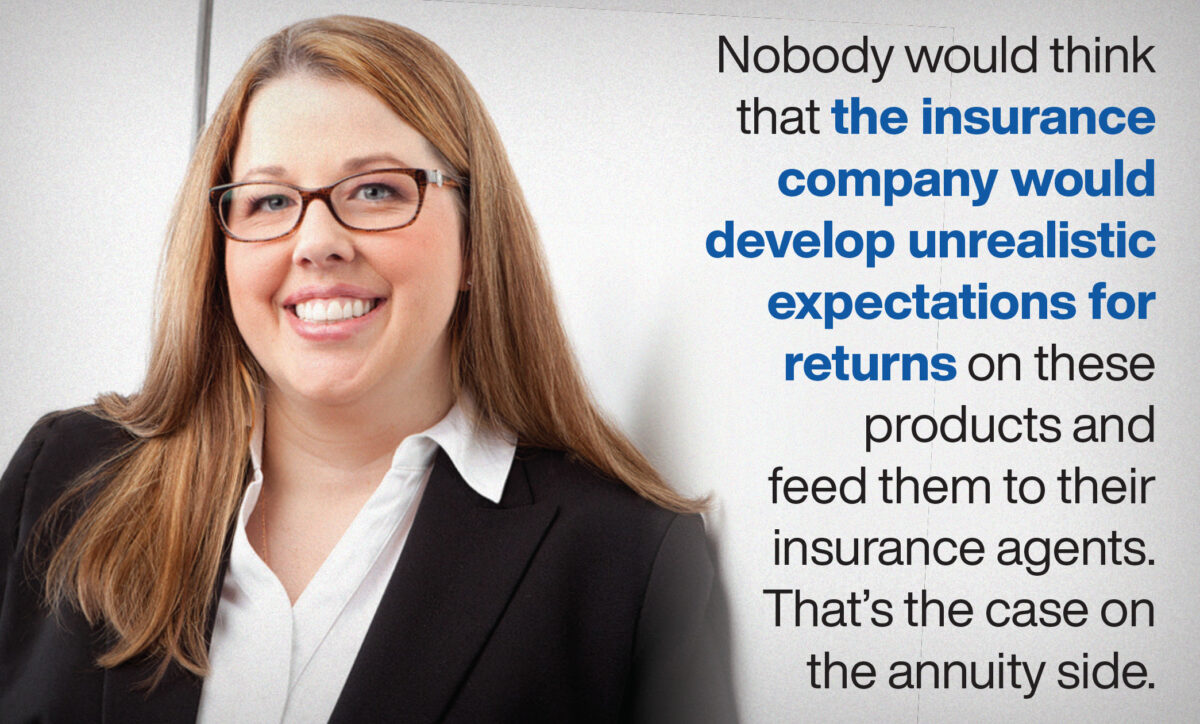
Nobody would think that the insurance company would develop unrealistic expectations for returns on these products and feed them to their insurance agents. That’s the case on the annuity side. But on indexed life, I am seeing so many problematic issues with illustrations. The same issue we just discussed with indexed annuities is definitely going on with indexed life as well. I am seeing a ton of mismarketing of these products, and I don’t want to corner any one distribution channel as being responsible for that. But there are a lot of marketing groups that train their insurance agents to sell but not to understand the products that they’re proposing to their clients. The end result is that there is a lot of mismarketing of indexed life. And if you’ve ever gone on TikTok and typed in indexed universal life, you can get a good flavor for what’s going on.
I lobbied the National Association of Insurance Commissioners about indexed life illustrated rates for 15 years before any action was taken. I’m not satisfied with the state of illustrations for any products right now, not just indexed life. I absolutely believe the NAIC has to reopen the illustration regulation because the illustration model regulation did not exist at the time that — well, indexed life didn’t exist — at the time the model reg was developed. And so it doesn’t take those products into consideration. What we’ve seen is NAIC putting a bandage on the situation with AG 49, AG 49-A, AG 49-B.
It’s gotten to the point where I’m not a fan of illustrations at all. I don’t think that products should be illustrated with loans just because of the way the mismarketing has really kind of bastardized these products. I think that reopening the model reg is really the only way we’re going to get meaningful change. And it is political. I mean it’s very political, so I’m not holding my breath on that happening. But I think that’s where we need to go to put some true solution into the outrageous illustrations that we see on indexed life.
And it’s not much better on the indexed annuity side.
Feldman: Well, let’s talk a little bit more about that.
Moore: What’s interesting is that at the beginning of last year, I believe, the NAIC was exploring if they should allow indexes like those engineered indexes to be illustrated if they were less than 10 or 20 years old. That’s because, right now, there’s a lot of backcasting where the insurance companies are saying, “Although this index didn’t exist 10 years ago, here’s how we think it might have performed had it existed.” And truthfully, in my opinion, you’re saying, “Here are some made-up numbers. I hope they induce a sale.” I was encouraged to see the NAIC going that route. At the time, just about 85% of indexes had not existed for 10 years, even a greater percentage for a 20-year backcast just because most of these indexes are developed within a month or so of the product being introduced.
There aren’t a lot of indexes that have that long a history on them. And, quite frankly, the illustrative rates I’m seeing on products right now, especially those hybrid indexes, are often into the double digits, which is so interesting to me because these indexes were not developed to outperform, say, the S&P 500 Index option. They’re developed to provide more-consistent returns. Let’s just say we’re talking about the S&P 500 and you earn 6% in your first year, 0% in year two, 0% in year three. So, your overall return over that three-year period is 6% plus compounding. Well, hybrid indexes were developed to earn 2% year one, 2% year two, 2% year three. So, you still get 6%, but it’s just a more consistent return. Those are just numbers that I’m using to give people an idea, but these indexes are not performing better than the S&P 500, and they weren’t meant to.
Feldman: What are your thoughts on hybrid indexes?
Moore: I’m all for innovation. I like it when people have choices when it comes to these products. The chances of finding a product that is just right for you is a lot greater when you have all of this innovation. But I’ve been hearing from a lot of insurance agents that the first round of hybrid indexes has returned a lot of nominal returns or 0% to their customers. And so, a lot of agents have said, “You know what? I’m going to stick with the S&P 500 from now on because my client earned zero when the market was up 25%.” We are seeing kind of a shift away from those indexes, but I’ll say the lure is really strong when you see the illustrations on those indexes, which are often much more advantageous than an S&P 500 option.
Feldman: There’s also the concept out there to “be your own bank.”
Moore: I have to give a certain amount of credence to “be your own bank” just because I’ve used the cash values in my life insurance policies to pay for things that I wanted to get a lower rate on than what I could get at the bank. But I think there are a lot of marketing approaches to indexed life that are problematic.
There’s a lot of premium finance business going on, which shouldn’t be sold, quite honestly, in the scenarios that we’re seeing. And quite frankly, these problems that we’re seeing with indexed annuities and indexed life are resulting in class action lawsuits. That’s something that’s not good for any of us.
Feldman: Everybody thought the Department of Labor’s fiduciary rule proposal was dead, and now it’s popping up again. What are your thoughts on that?
Moore: I’m not a huge fan of the fiduciary rule because I don’t necessarily think it’s an improvement over our current regulatory structure. There are a lot of people who would argue with me on that, but I do think it’s being proposed with the best of intentions by the people who are sponsoring it and lobbying for it. I do think it’s coming, and I honestly don’t think most insurance agents have a problem disclosing their commissions or what they’re paid on the products that they sell. What I’m more concerned about is consumer access to these products and innovation in the market. I just think that there’s a propensity for products to be limited every time we see new regulation in this business. For example, the 10/10 rule — or what someone called 10/10 rather than 70/10 — limited fixed and indexed annuity products to a 10-year surrender charge and often a 10% penalty in year one.
My personal perspective on that is you’re limiting choices by doing that because I’m only 40-something years old and I can’t touch my annuity dollars until I’m 59 and a half because it’s qualified business. So, maybe a 14-year annuity is right for me, but I now don’t have that choice because of the regulation that’s passed. And I think there’s a propensity for things like that to happen anytime you see new regulation in this market. I’m all for people acting in their client’s best interests, and I think there are tons of insurance agents who treat their clients that way today even though we’re not bound by a fiduciary rule, depending on the state that you’re in. I thought under a Trump administration that we wouldn’t be dealing with this, but here we are.
Feldman: With annuities, the industry has continually been fighting the Ken Fishers of the world and other people who don’t understand our products. You’ve been great in that you’ve been calling out reporters and others who have been doing damage to our industry. What can we do better in the industry as a whole and not just rely on you to be our spokesperson?
Moore: I appreciate your recognition. I like to say that I’ve been rebranding annuities for 21 years just because I have been responding to all those negative, inaccurate articles about these products for so long. I forged relationships with 55 different news media outlets and said, “Hey, I do fact-checking on these products. Let me know if you need help. And I can always make you look like a rock star when it comes to your journalism on these products.” But I honestly think the No. 1 thing that has put this business in a positive light from a journalism standpoint is the SECURE Act. That legislation basically paved the way for annuities in 401(k)s, and now that they’re affiliated with 401(k)s, there’s actual legitimacy in the eyes of the journalists. We’re actually seeing positive news on these products when historically it was all negative.
Feldman: You describe yourself as the “chief storyteller” at Wink. What can we do better to tell the story of annuities, and what are some good tips you’d give?
Moore: All the research that I’ve read over the past 26 years says that when you say the word “annuity,” consumers balk and get concerned and say, “I would never buy that.” But when you talk about what an annuity does — provides you a pension that you build yourself, guarantees you a paycheck for life — consumers are really interested when they hear that. I think we all need to do a better job as storytellers in this business to talk about those benefits and really make them comfortable before we say the word ”annuity.” I’m not suggesting we hide the fact that these products are annuities, but I’m saying in your presentation, talk about what they do and get the client comfortable with them before you whip out the “A” word. I think that’s one thing that would make a dramatic change in consumers’ opinions of these products and their willingness to purchase them.
Feldman: How do you think annuity sales will do this year? Do you think we will see a big increase in sales because we’re starting to see a little bit of market volatility?
Moore: What’s interesting is that indexed annuities and structured annuities, what some people would call a registered index-linked annuity, really are very insulated from the market’s performance and low interest rates, so, they tend to do well regardless of what the market’s performance is. I am projecting that we’re going to have record sales of both of those products. MYGA rates have been a little less attractive than they were last year, and so I don’t anticipate records there unless something changes during the fourth quarter, which, if an insurance company hasn’t met their run rate, that’s entirely possible. But I am very optimistic about what the sales of the products look like in the rest of 2025.
Feldman: Let’s talk about RILAs. You’ve told me previously you think that RILAs could be the future of products in this industry.
Moore: As much as I love indexed annuities because I have a personal experience with them, and, honestly, at this stage in life, I have a personal experience with just about all products, I think that RILA sales will eclipse indexed annuity sales before we know it. The products have become very popular. There are a lot of insurance agents who sell indexed annuities who have now tried the RILAs and are like, “Gosh, it’s really hard for me to go back to talking about an indexed annuity with a 9% cap when I can present this product to my client with a 20% cap if they’re just willing to accept a little bit of downside exposure.” And certainly there are agents who sold variable annuities, which have now transitioned to the RILA. So, I mean, I am projecting record sales of structured annuities and RILAs unlike anything we’ve seen. And that will continue to be consistent until honestly, it is going to eclipse indexed annuity sales. They’re very, very popular.



Medicare’s best-kept secret: The licensed agent
Indexed Life & Annuities: Unlocking Opportunity
Advisor News
- Navigating client communication in a digital age
- Can your advisory firm survive without you?
- I started using AI, but what now?
- How to support an entrepreneur client with multiple businesses
- Could a narrower focus help grow your practice?
More Advisor NewsAnnuity News
- Solen Software Group Acquires Cooperative Technologies, Provider of 1035 Exchange and Annuity Replacement Software
- MassMutual Expands Lending Options With New Secured Credit Line
- Corebridge Financial Introduces Progressive Trigger, a First-of-Its-Kind Index Annuity Strategy Designed to Turn Missed Years into Future Opportunity
- Insurer proposes $1.1M deal to resolve CA teachers’ annuity fee lawsuit
- IMOs get frustrated with slow carrier adoption of faster technology
More Annuity NewsHealth/Employee Benefits News
- Health plans task force fight Medicaid fraud
- Recent Findings from Brown University Provides New Insights into Managed Care (Use of Brokers In Medicare Advantage and Standalone Part D Plans): Managed Care
- More than 1,700 Pottawattamie County residents face Medicare plan cancellations
- KENTUCKY CAN CUT HEALTH PREMIUMS WITHOUT SPENDING A DIME
- SpecialtyCare sues Anthem over $2.5 million in unpaid awards
More Health/Employee Benefits NewsLife Insurance News