

Retirement Planning Has to Answer “What Now?”
Retirement planning cannot end with accumulation. The real work is helping clients turn assets into income that can support the retirement life they want.
After more than 30 years in the insurance industry, Drew Farrell has watched retirement planning evolve. As Senior Vice President of Symetra’s Retirement Division and President of Symetra Securities Inc., he believes the industry must give greater urgency to a question that often gets pushed into the future: How will clients turn their savings into retirement income?
“The conversation that we’re having today continues to evolve, but with a sense of urgency,” Farrell said. “It’s a passion, but it’s also why we show up every day to help financial professionals navigate clients through their earning years. Then comes the question that has been looming all along: What now?”
For Farrell, the gap is not an opportunity to introduce another retirement solution. It is an education gap. Accumulation remains essential, but clients must understand how those assets will generate income and address retirement’s uncertainties.
The Number Is Only the Beginning
Accumulation offers a measurable objective. Clients can increase contributions, monitor balances, and track progress toward a target. Income planning asks different questions: How much income will be needed? How long must it last? How could changing conditions affect the answer?
“Accumulation planning feels more certain because it is linear: save as much as possible and work toward a number,” Farrell said. “The particulars of the income that number must produce often get pushed to later.”
But reaching that target does not answer the most important question once the paycheck stops.
“Retirement income is about cash flow, not simply the total value of an account or the size of the savings bucket,” Farrell said. “For most people, a portfolio balance alone cannot tell them how long their money will last.”
Farrell believes income planning should be part of the conversation well before retirement.
“Retirement income should be part of every financial conversation a financial professional has with a client,” he said.
That does not mean clients or advisors are ignoring retirement. Families, education, housing and everyday expenses naturally command attention during the accumulation years.
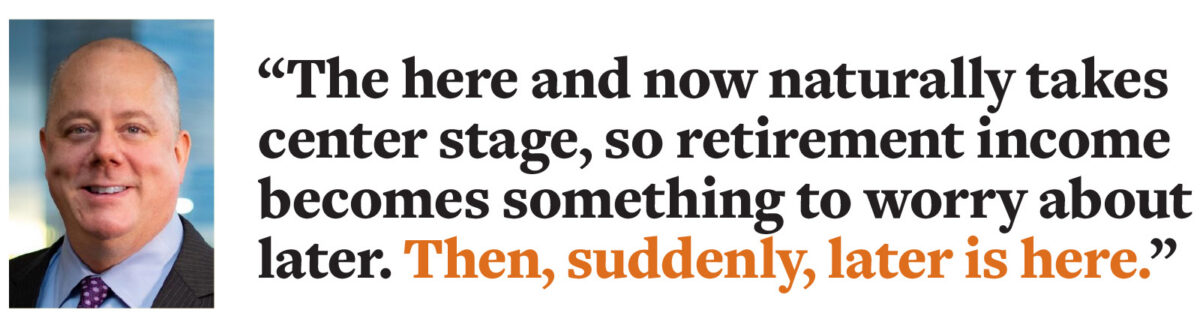
“It’s not that consumers and financial professionals are procrastinating,” Farrell said. “The here and now naturally takes center stage, so retirement income becomes something to worry about later. Then, suddenly, later is here.”
Make Income Planning an Ongoing Conversation
By retirement, many earlier assumptions may have changed. Retirement dates move, families change, healthcare needs evolve, and lifestyle priorities shift, while markets, inflation and interest rates add uncertainty.
For Farrell, that makes income planning an ongoing discipline rather than a one-time calculation.
“People’s lifestyles evolve, and so do the goals,” he said. “Income planning has to evolve with them.”
Four risks, in particular, deserve attention: inflation, interest rates, sequence of returns, and longevity.
“These are the factors that can change,” Farrell said. “They are not disclaimers. They are realities of retirement planning.”
Longevity may be the most fundamental uncertainty. Clients may know when they hope to retire, but they cannot know exactly how long their income will be needed.
“People do not like talking about mortality, but longevity does not have to be a morbid conversation,” Farrell said. “It has to be a real one, because clients cannot know how long their retirement income will need to last.”

Start With the End in Mind
Farrell’s approach is straightforward: define what retirement income needs to accomplish, then work backward.
“Let’s start with the end in mind and work our way backwards,” he said.
That means defining the retirement itself before determining how the portfolio should support it. What expenses are essential? What income needs to be dependable? What does the client want retirement to look like beyond the basics?
“This is where art and science collide,” Farrell said. “The numbers show what may be possible, but an in-depth discussion between a client and financial professional shapes what retirement should actually look like.”
Once essential spending is established, the conversation can move to discretionary goals such as travel, hobbies and experiences.
“That picture is different for everybody,” Farrell said.
Starting with those priorities connects accumulation to the life the client wants. Saving becomes less about reaching the largest possible balance and more about building the resources and income strategy needed to fund a specific retirement.
The Risks Change When Saving Becomes Spending
The shift from accumulation to income changes retirement risk. During the accumulation years, clients generally have time to continue contributing through market declines. Once withdrawals begin, the sequence of returns can become much more consequential.
“Sequence of returns risk can permanently impact the income, particularly the early income of retirement,” Farrell said. “It’s something that probably has the greatest amount of control in terms of how people arrive at retirement income.”
The issue is not simply how much a portfolio earns. It is how assets are converted into income.
“How and when you withdraw can be as important as the returns themselves,” Farrell said.
Inflation and interest rates add uncertainty that cannot be controlled, while longevity can extend the period over which assets must support a client. Those risks reinforce the importance of considering income solutions as part of the overall strategy.
“A portfolio setting can include lifetime and guaranteed lifetime income, with an emphasis on guarantee, that can provide a level of stability that market-based assets alone can’t deliver,” he said.
For clients, that can create a foundation for essential expenses while the broader portfolio supports other retirement goals. The objective is not to eliminate uncertainty, but to create enough certainty to give clients a plan for the retirement they envision.
Partnering for Better Retirement Conversations
If income planning is ongoing, financial professionals need more than a solution to recommend at a single point in the client’s journey. They need resources to continue the conversation as circumstances change.
That is an important part of how Farrell describes Symetra’s role. Its support extends beyond retirement solutions to thought leadership, practice management and behavioral finance.
“It’s not just about the solutions we offer,” Farrell said. “Our thought leadership, practice management and behavioral finance resources help financial professionals have difficult conversations with clients as needs and market conditions change.”
“We continually look for ways to close gaps in retirement income planning and equip financial professionals to lead these conversations and educate clients along the way,” he added.
Make the Conversation Matter From Day One
For Farrell, the answer to “what now?” begins with a change in the conversation. Retirement income should help shape the strategy from the beginning.
When asked what he most wanted financial professionals to take away, Farrell returned to education and guaranteed lifetime income.
“Guaranteed lifetime income is paramount in any financial plan. And it starts in the first profile that you have with a client.”
The conversation should remain alive throughout the relationship. And financial professionals do not have to navigate it alone.
“Look to partners and thought leaders like Symetra to help along the way,” Farrell said. “We do a lot of work to help you as a financial professional and your clients realize financial freedom. There’s a lot that goes into it. We want to be your partner of choice.”
Retirement planning may begin with a number. But the more important question is what that money must do and whether the strategy can turn savings into income that supports the retirement a client has spent a lifetime preparing for.
Learn how Symetra can help you start stronger retirement income conversations with clients. Click here to explore retirement income resources for financial professionals.


Preparing clients for retirement’s variables
What if the Best Retirement Strategy isn’t About Avoiding Risk?
Advisor News
- Majority of Americans concerned recent market highs are unsustainable
- GLP-1 users choose between medication and retirement saving
- Gen X and millennials seek new retirement model
- Are families ready for the costs of aging at home?
- When a client moves, their insurance plan needs to move, too
More Advisor NewsAnnuity News
- A client remarried: Does their annuity still fit?
- Gen X and millennials seek new retirement model
- Global Atlantic names Dan Farrelly head of IMO and IBD channels
- A rising retirement challenge: The license to spend
- What lower interest rates mean to annuity payouts
More Annuity NewsHealth/Employee Benefits News
Life Insurance News