

DC plan sponsors see opportunity in alternatives
Livonia, Mich. —Alternative investments—historically the domain of high-net-worth and institutional investors—are quickly garnering attention in the defined contribution (DC) retirement plan market. New research from Escalent shows 44% of DC plan sponsors are interested in learning more about incorporating alternatives into their 401(k) lineups. Large ($100M-<$500M) and Mega ($500M+) plans voiced the highest levels of enthusiasm, at 62% and 50%, respectively.
These are among the latest findings from 2026 Retirement Planscape®, a Cogent Syndicated report from Escalent. This annual study surveys over 1,000 401(k) plan sponsors to uncover the most important trends in the retirement plan market. It also benchmarks the leading DC plan providers and DC investment managers on key brand equity and experience metrics to help firms grow market share and strengthen plan sponsor loyalty.
“New regulations from the US Department of Labor have given alternatives a major boost,” said Sonia Davis, lead report author and senior product director in Escalent’s Cogent Syndicated division. “Plan sponsors now have greater flexibility in deciding which asset classes are advantageous to their plans, and that’s led to an influx of interest in alternatives. The industry is still in the early exploratory phases with most sponsors mulling which types of alternative investment options could fit best within their lineups. As such, recordkeepers and DC investment managers will need to lean heavily into education to translate sponsor curiosity into smart adoption.”
Among DC plan sponsors who are seeking to learn more about alternatives, hedge funds generated the most interest (75%, up from 62% in 2025). Plan sponsors also proved receptive to private credit (75%), private equity (75%), private infrastructure (73%) and venture capital (72%). Private real estate ranked lowest among the eight categories of alternative investments included in the study, yet still drew a healthy level of interest at 61%.
When asked about their motivations for offering alternatives on their respective lineups, sponsors cited lower fees (35%) and diversification/managing downside risk (33%) as the top two factors overall. However, when broken down by plan type, motivations varied significantly. The leading motivator for Mid ($20-<$100M) plans was inflation hedge/inflation protection, at 40%, a sentiment that is cited significantly higher than Small ($5–<$20M) plans at 16%. Among Large plans, increasing diversification/ managing downside risk was the top catalyst, while Mega plans placed the greatest emphasis on increased liquidity.
Interestingly, sponsors ranked high fees and expenses as the biggest barrier to incorporating alternatives into DC lineups, highlighting an apparent contradiction in overall understanding, given that lower fees were sponsors’ top motivator for offering them. This suggests a need for more education on the asset class, including how alternatives are priced, which offerings are most appropriate for DC plan participants and clear guidance on how they can be integrated on 401(k) lineups.

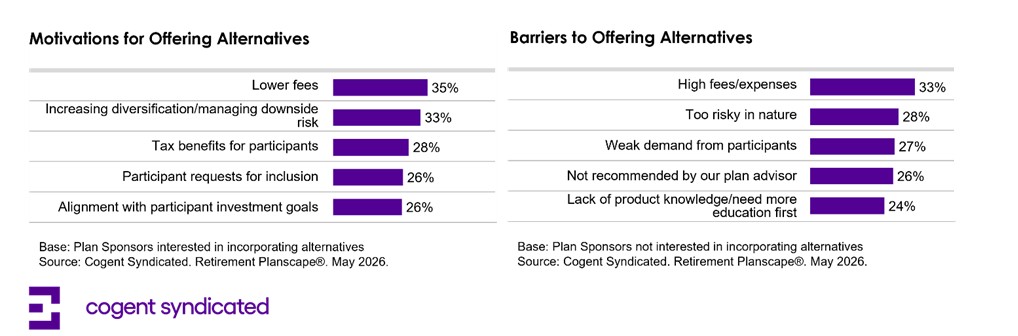
A broader look across Escalent’s full suite of research among DC stakeholders reveals some key disconnects in the overall market. Among those not interested in incorporating alternatives, nearly half of Large plans (49%) flag weak participant demand as a key obstacle. However, in a recent whitepaper, Alternatives in the DC Market, Cogent Syndicated found younger plan participant cohorts at the helm of demand, with interest highest for real estate investment trusts, liquid alternatives, private equity and venture capital. In fact, more than 40% of Millennials cited being extremely interested in each of the eight types of alternative investment vehicles included in the study.
“Alternative investment managers have reason for optimism given the level of interest among both DC plan sponsors and participants,” said Linda York, a senior vice president in Escalent’s Cogent Syndicated division. “However, asset managers must address plan sponsor concerns around risk, fiduciary responsibility and product knowledge in order for alternatives to be integrated in a thoughtful, prudent manner and broader adoption.”
For more information about Escalent’s Retirement Planscape report, visit escalent.co.
About Retirement Planscape™
Cogent Syndicated, a division of Escalent, conducted an online survey of a representative cross section of 1,008 401(k) plan sponsors from February 18 to March 17, 2026. Survey participants were required to have shared or sole responsibility for plan design, administration or selection and evaluation of plan providers, or for evaluating and/or selecting investment managers/investment options for 401(k) plans. In determining the sampling frame for this study, Cogent relied upon recent Form 5500 filings as maintained by ALM’s Judy Diamond Associates. To ensure the population for this research is representative of the universe of 401(k) plan sponsors, quotas were set during the data collection phase around key firmographic variables including total plan assets, number of plan participants, industry and geography. Minimal weighting was applied to adjust for purposeful deviations from the actual marketplace distribution. The data have a margin of error of ±3.09% at the 95% confidence level. Escalent will supply the exact wording of any survey question upon request.


REP. ANGIE CRAIG INTRODUCES LEGISLATION TO CREATE A PUBLIC OPTION, LOWER HEALTH INSURANCE COSTS FOR MINNESOTANS
New law provides clarity for firefighters’ health insurance
Annuity News
- Symetra and TIAA Announce Launch of Mariner Re
- Jackson Launches Suite of Fixed Index Annuities Focused on Accumulation
- Farm Bureau P&C insurers post first underwriting gain since 2021
- Legacy Marketing, Malibu Life launch two fixed indexed annuities
- Changing client priorities are reshaping annuity conversations
More Annuity NewsHealth/Employee Benefits News
- Shopping for ACA plan this year? Here’s what you need to know
- 10 things to know about open enrollment for 2027
- WITH FEDERAL MEDICAID CHANGES, BROWN STUDENTS AIM TO HELP PEOPLE STAY COVERED ON HEALTH INSURANCE
- HEALTH COVERAGE CONSUMERS SHOULD BE WARY OF SUBPAR PRODUCTS
- Study: Colorado's Medicaid covers more services than private insurance
More Health/Employee Benefits NewsLife Insurance News
Property and Casualty News
- Total Loss Auto Claims Weigh on Insurance Customer Satisfaction
- District 48 candidates Brian Hardin, Jessica Landers weigh in on taxes, spending and representation
- The Hartford Reports Strong Third Quarter 2026 Financial Results
- EMC Insurance Receives Insurity’s Excellence in Operational Efficiency Award
- USAA lowers auto insurance rates for nearly 500,000 Floridians
More Property and Casualty News