

Report: Many Americans paying up to 45% of annual income on auto loans

When it comes to automobile loans, many Americans are drowning in debt. Today, Americans carry nearly $1.7 trillion in auto loan debt—over $13,800 per household—and that figure continues to rise.
At the same time, interest rates are going up and vehicle prices have surged significantly due to inflation.
Experian, a credit reporting company, reports that in the first quarter of 2026, the overall average auto loan interest rate was 6.39% for new vehicles and 11.43% for used. The auto loan interest rate, however, is based on several factors — including income, credit history and credit score. A credit score is one of the biggest factors in determining the rate because lenders use it to gauge how likely consumers are to repay the loan.
These combined pressures have led some people to take on more debt than they can realistically afford to have transportation. WalletHub recently compared the median auto-loan debt to residents’ income across all 50 states and the District of Columbia, identifying where borrowers are stretching their finances the most.
The top three states for auto loan debt
The top three states where Americans carry the highest auto loan debt as a percentage of their income are Mississippi (45%), New Mexico (44%), and Arkansas (43%). On the other end of the spectrum, those in the District of Columbia, Massachusetts and New Jersey have much lower car loan debt relative to their income.
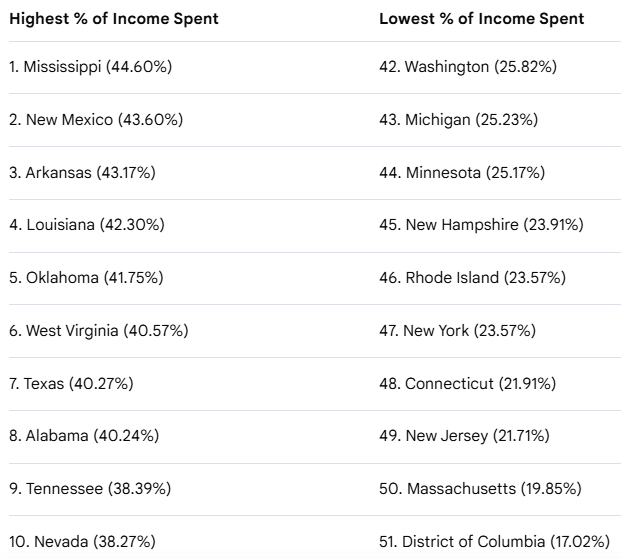

States with the highest average auto loan debt relative to median income are also among those with the highest auto loan delinquency rates.
Mississippi is the state where people overspend the most on vehicles. In this state, the average auto loan debt is $21,635, which is high considering the median household income in Mississippi is $48,509 per year.
By contrast, in the District of Columbia, the median auto loan debt is $17,711, while the median household income is $104,048, so consumers there are spending just over 17% of their income on auto loans.
What consumers can do
“When you become over-extended, you have to make choices on which payments to prioritize (for example, paying the mortgage versus making a car payment),” said Chip Lupo, WalletHub writer and analyst. “If you’re paying just the minimum or making late payments, there are increased costs for that.”
Lupo noted that when you have bad credit, you need to buy a less expensive vehicle, which can sometimes lead to costly repairs. In addition, fuel prices are rising in many states, which adds to the overall expense.
Researching auto ratings and reliability is always a good idea, Lupo said. In addition, making as large a down payment (ideally 20%) as you can helps because you’re paying off less debt. He suggested taking on a second job or a side hustle and dedicating the money you earn toward paying down your payments. Look at a shorter period of time to pay off your auto loan.
“Don’t fall for 0% financing. At the end of the time period, the interest will pile up,” Lupo said. “Always make at least the minimum payment and more if you can.”
The key to managing your personal finances is to make sure you have a responsible budget that includes an emergency fund in case things like unexpected car repairs are needed, he added.
In addition, at-risk Americans can improve their credit scores by paying bills on time and paying more than the minimum if possible, Lupo explained.
Between 20% and 30% of income is a good target for how much Americans should be spending toward an auto loan, he said.
© Entire contents copyright 2026 by InsuranceNewsNet.com Inc. All rights reserved. No part of this article may be reprinted without the expressed written consent from InsuranceNewsNet.com.



Why annuities are gaining traction with younger investors
CareFirst accuses Maryland insurance brokers of overseeing $50M fraud
Advisor News
- Flourish brings private-bank-like cash solution to MassMutual’s network
- Majority of Americans concerned recent market highs are unsustainable
- GLP-1 users choose between medication and retirement saving
- Gen X and millennials seek new retirement model
- Are families ready for the costs of aging at home?
More Advisor NewsAnnuity News
- New class-action lawsuit targets Delaware Life over annuity disclosures
- A client remarried: Does their annuity still fit?
- Gen X and millennials seek new retirement model
- Global Atlantic names Dan Farrelly head of IMO and IBD channels
- A rising retirement challenge: The license to spend
More Annuity NewsHealth/Employee Benefits News
Life Insurance News