

For Young Adults, The Hardest Part Of Life Insurance Is Getting Started
Many financial planning decisions benefit from early action.
When it comes to saving for the long term, millennials and Generation Z have time on their side. Although we are currently in a period of extreme market volatility, if millennials and Gen Z start investing early, there is the potential for their assets to compound and appreciate over the next 40-plus years.
Early action can be equally beneficial for another important financial decision — purchasing life insurance. Like budgeting, saving for the future and paying off debt, life insurance is an important part of a secure financial plan.
For many young Americans, the hardest part may be getting started. Consideration of term life insurance can become that important first step.
Age and health are the most significant drivers of policy cost and insurability. By purchasing a term life insurance policy at a low price when they are young and generally healthier, millennials and Gen Zers can lock in a level of immediate protection. Then, if the policy allows, which most do, they will be able to convert it to a permanent policy before the term expires — even if their health declines while the policy is in force.
A Missed Opportunity
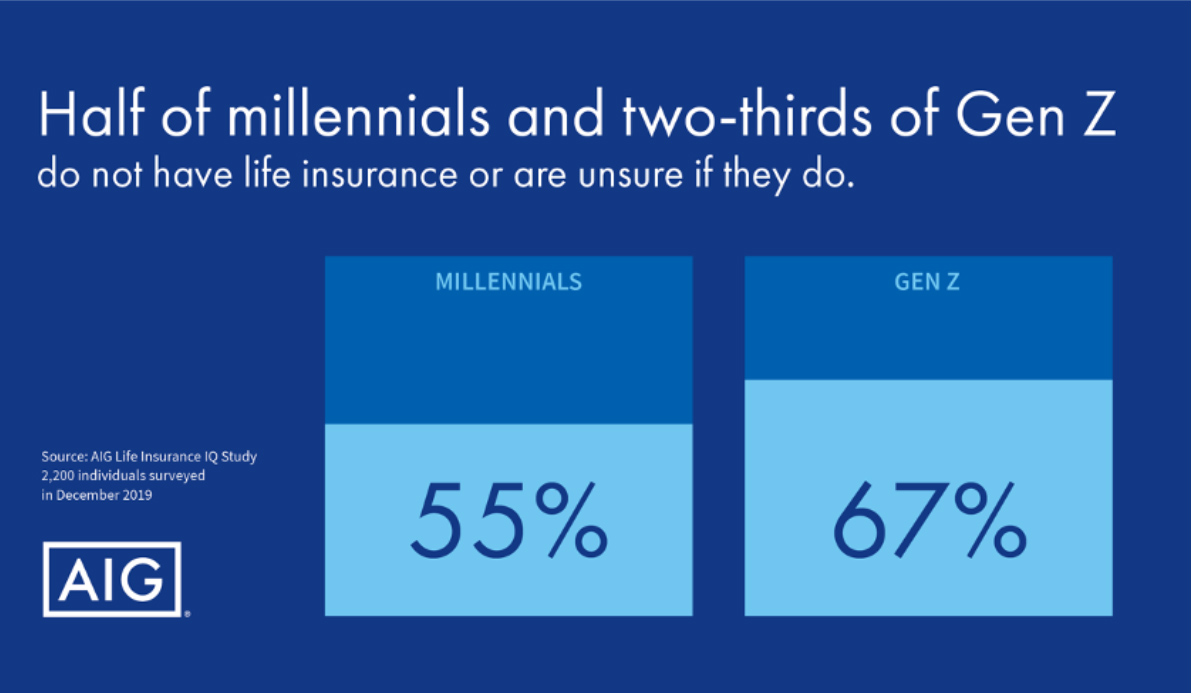
AIG Life & Retirement’s recent Life Insurance IQ Study shows that millennials and Gen Zers strongly believe in the value of life insurance. According to the research, seven in 10 respondents ages 18 through 38 say that life insurance will protect their ability to live a long, financially secure life. Yet half of millennials and two-thirds of Gen Z do not have life insurance or are unsure if they do.

For financial and life insurance professionals, this knowledge gap represents a missed opportunity to help young Americans develop a holistic financial plan that includes protection.
Caring For Others
Protection is clearly something that is important for millennials and Gen Z. Nearly half said they currently have someone who depends financially on their care, including a child (34%), pet (22%), spouse (17%), parent (10%), sibling (7%) or friend (6%). Further, more than half of respondents ages 18 through 38 said leaving money to a loved one after they’re gone is their driving motivation for buying life insurance.
Need For Education
A key barrier to helping young investors get started with term coverage is the knowledge gap associated with all forms of life insurance.
According to the AIG Life Insurance IQ Study, most millennials and Gen Zers do not have a solid understanding of the differences between term and permanent coverage. Nearly two-thirds (65%) indicated they did not know whether the death benefit for term life insurance is set at a fixed amount and does not change. Nearly all term life insurance purchased in the U.S. is level term, where the size of the policy stays at a fixed level for the length of the policy.
That’s one of the many misconceptions that financial and life insurance professionals can help bridge through education. Another is unfamiliarity with the living benefits associated with permanent policies.
Fewer than two in 10 respondents ages 18 through 38 are aware that some forms of life insurance can be used to build a supplemental retirement income stream for themselves (17%), pay for a child’s or grandchild’s education (16%), cover nursing home or at-home health care costs if they experience cognitive or physical decline (13%), or leave money to a charity (5%).
Start With Term, Convert To Perm
For insurance and financial professionals interested in helping millennials and Gen Z build a life insurance portfolio, term coverage can be an affordable starting point, and term is often preferred for temporary, short-term needs.
By educating millennials and Gen Z about the affordability of term coverage today — as well as the living benefits of permanent coverage for down the road — advisors can help young Americans flex “from term to perm,” when budgets allow.
Reasons for converting to permanent insurance over time include:
» Term coverage can typically be converted into permanent coverage without a medical exam or the need to prove insurability.
» The amount of coverage to convert can be flexible — you can often choose to convert all or just part of your term life insurance to permanent insurance.
» Permanent insurance generally has the option to build cash value. A term life insurance policy does not.
» The cash value accumulated within permanent insurance is tax-advantaged, allowing assets to compound and grow while they remain within the policy.
» You can access the cash value of your permanent insurance during your lifetime.
A Call To Action
Fortunately, several of the misconceptions that used to deter 18-through-38-year-olds from recognizing the need for life insurance have faded with the times. Now most millennials and Gen Zers say that life insurance isn’t only for breadwinners, married couples or parents of youngsters.
Eighty-six percent believe that stay-at-home parents can benefit from life insurance, and 81% believe that the primary earner shouldn’t be the only household member with coverage. Ninety-two percent say that parents still may need life insurance after their kids turn 18, and nearly seven in 10 (69%) believe singles may benefit from life insurance.
The challenge for insurance and financial professionals, then, is to break down the barriers that stand between young Americans and the protection they value. Because of its affordability, term insurance can be an important way for millennials and Gen Z to lock in future insurability and to begin the process of building a holistic financial plan that includes protection and security.


COVID-19 Magnifies The Retirement Income Crisis
After A Year Of Reacting, NAIC Looks To 2021 Reset Of Focus
Advisor News
- Your client’s $3 million portfolio doesn’t tell you their insurance needs
- How life insurance can provide liquidity for wealthy families
- Retirement providers turn to digital engagement to retain assets
- Looking out for clients with diminished mental capacity
- House panel advances CLEAR Forms Act backed by IRI
More Advisor NewsAnnuity News
- AM Best downgrades A-Cap insurers amid financial and regulatory troubles
- Lawsuit claims Delaware Life hid billions in insurer-linked investments
- AM Best to Deliver Presentation at 2026 ACLI Annual Conference
- Global Atlantic Announces Launch of ForeLifetime Income, a New Fixed Index Annuity
- A-Cap strikes back with lawsuit accusing SC regulators of sloppy process, leaking secrets
More Annuity NewsHealth/Employee Benefits News
Life Insurance News