

‘Credit score penalty’ doubling the cost of insurance for some, CFA reports

In all but three states it's often more expensive for homeowners to have poor credit than to live in an area with a high risk of natural disasters.
That’s due to insurers adding a “credit score penalty” to homeowner’s insurance in every state except California, Maryland and Massachusetts. The penalties can devastate families just trying to get by and live out their dream of home ownership, said Michael DeLong, research and advocacy associate for the Consumer Federation of America.
DeLong presented the CFA’s findings on the topic Monday during the National Association of Insurance Commissioners’ fall meeting. The NAIC has made affordability of property insurance a priority during recent meetings.
“It's important to remember that these credit penalties are when every other factor is held constant, and these penalties are expensive and even unaffordable for many people, especially people living paycheck to paycheck,” DeLong said. “A person who's struggling to afford things like groceries or utilities or other expenses, they're probably going to prioritize that over homeowner’s insurance.”
Double the cost
CFA issued a recent study finding that homeowners with low credit scores (FICO scores of 630 or below) typically pay nearly $1,996 more per year for homeowners’ insurance than otherwise identical homeowners with high credit scores (about 820). On average, it added up to almost double the premium cost, a roughly 99% “credit penalty.”
The credit-score penalty varies greatly by state, the CFA found. A typical Pennsylvania homeowner can expect to pay 181% more each year due to having a low credit score compared with someone with a high credit score – all to insure the same kind of house in the same location.

States with the next-highest penalties are Arizona, Oregon, and West Virginia. In 23 states, homeowners are charged a credit penalty of at least 100 percent, meaning they can expect to pay at least double for homeowners insurance just for having a weaker credit score, the CFA found.
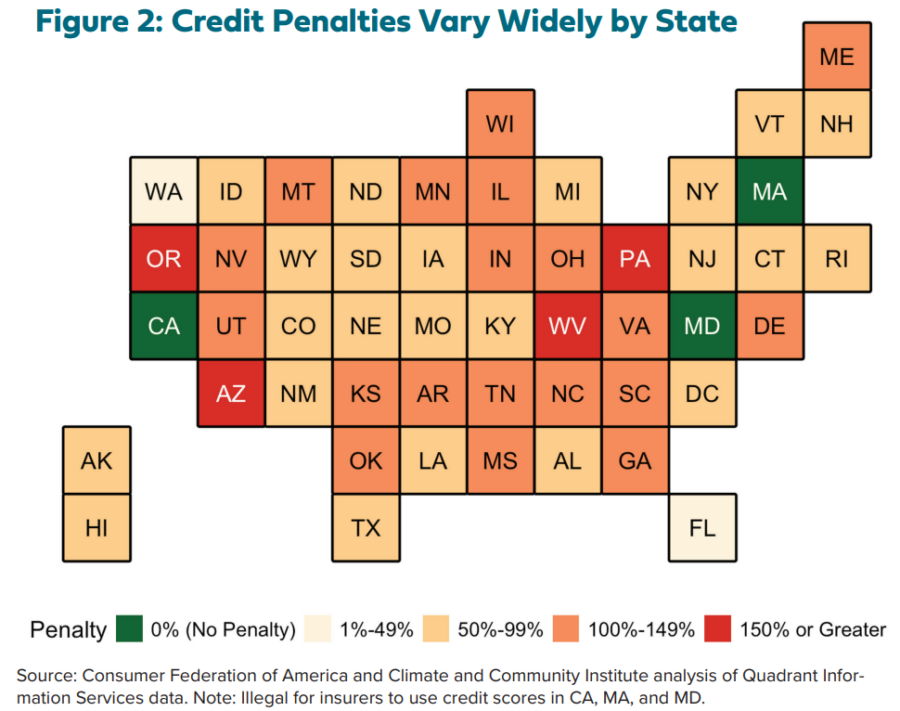
The CFA found that credit score is a greater variable impacting homeowner’s insurance premiums than even living in wildfire, hurricane or flood-prone areas.
“It's more expensive to have a low credit score than to live in an area with a lot of disaster risks,” DeLong said. “[T]hat seems quite unfair. Effectively, homeowners’ insurance with low credit [scores] are subsidizing premiums of homeowners with high credit who live in risky areas.”
The CFA relied on a “national, high-quality dataset” purchased from Quadrant Information Services. The data consist of 608,105 “test quotes” from every ZIP code in the United States from August 2024. The test quotes were generated from insurance rate filings in all states, and the dataset covers approximately 57% of the homeowners’ insurance market, according to the report.
'A lot of questions'
Angela L. Nelson, director of the Missouri Department of Commerce and Insurance, disputed the numbers representing her state. The report cites a low credit penalty of $2,403 in Missouri, while Nelson noted that the average statewide premium in Missouri is only $2,050.
“In my mind, that causes a lot of questions about that rating information and how accurate is,” Nelson said.
In May, a tornado with 150-plus mph winds hit the St. Louis area, a very high minority, low income, economically disadvantaged area, Nelson explained.
“I don't think that a tornado possibly could have hit a worse area in our state in terms of hitting a vulnerable population than where it did,” she added.
One of the most heavily damaged St. Louis ZIP codes, 63107, has a 73% uninsured rate, Nelson said, and the average premium there is $723.16.
DeLong acknowledged that “no report is perfect” and added that the CFA is willing to discuss what they view as a big problem. He encouraged the states to do their own study of credit scores and the impact on the market.
The CFA is making two recommendations to insurance regulators: ban the use of credit scores in calculating homeowners’ insurance rates, and “require insurance companies to file public disclosures that provide greater transparency into their pricing models.”
© Entire contents copyright 2025 by InsuranceNewsNet.com Inc. All rights reserved. No part of this article may be reprinted without the expressed written consent from InsuranceNewsNet.com.


Health plan approved drug lists more complex, challenging consumers
Life insurance and annuities: Reassuring ‘tired’ clients in 2026
Advisor News
- Turning expanded eligibility into a better coverage plan for federal clients
- Election 2026: Which of Berkeley's 7 ballot measures will pass?
- How advisors can help frugal retirees finally enjoy their savings
- Wealth planning vs. estate planning: Honoring your client’s wishes
- What to discuss during the first retirement planning meeting
More Advisor NewsAnnuity News
- Why the market doesn’t need more carriers
- Equitable, Corebridge steam toward merger with strong Q3 annuity sales
- Jackson Announces New Annuity Offering for AARP Members
- National Life Group expands annuity portfolio
- AM Best to Join Life/Annuity Insurance-Focused Panel Discussion at Capitol Forum Event
More Annuity NewsHealth/Employee Benefits News
- NO SURPRISES ACT ARBITRATION 'RUN AMOK' PROVIDER-DRIVEN ABUSE DRIVING UP AMERICANS' HEALTHCARE COSTS
- Hospital ending health plan amid industry's struggles
- Missouri Department of Commerce and Insurance releases health insurances rates for 2027
- Austin workers weigh health coverage as insurance costs are forecast to rise
- My unhappy day in small claims court | Letters to The Republican
More Health/Employee Benefits NewsLife Insurance News
- Why the market doesn’t need more carriers
- Unum Group Reports Third Quarter 2026 Results
- First American Financial Corporation Appoints Darryl D. Button to Board of Directors
- Corebridge Financial Announces Third Quarter 2026 Results
- MassMutual announces record $3.3 billion policyowner dividend for 2027
More Life Insurance News