

Why fewer than half of independent agents see carriers as true partners

Independent agents write most property and casualty insurance business in the United States, yet fewer than half view their carriers as true partners, according to a pair of new studies.
According to the Independent Insurance Agents & Brokers of America's 2026 Market Share Report, the independent agency channel places 62% of all property and casualty insurance written in the United States and 87.7% of commercial-lines premium.
The 2026 U.S. Independent Agent Satisfaction Study from JD Power found that 48% of agent-carrier relationships met its criteria for partner status. The finding comes as other industry research examines what independent agents want from their carrier relationships.
Agents who viewed carriers as partners were 43% more likely to recommend those carriers and 37% more likely to report writing more policies with them than they were 12 months earlier.
"Partnership isn't about who writes the most business or always has the best rates. It's about consistency and proactive communication," said Craig Martin, executive director of global insurance intelligence at JD Power.
What agents want from carriers
JD Power classified a carrier relationship as a partnership when agents said the insurer valued them as an agent, cared about the agency's success and put customers' interests first. Twenty-nine percent of relationships were classified as providers and 18% as vendors.

Among agents who viewed carriers as partners, 76% associated those relationships with trustworthiness and 50% with innovation. Being the lowest-cost carrier was cited by 17%.
In a third study, Corporate Insight found commercial-lines agents ranked underwriting flexibility and appetite first among carrier selection factors, at 39%. Competitive pricing ranked at 26%, while ease of doing business ranked at 35%.
Martin said agents also consider the work required to keep business with a carrier. Higher compensation can be offset when pricing or underwriting changes force an agency to remarket an account.
When carriers change course
Carriers may change underwriting appetite, pricing or renewal strategies as market conditions shift. Agents may understand those decisions, Martin said, but they still have to explain them to clients.
"The agent is ultimately writing the business and is the face of the carrier to the client," he said.
Martin described an Arizona agent interviewed for the JD Power study. A carrier entered the market aggressively, wrote substantial business and then declined to renew about 40% of what it had written the following year.
The agent told JD Power the agency would not do business with the carrier again, even if the insurer remained in the market.
Workflow matters
Other industry research found that 90% of agents had reduced business with a carrier because the process was too difficult. Seventy-four percent identified re-keying as their top workflow pain point.
The research also found 76% of agents said digital submission and policy-servicing experiences matter more than commission. Simple quoting ranked nearly twice as high as commission as a placement driver.
A separate industry survey involving nearly 1,300 independent agency professionals found 78% said ease of communication influences whether a carrier receives more business. Sixty percent cited personal relationships with underwriters and 75% cited claims service.
Commercial lines puts pressure on the relationship
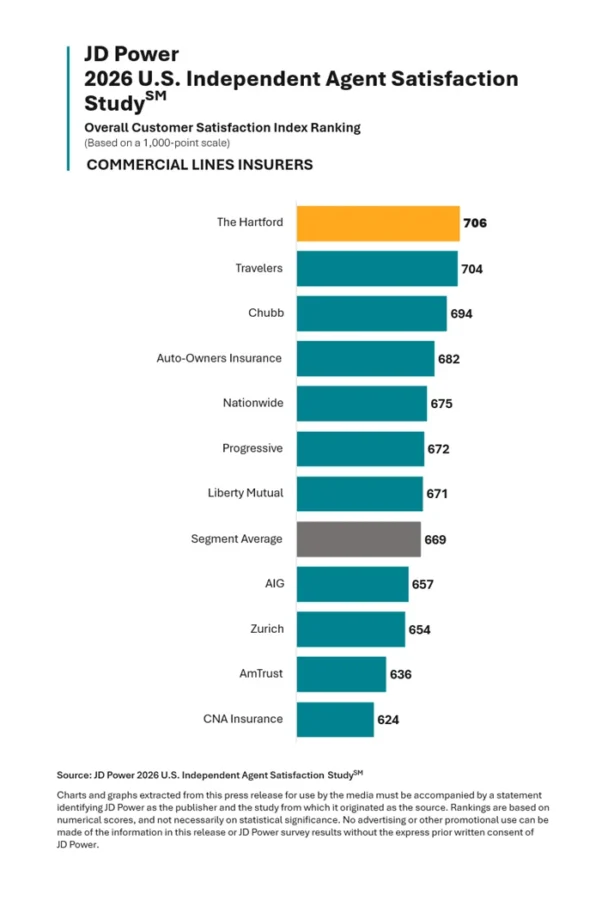
Commercial-lines satisfaction fell 16 points year over year to 669 in the JD Power study, while personal-lines satisfaction increased three points to 667. The commercial decline occurred across all six dimensions measured in the study.
Corporate Insight found 61% of commercial-lines agents spend at least 60% of their day on administrative tasks rather than selling. Claims communications were the most time-consuming administrative task, cited by 58%.
Martin said commercial accounts require more carrier support because of their complexity.
"When a carrier changes appetite or pricing, agents have to go back to clients and explain why rates are increasing, sometimes substantially, and why they should stay with their current carrier," he said.
Appointments do not equal loyalty
A carrier can have a large number of appointed agents without having strong relationships with those agencies, Martin said.
An agent may remain appointed and submit occasional business while placing most growth elsewhere.
"Having many appointed agents isn't necessarily a sign of success," Martin said. "The better question is whether the carrier has the right agents and has aligned its business so it can serve them well and grow together."
The JD Power study found agents who viewed carriers as partners were more likely to recommend those carriers and report writing more business with them.
The study was based on 4,355 evaluations of personal- and commercial-lines insurers conducted between May and July 2026.
© Entire contents copyright 2026 by InsuranceNewsNet.com Inc. All rights reserved. No part of this article may be reprinted without the expressed written consent from InsuranceNewsNet.com.



Blue Cross faces Michigan lawsuit over alleged monopoly and pricing practices
What 70% doesn’t tell you
Advisor News
- U.S. debt hits $40 trillion: how to support concerned clients
- Flourish brings private-bank-like cash solution to MassMutual’s network
- Majority of Americans concerned recent market highs are unsustainable
- GLP-1 users choose between medication and retirement saving
- Gen X and millennials seek new retirement model
More Advisor NewsAnnuity News
- Corebridge Financial Introduces Progressive Trigger, a First-of-Its-Kind Index Annuity Strategy Designed to Turn Missed Years into Future Opportunity
- Insurer proposes $1.1M deal to resolve CA teachers’ annuity fee lawsuit
- IMOs get frustrated with slow carrier adoption of faster technology
- New class-action lawsuit targets Delaware Life over annuity disclosures
- A client remarried: Does their annuity still fit?
More Annuity NewsHealth/Employee Benefits News
Life Insurance News