

The $42B opportunity: Unlocking latent demand for life insurance

Life insurance doesn’t sell itself the way that auto, property and health coverage do. But life insurance remains an important source of long-term financial protection for families and businesses.
Too many prospects fail to buy the coverage they know they need. According to LIMRA and Bain & Company’s 2025 report, “How to Convert Intent to Action: Closing the Life Insurance Coverage Gap,” some 100 million Americans acknowledge they need life insurance, yet only 9.4 million new policies were sold in 2024. The gap between need and action — commonly known as the protection gap — has widened by nine percentage points over the past decade.
I believe we can narrow it, and the opportunity is significant.
Why prospects wait
Understanding consumer hesitation can help life insurers target, engage and convert the right leads. So why do so many people put off this critical purchase?
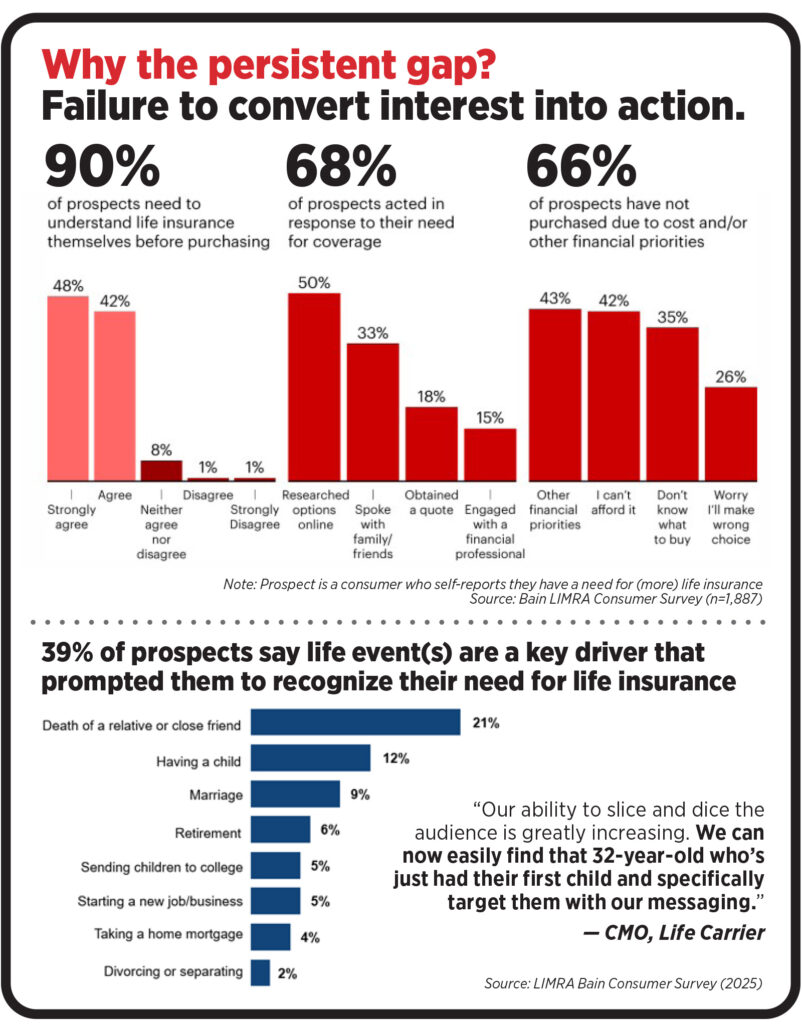
Cost is one reason. The LIMRA and Bain research found that two-thirds of those who say they need life insurance, or need more of it, believe they cannot afford it or have competing financial priorities. Many Americans also overestimate its true cost by six to 10 times.
Complexity is another barrier. Many are unsure what life insurance covers, how much they need or where to begin. Of those who say they need coverage, only 15% have consulted a financial professional.

Yet 86% of those who meet with a life insurance agent buy a policy, according to the same research.
These barriers — misperceived cost, product complexity and limited access to advice — are also data challenges. Without visibility into who needs coverage, when they are receptive to buying and what guidance they require, insurers struggle to address them at scale.
Connecting advisors to prospects: The upside
The most efficient way to connect prospects with agents is through predictive tools and data that show which obstacle is likely to hold someone back. Carriers can then tailor outreach to correct affordability misperceptions, simplify decisions or connect people with advice when they are most likely to act.
LIMRA estimates that converting only 30% of the 100 million Americans who need but have not bought life insurance would boost new policy premium equivalents from $16 billion to $42 billion — a $26 billion opportunity. Better prioritization and timing can produce more conversions while helping more consumers protect their families.
Learn more about your prospects
Lead quality and quantity are critical to improving close rates and policyholders’ lifetime value. Carriers and agencies can strengthen the leads they provide by integrating authoritative market data with existing prospect data, helping agents select, prioritize and time their outreach.
These insights can help carriers match messages to specific barriers such as correcting cost assumptions, simplifying coverage recommendations or prompting advisor outreach when a consumer is most likely to act.
Insurance-specific scores and tools that screen out fraudulent identities can enrich leads with metrics.
Family events: A death, marriage, birth, new job, child entering college or retirement can signal higher intent. LIMRA and Bain found that 39% of prospects cite a major life event as the reason they finally bought life insurance.
New data can identify these events as they occur and help carriers distinguish new prospects from existing policyholders who may be underinsured. Timely outreach can make advisor conversations more relevant and actionable.
Mortality risk: Earlier insight into a consumer’s likely risk profile can help carriers and advisors identify realistic coverage amounts and product paths. Instead of a generic message, an advisor can offer a right-sized recommendation tied to the prospect’s financial responsibilities and likely path to coverage. That can address affordability concerns while supporting sound risk alignment.
Attrition risk: Closing the protection gap also means preventing consumers from becoming underinsured or uninsured. AM Best reported a 5.1% lapse ratio for U.S. individual life insurance in 2023. Historical data can help carriers identify policyholders at higher risk of lapsing or reducing coverage and offer a coverage review before a policy is lost.
Customized ‘net’ yields better catch
Many life producers still sort prospects by broad metrics such as homeownership or presence of children. Richer consumer insights can help insurers identify high-intent segments.
These solutions can enrich and score leads, then share them with agents through automated workflows that track results.
Carriers can tailor outreach around life events, prioritize prospects with higher lifetime value and address the factors most likely to delay purchase. They can also test strategies by segment to learn what is most likely to drive action.
Closing the gap
No one benefits when families remain uninsured and unprotected. Helping more Americans get the coverage they need supports financial security while strengthening long-term customer relationships.
Addressing affordability misperceptions, reducing complexity and connecting consumers with timely advice can turn intent into action.
With better targeting and timing, carriers can reach underinsured populations more effectively and make progress toward closing the protection gap.



Help clients get a head start on their financial resolutions
4 ways to give workplace life insurance a higher profile
Advisor News
- Survey: Most Americans still feel prosperous despite economic worries
- SEC settlement would require Tai Lopez, two others, to pay $6.8 million
- The Gen Z money paradox
- NAIFA applauds final SECURE 2.0 regulations
- What will Democrats in Congress do about healthcare and retirement?
More Advisor NewsAnnuity News
- AM Best Affirms Credit Ratings of Global Atlantic Financial Group Limited and Its Subsidiaries
- Best’s Market Segment Report: AM Best Maintains Stable Outlook on US Life/Annuity Insurance Segment
- AM Best Affirms Credit Ratings of Massachusetts Mutual Life Insurance Company and Its Subsidiaries
- Boomers want retirement protection, but their actions don’t match their mindset
- NAIC task force to address LTC riders
More Annuity NewsHealth/Employee Benefits News
- EXPLORING INSULIN COST-SHARING CAPS FOR PATIENTS WITH PRIVATE COVERAGE
- THE AMERICAN DIABETES ASSOCIATION FIGHTS TO MAINTAIN ACCESS TO HEALTH INSURANCE
- Grand jury accuses veteran of making false disability claims that defrauded VA
- States push short-term insurance as healthcare costs climb
- Study Findings on Managed Care Are Outlined in Reports from Massachusetts General Hospital (A RUC Rescue of Primary Care?): Managed Care
More Health/Employee Benefits NewsLife Insurance News
- FORMER PRINCE GEORGE'S COUNTY INSURANCE AGENT SENTENCED FOR FELONY INSURANCE THEFT SCHEME
- AM Best Affirms Credit Ratings of Ameriprise Financial, Inc. and Its Subsidiaries
- AM Best Takes Various Credit Rating Actions on Certain Subsidiaries of Auto-Owners Insurance Group
- AM Best Affirms Credit Ratings of Global Atlantic Financial Group Limited and Its Subsidiaries
- AM Best Downgrades Credit Ratings of CICA Life Insurance Company of America
More Life Insurance News