

The structural rise of structured products

Structured credit has shifted over the past decade from a niche allocation to a core component of fixed-income portfolios for both insurers and mutual fund managers. National Association of Insurance Commissioners Schedule D data and quarterly Securities and Exchange Commission filings point to steady, compounding growth in exposure. This growth is driven by relative-value advantages, risk-based capital efficiency and growing demand for stable, cash-flow-generating assets.
Insurer allocations: From modest to meaningful

For insurers, the shift has been both steady and substantial. Structured product holdings increased from $884 billion in 2014 to $1.44 trillion in 2024, raising their share of total bond portfolios from 22.9% to 26.5%. Growth was led by ABS and “Other Structured” categories, which more than doubled from $261 billion to $700 billion over the period. RMBS and CMBS exposures remained comparatively stable but benefited from the revival of the RMBS 2.0 market and the introduction of new collateral types, such as Non-Qualified Mortgage and Second Liens. Since 2021, insurers have increasingly relied on structured products to enhance yield and capital efficiency amid corporate spread compression and greater capital sensitivity, as we illustrate in Figure 1.

The resulting reallocation has been toward senior, cashflow stable structured deals that provide higher spread per unit of capital charge – a critical metric for insurers seeking to meet liabilities efficiently, particularly with multiyear guaranteed annuities.
Mutual funds: Active managers embrace structured
In parallel, the 10 largest active fixed-income funds, representing more than $660 billion in assets under management, have steadily increased their structured product exposure over the last six years, illustrated in Figure 2. On a weighted-average basis, allocations to structured products (agency and non-agency MBS, ABS, CMOs and CLOs) rose from 39.3% in 2019 to 47.9% in 2025, a gain of nearly 9 percentage points. This shift reflects more than $55 billion of reallocation away from traditional areas of the fixed-income market.
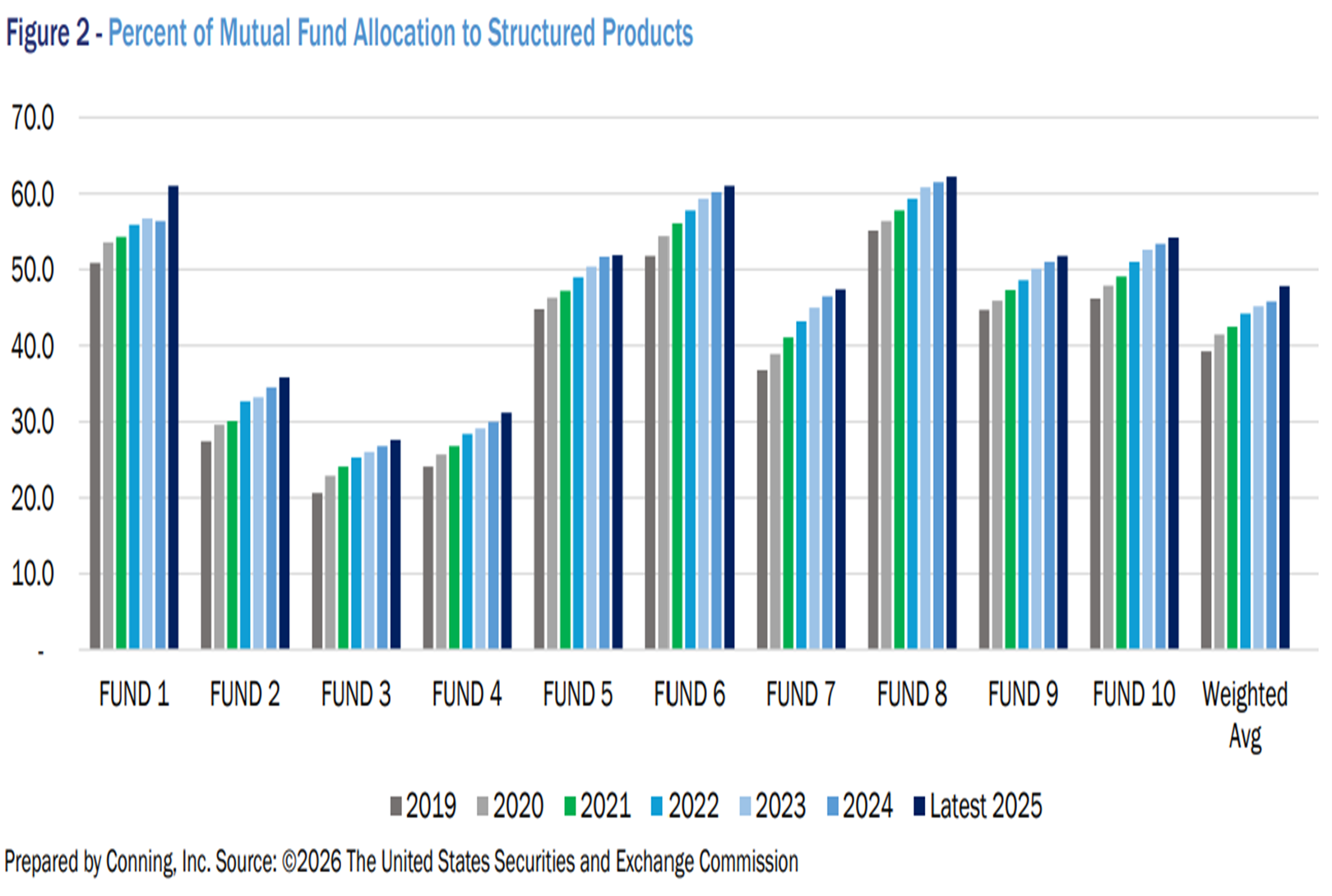

Portfolios once dominated by corporates now commonly allocate more than one-third of their investments to structured sectors. Managers have been drawn to the incremental spread advantage relative to investment-grade corporates of similar duration and quality, as well as the flexibility offered by diverse collateral types across consumer, commercial, equipment and real estate markets. This breadth supports more precise duration and risk positioning.
Demographics and income demand
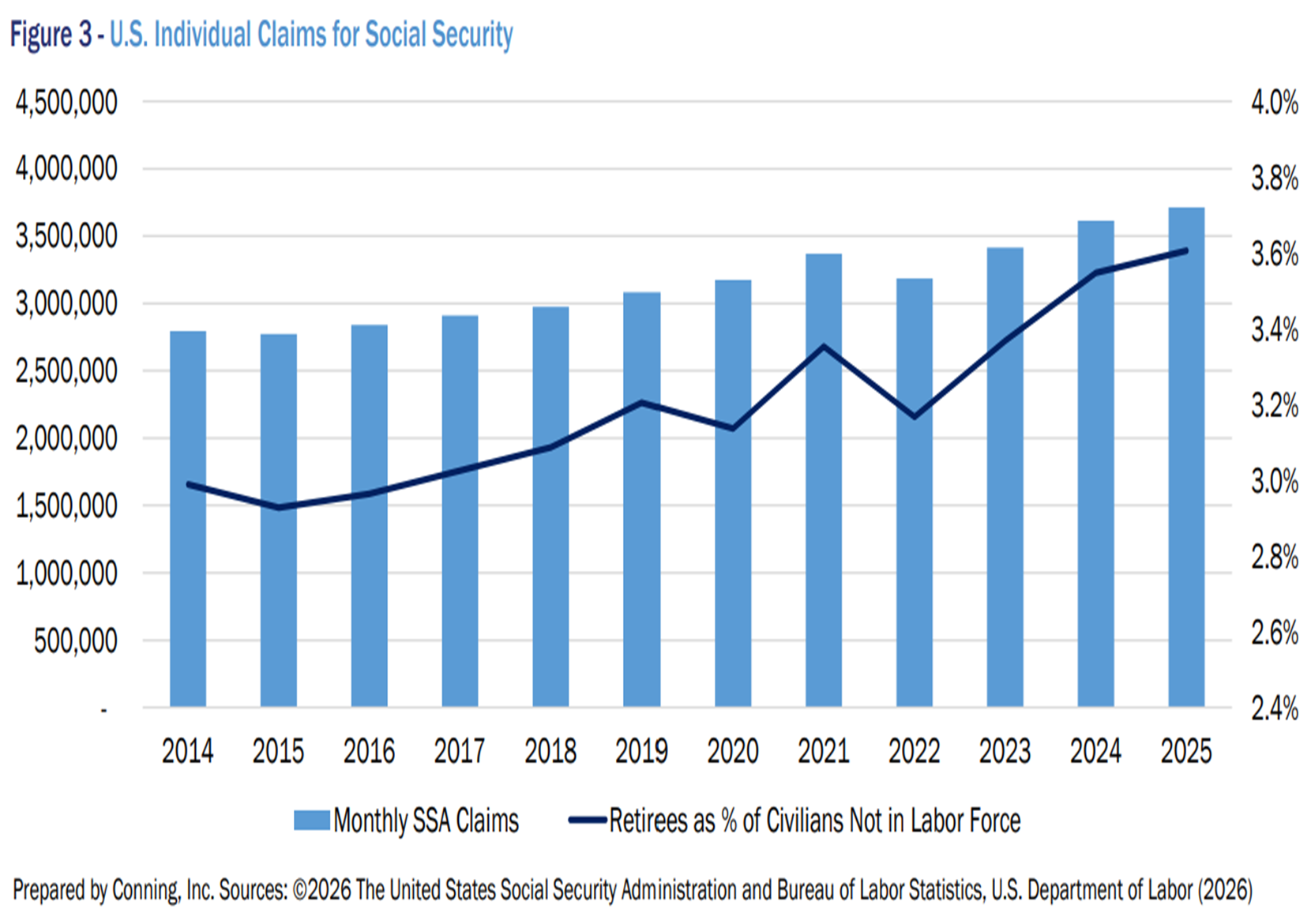
Demographic shifts are reinforcing the move toward income-oriented strategies. Since 2020, the share of retirees in the U.S. non-labor force population has increased from 3% to 3.6% and monthly Social Security claims have risen by nearly one million individuals since 2014, illustrated in Figure 3. As a growing portion of the population transitions to retirement, both money managers and insurers have seen increased inflows into fixed income funds and MYGA products, reflecting stronger demand for predictable, cash-flow producing assets.
Structured credit, particularly senior tranches of Esoteric ABS, RMBS, CMBS and CLOs, have emerged as an attractive alternative to traditional fixed income sectors for generating higher income and yields to offset liabilities. These sectors offer:
- Predictable amortization schedules that align well with liability-driven portfolios.
- High levels of credit enhancement and historically low default rates, particularly in seasoned collateral pools.
- Compelling relative value compared to investment-grade corporates of similar duration and quality.
In this environment, both insurers and mutual fund complexes are increasingly converging toward the same solution: structured products as core portfolio anchors for a generation seeking income and downside resilience.
Viewed across both insurers and mutual funds, structured products are no longer peripheral building blocks; they have become foundational. The sustained rise in allocations over the past decade reflects a deliberate shift in fixed-income portfolio construction rather than a temporary search for relative value. With a growing share of baby boomers entering retirement and increasing demand for stable income solutions, this trend is likely to persist. Structured products now sit at the intersection of income generation and capital efficiency, and they will continue to play a central role for investment managers navigating today’s fixed-income landscape.
© Entire contents copyright 2026 by InsuranceNewsNet.com Inc. All rights reserved. No part of this article may be reprinted without the expressed written consent from InsuranceNewsNet.com.



Invigorating client relationships with AI coaching
Metlife study finds less than half of US workforce holistically healthy
Advisor News
- CT governor’s candidates claims: What’s true, and what’s misleading
- Retaining clients by giving them a memorable experience
- Addressing the longevity paradox
- Employers shift focus from retirement access to financial outcomes
- Helping widowed clients navigate their new financial reality
More Advisor NewsAnnuity News
- Farm Bureau P&C insurers post first underwriting gain since 2021
- Legacy Marketing, Malibu Life launch two fixed indexed annuities
- Changing client priorities are reshaping annuity conversations
- Solen Software acquires annuity software provider Cooperative Technologies
- MassMutual Expands Lending Options With New Secured Credit Line
More Annuity NewsHealth/Employee Benefits News
- Cost of employer-sponsored health insurance plans rises again, nonpartisan survey finds
- Centene sues feds over low ratings for senior health plans
- Terry Savage: Small business owners, now is the time to offer health insurance coverage
- Aldermen select employee medical insurance broker services provider
- Southwest Bridge Health focusing on insurance coverage gap in Berrien County
More Health/Employee Benefits NewsProperty and Casualty News
- FEMA launches option to buy national flood insurance policy online
- Hurricane Isaias causes $582 million in insured damage; state seeks $237 million from FEMA
- How credit score affects your car insurance
- State of health care, part 3
- Sponsored Content: The Spotlight – Fact or Fiction w/ Noble McIntyre
More Property and Casualty News