

Most insurance AI patents come from just 3 U.S. insurers, study finds
Artificial intelligence patenting in insurance is becoming a high-stakes, highly concentrated race dominated by a handful of U.S. property and casualty carriers, even as overall activity remains 30% below its 2020 peak.
Evident, an AI benchmarking and intelligence platform focused on financial services, has released new data from its Insurance AI Patent Tracker, providing a sector-wide view of how insurers are protecting AI innovation.
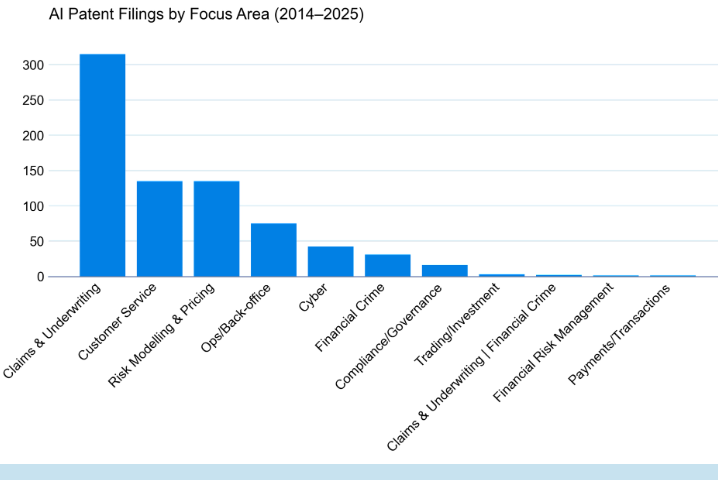
The analysis shows that 166 AI-related patents have been filed by 30 major insurers in North America and Europe since January 2023. Filings are heavily clustered among a small group of U.S. carriers, with State Farm, USAA and Allstate alone accounting for 77% of all AI patents filed by insurers over the past decade. P&C insurers dominate overall, responsible for 89% of AI patents, reflecting their advantage in telematics, IoT-driven risk monitoring, and other sensor-based systems that more easily satisfy patentability standards in the U.S. and Europe.
“Patents offer a rare window into where insurers are placing their biggest bets on AI,” said Alexandra Mousavizadeh, Co-founder and CEO of Evident. “This data shows that innovation is overwhelmingly being driven by a handful of US firms, especially in P&C. While the volume of filings remains modest compared to banking, we’re seeing a sharp uptick in generative and agentic capabilities. The IP landscape is shifting from protecting past systems to enabling future ones.”
GenAI and agents rising
Despite growing interest and investment in generative AI, patent volumes have not returned to their 2020 high. Evident reports that aggregate AI patent activity across insurance is currently about 30% below that peak, suggesting a more selective or strategic approach to filing in the post-2020 period. Within those filings, however, there has been a sharp shift toward generative AI: these patents have climbed from 4% of insurer AI filings to 31% in 2023, with most focused on customer service and claims automation use cases.
Agentic AI—systems that can take autonomous actions on behalf of users—is beginning to appear in the portfolio but remains rare, with only three insurers having filed agentic AI patents to date, led by USAA.

Where insurers are applying AI today
The patent data offers a detailed look at how leading insurers are embedding AI throughout the value chain. Examples highlighted in Evident’s analysis include USAA’s use of generative AI to clarify aerial imagery for property damage assessment, and State Farm’s work on machine learning–based claims triage and autonomous vehicle fault analysis.
Allstate has pursued patents around an in-vehicle AI assistant aimed at automating elements of the claims process and enabling behavior-based discounts, while Swiss Re has focused on predictive analytics for medical data and anomaly detection. Other filings point to MassMutual’s efforts in interpretable underwriting and AI-driven document tagging, Liberty Mutual’s deployment of generative AI for engineering release notes, and Zurich Insurance Group’s systems for transforming user-entered addresses into clean, structured datasets.
Strategic implications
Evident positions this patent landscape as a strategic crossroads for the sector. On one path, AI patents remain the preserve of a small group of frontrunners, particularly in U.S. P&C, who use IP to lock in technical and data advantages around telematics, automation and advanced analytics. On the other, patent filings could become a broader signal of competitive intent as more carriers move from experimentation to production-scale AI.
The data underscores a shift from protecting legacy systems toward securing the next generation of AI capabilities, especially in generative and agentic technologies that touch underwriting, claims, customer interaction and internal operations.
“The insurance sector is at a crossroads,” added Mousavizadeh. “Either patents remain the domain of a few frontrunners, or they become merely a signal of broader competitive intent. As generative and agentic AI reshape the value chain, insurers will need to decide whether to build IP defensively or lead from the front.”



What your homeowners insurance doesn’t cover anymore
Health plan approved drug lists more complex, challenging consumers
Advisor News
- Your client’s $3 million portfolio doesn’t tell you their insurance needs
- How life insurance can provide liquidity for wealthy families
- Retirement providers turn to digital engagement to retain assets
- Looking out for clients with diminished mental capacity
- House panel advances CLEAR Forms Act backed by IRI
More Advisor NewsAnnuity News
- What lower interest rates mean to annuity payouts
- AM Best downgrades A-Cap insurers amid financial and regulatory troubles
- Lawsuit claims Delaware Life hid billions in insurer-linked investments
- AM Best to Deliver Presentation at 2026 ACLI Annual Conference
- Global Atlantic Announces Launch of ForeLifetime Income, a New Fixed Index Annuity
More Annuity NewsHealth/Employee Benefits News
Life Insurance News