

America’s ‘confidence recession’ in retirement
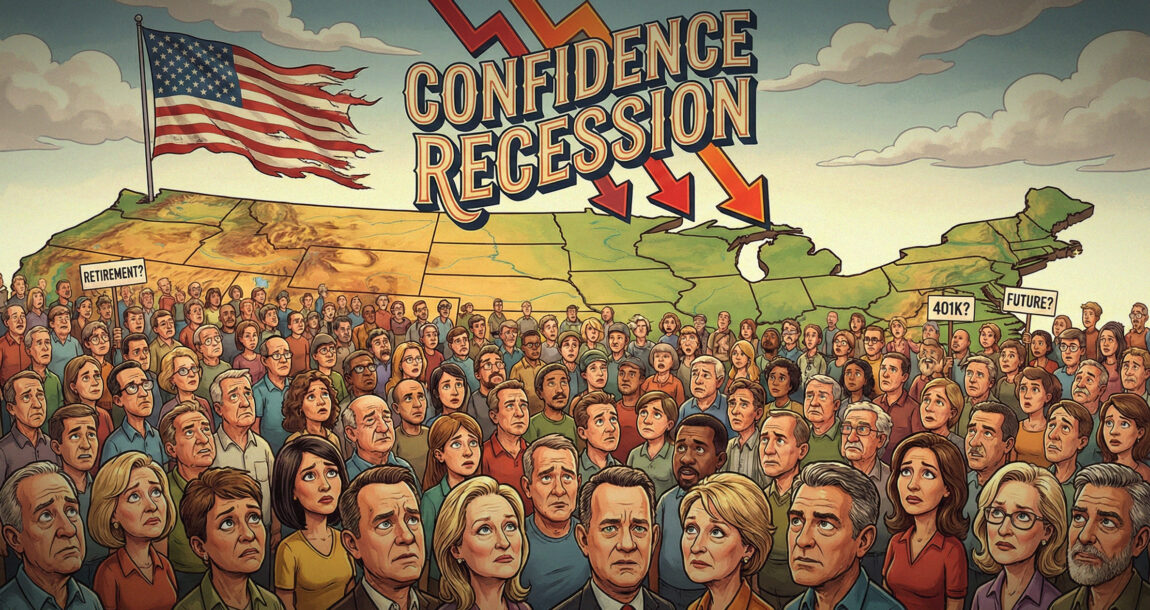
By early 2026, it’s no longer accurate to say Americans are merely uncertain about retirement. A better description is that they are experiencing a confidence recession — a sustained erosion of belief that their savings, income sources and planning assumptions will actually hold up over a longer, more volatile retirement.

The 2025 Annual Retirement Study from Allianz Center for the Future of Retirement captures this shift with unusual clarity. Americans’ confidence in their ability to financially support the life they want has dropped sharply over the past five years, even as retirement remains a top financial priority. The disconnect is striking people who care deeply about retirement, yet feel increasingly unprepared to navigate it
For advisors, this moment represents both a warning and an opportunity.
The real fear isn’t death — it’s running out of money
One of the most telling findings in the Allianz study is psychological rather than numerical: 64% of Americans worry more about running out of money than about dying.
Inflation, health care costs, market downturns, taxes and Social Security uncertainty now dominate retirement anxiety.
This matters because fear changes behavior.

When retirees or preretirees fear loss more than death, they often:
- Delay retirement unnecessarily
- Under-spend during retirement
- Chase “safe” solutions without understanding tradeoffs
- Or disengage from planning altogether
From an advisory standpoint, this reframes the value proposition.
Retirement planning is no longer primarily about maximizing returns — it’s about reducing regret, stabilizing income and restoring psychological safety.
The income equation isn’t adding up
The traditional accumulation-centric model — “save enough and you’ll be fine” — is breaking down.
Nearly half of Americans have no written financial plan, and only 45% say they understand how they will convert savings into income in retirement
At the same time, 53% believe having a 401(k) or individual retirement account alone will be sufficient and 59% admit they don’t know what else they should be doing.
This “plan gap” is not a lack of effort; it’s a lack of translation. People are saving, but they don’t know how savings become paychecks.
Advisors who can clearly articulate withdrawal sequencing, tax-aware income strategies, longevity risk management, and tradeoffs between liquidity, growth and guarantees are no longer offering a commodity — they’re solving a problem clients cannot self-diagnose.
The $3 million myth — and the danger of anchor numbers
On average, Americans who name a retirement savings target say they need roughly $3.3 million to retire comfortably. Yet 45% don’t know how much they need at all, and most who do cannot explain why that number makes sense for them.
Big numbers can motivate — but they can also paralyze.
Without context around expected spending, health care risk, taxes under evolving IRS rules, longevity assumptions and income efficiency, a savings target becomes an anxiety amplifier instead of a planning tool.
The advisor’s role here is not to debate the number, but to replace the number with a strategy.
Retirement is no longer a date — it’s a transition
Another key shift highlighted in the research: Retirement is increasingly viewed as a phased transition, not a hard stop. More than half of Americans envision easing out of full-time work instead of retiring on a single date
This has major planning implications:
- Income may be hybrid for years (earned + portfolio + Social Security).
- Claiming strategies become more nuanced.
- Risk tolerance shifts gradually, not abruptly.
Advisors who still frame retirement as a binary “work vs. retire” event risk missing how clients actually live.
Social Security: Misunderstood, trusted — and doubted
Social Security remains a cornerstone of retirement income, yet confusion about how it works is widespread. Many Americans still misunderstand taxation, full retirement age, inflation adjustments and claiming strategies. At the same time, concern about Social Security’s long-term sustainability has risen sharply, with two-thirds now worried the system won’t last through their retirement
This combination — misunderstanding plus mistrust — is dangerous.
It increases the likelihood of claiming too early, over-reliance on benefits or abandoning integrated income planning altogether
For advisors, Social Security optimization is no longer an “add-on” conversation. It’s a trust-building moment where clarity replaces speculation.
Clients want protection, predictability — and a human guide
Perhaps the most actionable insight from the Allianz study is what clients say they actually want:
- Income that lasts as long as they do
- Protection against major losses — even if it means giving up some upside
- Simplicity, automation and reliability
- And most important, an advisor who understands their real life, not an idealized model
Despite this, fewer Americans work with a financial professional today than in prior years — a paradox that reflects intimidation, confusion and distrust of complexity rather than rejection of advice itself
This is where the advisory profession stands at a crossroads.
Turning the confidence recession into an advisory renaissance
The retirement landscape in 2026 is defined by longer lives, higher volatility, tax uncertainty and emotional strain. Consumers are not asking for perfect forecasts. They’re asking for guidance that adapts.
Advisors who thrive in this environment will be those who:
- Lead with income clarity, not product complexity
- Address risk in plain language
- Integrate taxes, longevity and lifestyle into one narrative
- And position themselves not as forecasters — but as navigators
The confidence recession is real. But for advisors willing to meet clients where they are—anxious, overwhelmed and searching for reassurance – it may also mark the beginning of a new era of relevance.
© Entire contents copyright 2026 by InsuranceNewsNet.com Inc. All rights reserved. No part of this article may be reprinted without the expressed written consent from InsuranceNewsNet.com.



Most Americans surveyed cut or stopped retirement savings due to the current economy
Life and annuity sales to continue ‘pretty remarkable growth’ in 2026
Advisor News
- Could a narrower focus help grow your practice?
- U.S. debt hits $40 trillion: how to support concerned clients
- Flourish brings private-bank-like cash solution to MassMutual’s network
- Majority of Americans concerned recent market highs are unsustainable
- GLP-1 users choose between medication and retirement saving
More Advisor NewsAnnuity News
- MassMutual Expands Lending Options With New Secured Credit Line
- Corebridge Financial Introduces Progressive Trigger, a First-of-Its-Kind Index Annuity Strategy Designed to Turn Missed Years into Future Opportunity
- Insurer proposes $1.1M deal to resolve CA teachers’ annuity fee lawsuit
- IMOs get frustrated with slow carrier adoption of faster technology
- New class-action lawsuit targets Delaware Life over annuity disclosures
More Annuity NewsHealth/Employee Benefits News
Life Insurance News