

Report Offers Guidance on Disaster Recovery, Rebuilding for Resilience
CAMBRDGE, Mass.,
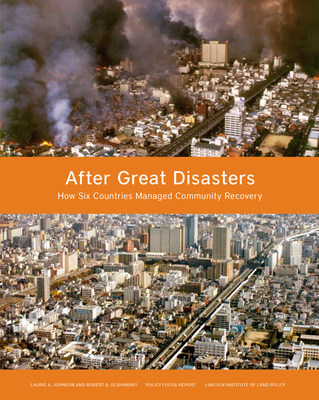
After Great Disasters: How Six Countries Managed Community Recovery, by
The report identifies lessons from six countries that employed different management approaches while recovering from major disasters: the 2008 Wenchuan earthquake in
Each of these governments faced considerable uncertainty and had to balance the tensions between speed and deliberation, and between restoration and betterment.
Extreme weather events and other disasters are becoming a fact of life for many metropolitan areas, exacerbated by the impacts of climate change, said
"While not all disasters are climate related, the broader lessons on post-disaster recovery are relevant for a world in which the combined effects of climate change and urbanization will result in an increasing incidence of disasters," he said. "Pre- and post-event planning will be essential to reduce human suffering and economic loss."

The aftermath of major natural disasters can change the fortunes of a city or region forever. Post-disaster reconstruction can offer opportunities to fix long-standing problems: to improve construction and design standards, renew infrastructure, create new land- use arrangements, reinvent economies, and improve governance. If done well, reconstruction can help break the cycle of disaster-related impacts and losses, and improve the resilience of a city or region.
To date, there has been little systematic knowledge of how to make recovery work well. When a catastrophic disaster strikes, leaders of affected communities know that they lack relevant experience, and they seek lessons from others. Typically, they muddle through, innovate, and learn as they go. But later, many note that their recovery could have been faster, better, and easier if they knew then what they have since learned. Given the growing number of disaster recovery experiences, the authors say, the time has come for organizing and synthesizing common lessons.
In examining the case studies, the authors offer the following recovery recommendations that reflect a set of core principles: primacy of information, stakeholder involvement, and transparency.
- Enhance existing government structures and systems to promote information flow and collaboration.
- Emphasize data management, communication, transparency, and accountability.
- Plan and act simultaneously involving continuous monitoring, evaluating, and correcting.
- Budget for the costs of communication and planning. Increase capacity and empower the governmental levels closest to the disaster to implement actions.
- Avoid permanent relocation of residents and communities except in rare instances when public safety and welfare are at risk, and only with full participation of residents.
- Although speed is important, reconstruction should not be a race.
Recovery after great disaster is always complex, takes a long time, and never occurs fast enough for affected residents. However, the process can be improved by setting more realistic expectations at the outset, working to restore communities and economies quickly and equitably, empowering stakeholders to participate in the process, improving pre-existing problems, ensuring governance for recovery over the long term, and reducing the risk of future disasters. Thinking ahead about strategies for future disasters improves community resilience -- the ability of the community to survive, adapt, and recover from extreme events.
Over the years, Johnson and Olshansky have coauthored several publications, including Opportunity in Chaos: Rebuilding After the 1994 Northridge and 1995 Kobe Earthquakes and Clear as Mud: Planning for the Rebuilding of
After Great Disasters: How Six Countries Managed Community Recovery will be useful to urban planners, local government officials and staff, state and national governments concerned with urban policy, and disaster relief organizations. The report is part of a series of
About the Authors
Photo - http://photos.prnewswire.com/prnh/20160721/391960
To view the original version on PR Newswire, visit:http://www.prnewswire.com/news-releases/report-offers-guidance-on-disaster-recovery-rebuilding-for-resilience-300302317.html
SOURCE


PIEtech℠, Inc. Releases Best Interest Scout™ – the First Tool Available to Help Firms Meet the DOL/Best Interest Standard Requirements
Advisor News
- Addressing the longevity paradox
- Employers shift focus from retirement access to financial outcomes
- Helping widowed clients navigate their new financial reality
- Navigating client communication in a digital age
- Can your advisory firm survive without you?
More Advisor NewsAnnuity News
- Farm Bureau P&C insurers post first underwriting gain since 2021
- Legacy Marketing, Malibu Life launch two fixed indexed annuities
- Changing client priorities are reshaping annuity conversations
- Solen Software acquires annuity software provider Cooperative Technologies
- MassMutual Expands Lending Options With New Secured Credit Line
More Annuity NewsHealth/Employee Benefits News
- Reports Summarize Managed Care Study Results from Brown University (Litigating the No Surprises Act: How Legal Challenges Undermined Cost Containment and Reshaped Provider Payments): Managed Care
- Researchers from Geisinger Provide Details of New Studies and Findings in the Area of Managed Care and Specialty Pharmacy (Trends In Annual Medication Possession In Older Adults With Type 2 Diabetes): Drugs and Therapies – Managed Care and Specialty Pharmacy
- Job-Based Health Plan Costs Rise, With Little Relief in Sight
- Here’s what Gov. Moore and Dan Cox promised Marylanders with disabilities
- AmeriHealth Caritas to join Ohio Health Insurance Marketplace in 2027
More Health/Employee Benefits NewsLife Insurance News