

Geopolitical instability and risk raise fears of Black Swan scenarios
New York, March 4, 2026: Despite seeming predictable in hindsight, Black Swans are unexpected or unforeseen events that are highly disruptive and economically damaging. Examples include the 9/11 attacks of 2001 in the US, the 2008 global financial crisis, and the Covid-19 pandemic. Allianz Research estimates cumulative global GDP losses from the pandemic between 2020 and 2023 to be in the region of US$12trn.
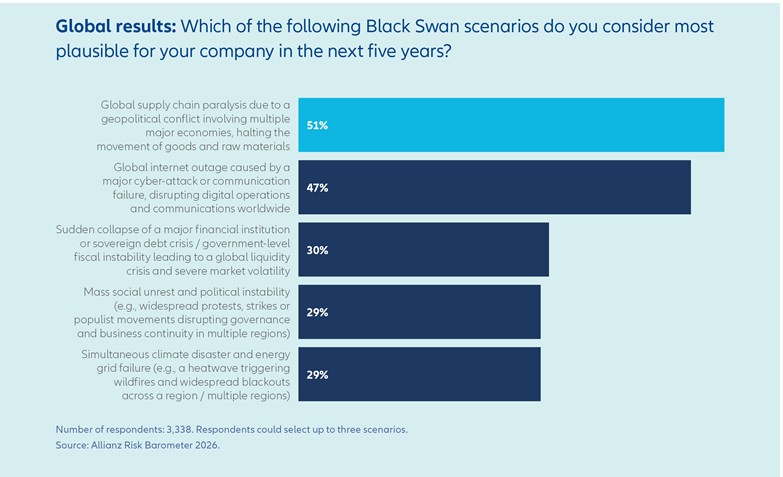
In addition to the huge financial and business costs, such events typically have long-lasting implications, resulting in geopolitical and societal shifts that continue many years after the initial event. According to new Allianz Risk Barometer analysis, more than half of the 3,000+ respondents (51%) identify a global supply chain paralysis due to a geopolitical conflict as the most plausible Black Swan scenario globally which could impact their company in the next five years. Fear of a global internet outage ranks second (47%) which reflects the increasing awareness of cyber and artificial intelligence (AI) risks among business leaders.
Allianz Commercial CEO Thomas Lillelund comments: “Although Black Swan events are not seen to be immediately likely, these rare, high-impact scenarios are perceived as increasingly plausible and should be considered by executive boards given their potential consequences. Growing interconnectivity across both physical and digital supply chains means disruptions now cascade much faster and can turn into major losses. In today’s fragmented geopolitical environment, companies must double down on resilience and integrated risk management to ride out the next perfect storm.”
In the United States, global supply chain paralysis tops the list (52%) followed by global internet outage (45%) and sudden collapse of a major financial institution (33%). According to Kostas Papapetridis, Regional Head of Risk Consulting, North America, “Global geopolitical instability, combined with persistent political violence and escalating SRCC (strike, riot, and civil commotion) activities worldwide, underscores the necessity for businesses to remain vigilant regarding the dynamic nature of such risks.”
Geopolitics is a key driver for Black Swans
Given the current geopolitical environment, it is no surprise that supply chain paralysis resulting from a geopolitical conflict is regarded as the most plausible Black Swan scenario. The threats of tariffs, trade wars and protectionism, as well as disruption to supply chains and shipping caused by regional conflicts in the Middle East and Russia/Ukraine are on the top of every board agenda. Allianz Research estimates that cumulative GDP losses over a two-year horizon triggered by a global supply chain disruption on the scale of the war in Ukraine could total US$1.5trn. In fact, political-related risks stand out as a leading potential trigger for Black Swan events, according to respondents. Mass social unrest and political instability is regarded as the fourth most plausible scenario globally (29%) and is a top three risk in the Americas (31%) and Africa and the Middle East (41%) regions, as well as in France (42%), for example. A sudden collapse of a major financial institution or a sovereign debt crisis, leading to a global liquidity crisis and severe market volatility ranks third (30%).
Interconnectivity and interdependency of both physical and digital supply chains are potentially increasing vulnerability at a time of geopolitical uncertainty, rapid advances in technology, and climate change. Businesses and global supply chains are also more vulnerable to Black Swan events due to growing concentrations of economic activity reliant on a limited number of critical suppliers and products in areas like AI and digital services, semiconductors, rare earth processors and transition technologies.

Company size influences risk perception
Global supply chain paralysis due to a geopolitical conflict halting the movement of goods and raw materials ranks top for both large (>US$500mn annual revenue, 55% of responses) and mid-sized companies (US$100mn+ to US$500mn, 52%). In contrast, smaller companies (<USS$100mn) are most concerned about the impact of a global internet outage (45%), which is the #2 scenario for larger and mid-sized businesses.
The third most plausible Black Swan for mid-sized and smaller companies is the sudden collapse of a major financial institution, while larger companies are more concerned about the risk of simultaneous climate disaster and energy grid failure, such as a heatwave triggering wildfires and widespread blackouts. Multinational enterprises have the advantages of bigger budgets and more diversified portfolios and therefore feel they are better prepared to mitigate the risks of an event such as a major internet outage than their smaller and medium-sized counterparts.
“Awareness of Black Swans and the need to build resilience has increased in recent years, but businesses can never fully prepare for rare high impact events such as a global outage or an unforeseen climate-related catastrophe. Building organizational agility, fostering a risk-aware culture and developing scalable response plans for a range of scenarios remain the most practical steps to best prepare for Black Swan events. Insurers can play a critical role in helping businesses strengthen their resilience in areas such as cyber risk and support more informed decisions when assessing and selecting critical suppliers,” says Michael Bruch, Global Head of Risk Consulting Advisory Services, Allianz Commercial.
The top global Black Swan scenarios
About the Allianz Risk Barometer
The Allianz Risk Barometer is an annual business risk ranking compiled by Allianz Group’s corporate insurer Allianz Commercial, together with other Allianz entities. It incorporates the views of 3,338 risk management experts in 97 countries and territories including senior managers, risk managers, brokers, and insurance experts. It is being published for the 15th time.


Trump’s new pick ‘may struggle’ to get Fed on board with MAGA agenda: report
Jackson Earns Award for Highest Customer Service in Financial Industry for 14th Consecutive Year
Annuity News
- A client remarried: Does their annuity still fit?
- Gen X and millennials seek new retirement model
- Global Atlantic names Dan Farrelly head of IMO and IBD channels
- A rising retirement challenge: The license to spend
- What lower interest rates mean to annuity payouts
More Annuity NewsHealth/Employee Benefits News
Life Insurance News
Property and Casualty News
- The next act for cyber insurance
- Proposed FEMA map could make some Howard residents get flood insurance
- Police investigating after explosion damages Tacoma business
- State insurance commissioner candidates clash over how to fix the system
- East Hartford woman charged with double-dipping from Medicaid caregiver programs
More Property and Casualty News