

The markets don’t care about the election

Americans are passionate about politics and interest in the Nov. 5 election is reaching a fever pitch. But while voters are all in for their favored candidate, the markets are saying, “meh.”
That was the word from Brian Levitt, global market strategist with Invesco, during a recent webinar by the National Association for Fixed Annuities.
People may care about elections, but the markets don’t, Levitt said, and presented several examples to back up that claim.
A June 30 Gallup poll asked voters what they believe to be the most important problem facing the U.S. today. The top answers were: the economy in general, the high cost of living, the federal budget deficit, immigration, poor leadership and unifying the country. But Levitt said those problems are nothing new; they have been top concerns since the Founding Fathers were alive. He quoted George Washington as saying, “The distemper in our nation is … certainly incurable.”
Voters often believe that one party or one president “will come along and be terrible for the market,” Levitt said, but history shows that belief is false. Looking at stock market returns versus economic growth from the Eisenhower administration through the Biden presidency showed economic growth in every one of those eras. “The U.S. economy is quite a vibrant thing,” Levitt said.
Also between the Eisenhower and Biden presidencies, every administration except for Richard Nixon and George W. Bush presided over a stock market that produced positive returns.

“Markets do well under most presidencies, and markets do well under both parties,” Levitt said. “With Nixon and Bush, it was more about bad timing. Both of them left office under really bad recessions.”
The range of market returns has generally been similar across administrations, he said. Looking at the S&P 500 index, rolling daily one-year returns by administration since 1961 showed most presidents experienced 30%-40% gains at some point and 20%-40% declines at some point during their terms in office.
Are you better off investing in the market only during a Democratic administration, only during a Republican administration, or remaining fully invested no matter what party is in charge? Levitt said the evidence is overwhelmingly in favor of remaining fully invested.
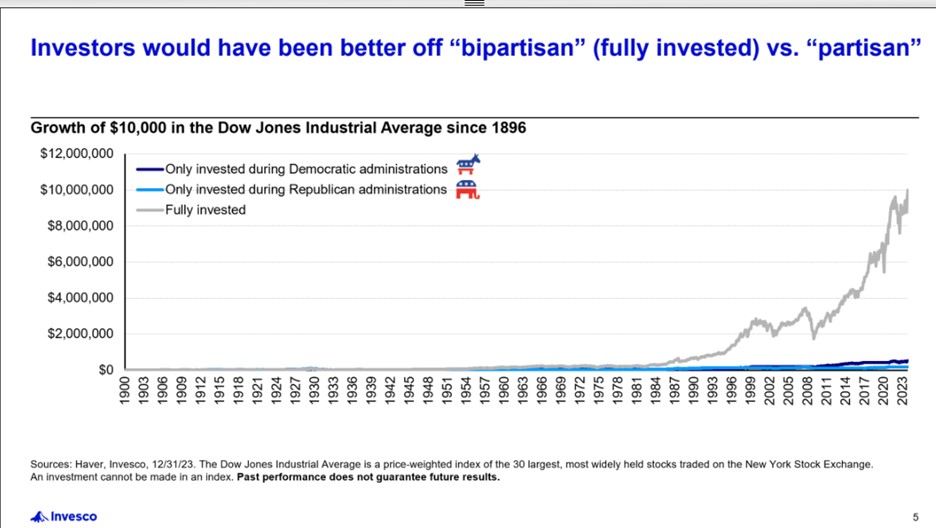
As each presidential election approaches, voters are often told that “this will be the most important election of our lives,” Levitt said, and again, the markets don’t care. He cited the 2016 campaign between Hillary Rodham Clinton and Donald Trump, and the 2020 campaign between Trump and Joe Biden as examples.
“Clinton said in 2016 if Trump wins, he’ll treat the economy like he treats one of his casinos and bankrupt it. Trump said Biden would make your 401(k) go to zero,” Levitt said. “But how did Trump and Biden do during their first 960 days in office? About the same. They both saw a cumulative advance in the S&P of 65%, 70%. They saw the market go big out of the gate, down in the second year and then recovering.”
The direction of the economy and what the Federal Reserve will do are more important than who sits in the White House, Levitt said.
“We have to remember through all of this that there's a policy platform to get elected. If you get elected, you need to see what the legislative branch looks like, then you need to determine what your political mandate is and go after a couple of things. Historically, you lose power by the midterms. Often, the politician, if they win, may decide that what they ran on was not their political mandate. It was just how to get elected. They may not have the Congress as approval for what they want to do, and ultimately they end up getting one or two major things done.”
© Entire contents copyright 2024 by InsuranceNewsNet.com Inc. All rights reserved. No part of this article may be reprinted without the expressed written consent from InsuranceNewsNet.com.



Medicare clients ask about prior authorizations, higher premiums
Flood insurance and condo associations: Dispelling 5 myths
Advisor News
- After the midterms: Addressing your clients’ tax concerns
- Berkeley arts tax heads toward passage while public bank measure looks likely to fail
- Americans’ sense of overall prosperity still ticks upward
- Turning expanded eligibility into a better coverage plan for federal clients
- Election 2026: Which of Berkeley's 7 ballot measures will pass?
More Advisor NewsAnnuity News
- AM Best Affirms Credit Ratings of Knighthead Annuity & Life Assurance Company and Merit Life Insurance Co.
- Jackson reports record annuity sales, increases share repurchase authorization
- Why the market doesn’t need more carriers
- Equitable, Corebridge steam toward merger with strong Q3 annuity sales
- Jackson Announces New Annuity Offering for AARP Members
More Annuity NewsHealth/Employee Benefits News
- Investigators at University of Pennsylvania Report New Data on Managed Care (In-hospital Medicaid enrollment facilitates follow-up care for emergency general surgery patients): Managed Care
- New Findings from University of Pennsylvania in the Area of Managed Care Described (Association of Neighborhood Socioeconomic Disadvantage With Excess Mortality Among Medicare Beneficiaries: Examining an Empirical Basis for Social Risk …): Managed Care
- Research on Acute Lymphoblastic Leukemia Published by Researchers at Stanford University (Travel time, insurance, and specialized cancer care for adolescents and young adults with acute lymphoblastic leukemia): Oncology – Acute Lymphoblastic Leukemia
- Investigators from Nationwide Children’s Hospital Zero in on Mental Health Diseases and Conditions (The 2021 Child Tax Credit Expansion and Mental Health Care Use Among Medicaid-enrolled Adolescents In Ohio): Mental Health Diseases and Conditions
- Study Results from Daegu Catholic University in the Area of Machine Learning Reported (Explainable machine learning framework with Granger-based temporal predictive validation for monitoring fiscal risk in national health insurance expenditure): Machine Learning
More Health/Employee Benefits NewsLife Insurance News
- AM Best Affirms Credit Ratings of Central States Indemnity Co. of Omaha and Its Subsidiary
- National Life Group Approves $23 Million Dividends for 2027
- Milliman’s proposed $15.5 million settlement puts life insurance underwriting data in focus
- Brighthouse Financial Announces Third Quarter 2026 Results
- Prudential earnings dip as Japan sales suspension offsets U.S. growth
More Life Insurance News