

Hawaii court first to classify greenhouse gases as pollutants
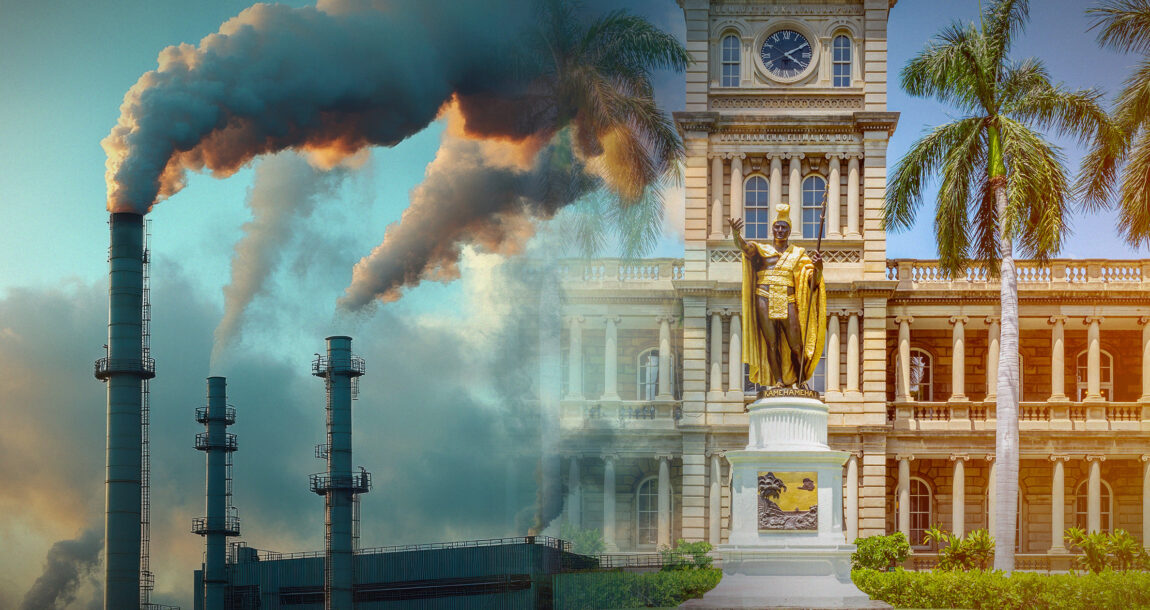
An oil company’s attempt to have its insurer pay judgements in two climate change-related lawsuits was foiled by a ruling in which the Hawaii Supreme Court became the first state court to classify greenhouse gases as pollutants, and thus excluded from traditional insurance coverage.
The case involved Aloha Petroleum, a subsidiary of Sunoco, versus National Union Fire Insurance Company. Aloha was sued by the city of Honolulu and its water company in 2022 that claimed fossil fuel products used in the ordinary course of Aloha’s business emitted carbon dioxide and other greenhouse gases that contributed to the damaging effects of global warming.
Such suits and similar legislative action by states are becoming common throughout the country as state governments and municipalities try to recover alleged damages from the toxic emissions of major oil and gas refiners.
Aloha provided National Union with notice of the climate change lawsuits under four AIG policies and requested defense and indemnity coverage that, at the time of the lawsuit’s filing, amounted to more than $880,000 in legal costs.
But National Union asserted that the so-called “qualified pollution exclusion” in the policy precluded all coverage – both defense and indemnity – for the climate change lawsuits. While the insurer conceded it was liable for personal injury and property damages, it said Honolulu’s lawsuits list no specific injuries or damages and, furthermore, the policies in question exclude coverage “arising out of the discharge, dispersal, release or escape of smoke, vapors, soot, fumes, acids, alkalis, toxic chemicals, liquids or gases, waste materials or other irritants, contaminants or pollutants into or upon land, the atmosphere or any water course or body of water.”
A split decision
The case went to the state’s Supreme Court, which issued what was essentially a split decision, saying the release of toxic materials was “accidental” under the terms of allowed coverage, but that the greenhouse gases were pollutants under the listed exclusions.
“What the right hand gave Aloha, the left hand took away,” said Robert Shulman, a partner in the Litigation Practice Group at Haynes Boone and leading attorney for companies seeking insurance coverage for complex claims.

Shulman and other attorneys believe the Hawaii Supreme Court erred in lumping greenhouse gases that cause climate change with traditional pollution.
“The states aren't suing the oil and gas companies for causing pollution per se,” he said. “They’re suing because the companies contributed to climate change. That’s a whole new phenomenon. A climate change claim is not a pollution claim.”
'Remarkably reductive'
In a brief co-authored with other Haynes Boone partners, Shulman wrote that the Hawaii Supreme Court's explanation for its ruling on the pollution exclusion was “remarkably reductive.”
“At the highest level, it announced (for the first time) that Hawaii follows the 'traditional environmental pollution rule,' and then summarily concluded that claims based on a theory of greenhouse gasses-caused climate change stem from ‘traditional environmental pollution.’ The Court's simplistic reasoning, however, belies its lack of rigor and diminishes the context of climate change which is hardly traditional under any supportable notion. In fact, the Court invoked the dictionary for the meaning of certain terms and propositions ('accident,' 'contamination') but did not make similar references to a dictionary when characterizing the claims as issue as 'traditional.' There simply is nothing about climate change that can be considered 'inherited, established or customary' or 'commonly accepted as historical.'"
Despite the ruling, Shulman and others say the court’s decision will not stand as a precedent for other jurisdictions wrangling with similar cases.
Because insurance is largely state regulated, the decision, they said, specifically applies to Hawaii, though it may guide courts in other states when interpreting similar policies, especially over coverage disputes.
“Resolution of these issues is only as good as the state where insurance is a product of state law,” he said. “So, you could have many different ways it could be interpreted. Each state might look at Aloha for guidance, but no state is beholden to a resolution in any other state.”
© Entire contents copyright 2024 by InsuranceNewsNet.com Inc. All rights reserved. No part of this article may be reprinted without the expressed written consent from InsuranceNewsNet.com.



How insurers can tackle the cyber insurance risk of deepfakes
MassMutual delivers record $2.5 billion dividend to policyholders
Advisor News
- Navigating client communication in a digital age
- Can your advisory firm survive without you?
- I started using AI, but what now?
- How to support an entrepreneur client with multiple businesses
- Could a narrower focus help grow your practice?
More Advisor NewsAnnuity News
- Solen Software Group Acquires Cooperative Technologies, Provider of 1035 Exchange and Annuity Replacement Software
- MassMutual Expands Lending Options With New Secured Credit Line
- Corebridge Financial Introduces Progressive Trigger, a First-of-Its-Kind Index Annuity Strategy Designed to Turn Missed Years into Future Opportunity
- Insurer proposes $1.1M deal to resolve CA teachers’ annuity fee lawsuit
- IMOs get frustrated with slow carrier adoption of faster technology
More Annuity NewsHealth/Employee Benefits News
- Americans Worry They Can’t Afford Health Care in Retirement, Allianz Life Study Finds
- Lawmakers urge USCIS to address immigration backlog affecting healthcare access
- Pennsylvania sues pharma and PBMs over insulin prices
- Seniors can get help wth Medicare sign-ups
- Oscar Introduces a New Wave of Consumer Health Products
More Health/Employee Benefits NewsLife Insurance News