

Blue Cross flags $5.5B in added medical coding costs at NAIC meeting

Medical coding practices that may be driven by artificial intelligence added an estimated $5.5 billion in health care reimbursements across Blue Cross Blue Shield commercial plans in 2025, according to research presented to state insurance regulators Monday.
The findings prompted competing explanations from insurers and hospitals during the National Association of Insurance Commissioners' fall meeting in Dallas, with consumer advocates raising concerns about higher premiums and billing disputes.
Luke Chalker, senior vice president of product and data science at the Blue Cross Blue Shield Association, said the research began after member plans reported unexplained increases in inpatient costs, particularly for diagnoses such as sepsis.
Patients with those diagnoses were experiencing shorter hospital stays, fewer physician encounters and faster discharges, even as reimbursement increased.
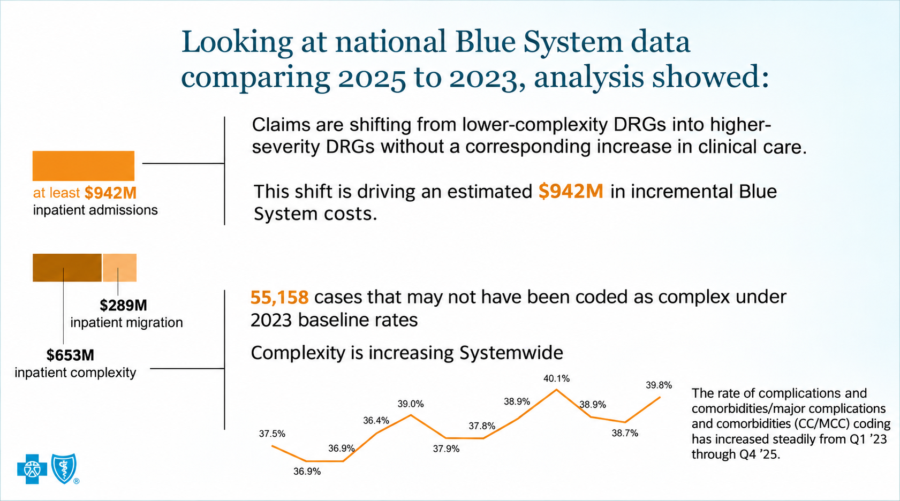
Compared with a 2023 baseline, the association estimated approximately $942 million in additional inpatient reimbursements and $4.6 billion associated with outpatient and professional services.
How AI is changing medical coding
AI-enabled revenue cycle management systems can analyze clinical records and identify billing codes that generate higher reimbursements without changes in the care delivered, Chalker explained.

In one example, a hospital admission classified as a respiratory infection with $20,000 in reimbursement could instead be coded as sepsis, increasing payment to $33,000 based on the same clinical information.
The association also identified approximately $650 million in additional inpatient reimbursements associated with higher complexity classifications.
Chalker cautioned that the findings do not necessarily indicate fraudulent billing.
"I want to be very careful in not saying that that is necessarily fraud in any way, shape, or form," he said, noting that existing coding and payment policies allow for some interpretation.
Some increases may reflect previously incomplete coding, he acknowledged. Still, Chalker maintained that AI-assisted coding is contributing to higher reimbursements that affect premiums and out-of-pocket costs.
Hospitals question the findings
The American Hospital Association offered a different explanation, citing changes in patient health and the growing complexity of hospital care.
Jennifer Holloman, the association's director of health IT policy, said hospitals are using AI to reduce administrative workloads, improve clinical documentation and allow physicians more time with patients.
An aging population, rising chronic disease rates and increasingly complex hospital cases are also contributing to changes in medical coding, she said.
An AHA analysis found that hospital case complexity increased approximately 5% between 2019 and 2024.
Holloman questioned whether the Blue Cross research distinguished claims involving AI from those processed through other documentation methods.
"The key question remains whether diagnoses are clinically supported, not whether they increase metric complexity," she said.
Chalker countered that the association's research covered approximately 60 million commercially insured people with an average age of 37, limiting the relevance of population aging to its findings.
Consumer concerns over billing disputes
Eric Ellsworth, director of health policy and innovation at Consumers' Checkbook, warned that competing uses of AI by providers and insurers could create a "battle of the bots."
As providers use AI to identify additional billing opportunities, insurers may respond with more claims reviews, coding restrictions and audits, potentially increasing disputes.
"I am especially concerned about the kind of battle of bots playing out in an increase in denied claims," Ellsworth said.
He called for stronger oversight of insurer denials and provider billing, clearer explanations of benefits and greater transparency about AI use in claims processing.
A Pennsylvania regulator described a recent complaint involving a preventive health visit that resulted in an additional charge of approximately $200 after the appointment was also coded as a mental health service.
The consumer was ultimately found not responsible for the charge.
Regulators weigh prior authorization oversight
The task force also discussed establishing a dedicated working group to oversee health insurance prior authorization reforms.
Maryland Insurance Commissioner Marie Grant, who chairs the task force, outlined two options: creating a separate working group or continuing oversight through existing NAIC committees.
Representatives from Colorado, Arizona, Pennsylvania and West Virginia supported establishing a dedicated group.
Pennsylvania regulators called for continued monitoring of insurers' commitments to streamline prior authorization, while West Virginia representatives urged greater attention to third-party vendors involved in authorization decisions.
Consumer representatives also supported the proposal, emphasizing transparency, data collection and enforcement of existing requirements.
The discussion follows the NAIC's adoption of a prior authorization white paper last year recommending standards and best practices for state regulators.
Grant closed the discussion without announcing a formal decision on establishing the working group.
© Entire contents copyright 2026 by InsuranceNewsNet.com Inc. All rights reserved. No part of this article may be reprinted without the expressed written consent from InsuranceNewsNet.com.



The Gen Z money paradox
Advisor News
- The Gen Z money paradox
- NAIFA applauds final SECURE 2.0 regulations
- What will Democrats in Congress do about healthcare and retirement?
- Election results cloud retirement legislation outlook, experts say
- Planning for the missing chapter
More Advisor NewsAnnuity News
- ‘It’s really shocking:’ Regulators scrutinize assets backing annuity sellers
- Jackson Launches Direct-to-Consumer Annuity Offering
- Global Atlantic launches ForeIncome Flex
- Athene CEO criticizes offshore reinsurance, risk-taking by competitors
- DOL, trade groups, state AGs file briefs supporting Alcoa in PRT lawsuit
More Annuity NewsHealth/Employee Benefits News
- Blue Cross flags $5.5B in added medical coding costs at NAIC meeting
- MEDICAL FRAILTY AND MEDICAID WORK REQUIREMENTS: CHALLENGES FOR PEOPLE WITH MENTAL HEALTH CONDITIONS
- HOW NEW PHYSICIANS CAN AVOID PAYMENT PITFALLS IN MEDICARE AND MEDICAID
- WHITEHOUSE, WYDEN, OSSOFF DEMAND BIG HEALTH INSURANCE CEOS DELIVER ON PROMISES TO REDUCE PATIENT CARE DELAYS
- Medicaid work rules don’t apply to Native Americans. They could still lose coverage.
More Health/Employee Benefits NewsLife Insurance News
- Best’s Commentary: Shanghai Cross-Border Investment Pilot Unlocks Overseas Growth Potential of China Non-Life Companies
- Military Briefs: November 19-25
- California’s new solvency rules: What should life insurance advisors watch?
- Navigating delayed death certificates: A guide for life insurance advisors
- Jackson Launches Direct-to-Consumer Annuity Offering
More Life Insurance News