

Beyond the S&P 500: The case for RILA diversification

For many financial professionals, the S&P 500 has become the default choice when investing client funds in registered index-linked annuities (RILAs).
New data from Equitable reveals that diversifying into less understood or potentially more volatile asset classes, like small-caps or emerging markets, can pay off as well.
While the S&P 500 offers broad, large-cap U.S. exposure, it does not capture all market segments or international opportunities. Adding indices like the following may introduce sources of return that behave differently over time, the new data found.
• Small-cap U.S. stocks (Russell 2000®) expand diversification further by capturing companies earlier in their growth cycle, which often behave differently than large, established firms and can provide higher long-term return potential.
• International stocks (MSCI EAFE) introduce exposure to faster-growing regions, different currencies and markets that may perform well when the U.S. lags.
• The NASDAQ 100® adds more emphasis on innovation-driven and technology-oriented companies, which may follow distinct performance cycles.

“By blending these indices, financial professionals can help clients tap into a range of growth themes and reduce the portfolio's sensitivity to sector or geographic weakness,” said Dr. Wade Pfau, professor of retirement income at The American College of Financial Services, and author of the research.
Many annuity providers rely on the S&P 500 because it has performed well in recent years, explained Pete Golden, chief sales and distribution officer for Individual Retirement at Equitable. He noted, however, that while the S&P looks great in the past, no one can predict what it will look like in the future.
“We see a heavy reliance on the S&P 500 being the primary source for most fixed index annuities and RILAs,” Golden said. “Diversifying with other indexes may create better outcomes.”
Since RILAs have had strong growth over the past five years, he said, there is increasing interest among financial professionals about how they can assist their clients using these products.
According to LIMRA’s U.S. Individual Annuity Sales Survey, RILA sales set new quarterly and annual sales records in 2025. In the fourth quarter of 2025, RILA sales were $22.1 billion. For the full year, RILA sales increased 20% year over year to $79.5 billion –10 times the sales recorded a decade ago for this product line.
A historical case for diversification
The Equitable research looked back over 20 years of historical performance, and found that a diversified portfolio, which includes a 40% investment in an S&P 500 segment, significantly outperforms a portfolio that is only allocated to an S&P 500 segment.
After 20 years, a diversified portfolio has a 31% greater account value, providing significant value over a non-diversified portfolio.
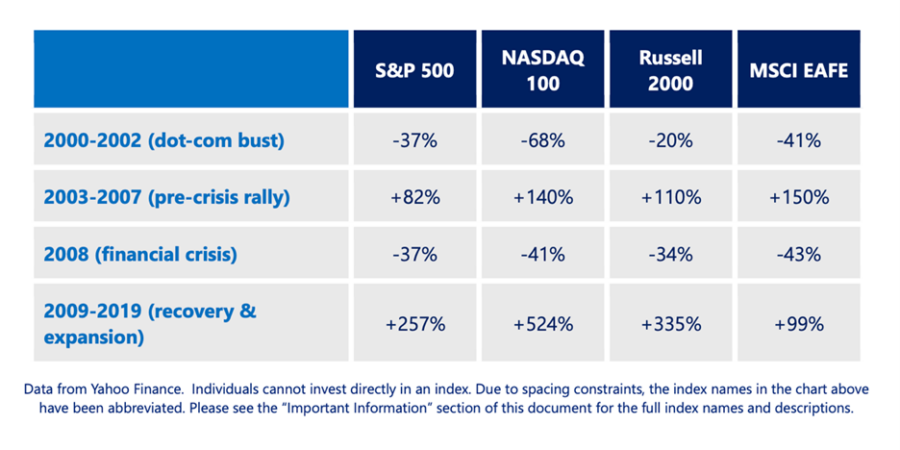
Looking back over time, different indices come out ahead. What performs well in one cycle can lag in another.
Returns from investments in other indices can surpass or pace the S&P 500. Data from 2009-2019 demonstrates the returns from each index below:
• S&P 500: +257%
• NASDAQ 100: +524%
• Russell 300: +335%
• MSCI EAFE: +99%
“Taking a diversified approach reduces exposure to any single market and offers downside protection, especially during periods when large-cap U.S. stocks underperform,” Pfau said.
While the research tested a specific Equitable product – the Structured Capital Strategies Premier (SCS Premier), a tax-deferred RILA – Golden noted that most index-based annuities provide access to multiple indices.
“Clients can be prepared for all market conditions regardless of the index with a broad range of crediting strategies and buffers,” he said.
With the SCS Premier, clients can use segments such as Dual Direction, which can deliver positive returns even when the market is down, or they can use deeper buffers up to 40% to protect against volatile markets. Additionally, clients are not locked into their segments until maturity; if financial professionals believe market conditions are shifting, they can easily reallocate clients into new segments at any time.
“Broader diversification within annuity segments offers the potential to improve the risk/return trade-offs for client portfolios,” Pfau said. “By thoughtfully adding complementary indices, different crediting strategies, and deeper buffers, financial professionals can help clients potentially have a smoother ride along the journey to meet their financial goals.”
“In today's markets, helping your clients widen their range of indices may be a strategic move that could potentially help them meet their long-term financial objectives and better set the stage for retirees to face their futures with confidence,” Golden added.
© Entire contents copyright 2026 by InsuranceNewsNet.com Inc. All rights reserved. No part of this article may be reprinted without the expressed written consent from InsuranceNewsNet.com.



Rethinking the ways employers manage benefits risk
Retirement is increasingly defined by a secure income stream
Advisor News
- Navigating client communication in a digital age
- Can your advisory firm survive without you?
- I started using AI, but what now?
- How to support an entrepreneur client with multiple businesses
- Could a narrower focus help grow your practice?
More Advisor NewsAnnuity News
- Solen Software Group Acquires Cooperative Technologies, Provider of 1035 Exchange and Annuity Replacement Software
- MassMutual Expands Lending Options With New Secured Credit Line
- Corebridge Financial Introduces Progressive Trigger, a First-of-Its-Kind Index Annuity Strategy Designed to Turn Missed Years into Future Opportunity
- Insurer proposes $1.1M deal to resolve CA teachers’ annuity fee lawsuit
- IMOs get frustrated with slow carrier adoption of faster technology
More Annuity NewsHealth/Employee Benefits News
- Health plans task force fight Medicaid fraud
- Recent Findings from Brown University Provides New Insights into Managed Care (Use of Brokers In Medicare Advantage and Standalone Part D Plans): Managed Care
- More than 1,700 Pottawattamie County residents face Medicare plan cancellations
- KENTUCKY CAN CUT HEALTH PREMIUMS WITHOUT SPENDING A DIME
- SpecialtyCare sues Anthem over $2.5 million in unpaid awards
More Health/Employee Benefits NewsLife Insurance News