

A-Cap insurers face new takeover push in South Carolina

South Carolina insurance regulators are taking another shot at placing two Advantage Capital Holdings-owned insurers into rehabilitation. This time, they appear to have considerably more ammunition.
Director Michael Wise of the South Carolina Department of Insurance filed a 56-page petition Tuesday seeking to take control of insurers Atlantic Coast Life Insurance Co. and Southern Atlantic Re Inc.
Wise argued that A-Cap and CEO Kenneth King gambled on “high-risk and inappropriate investments” that “grievously undermined” the insurers’ financial condition.
“The risky investments appear to be worth substantially less than what Respondents forecast, and they cannot be turned into cash in time to pay policyholder obligations without taking substantial losses on the investments,” the petition states. “These improper investments threaten Respondents’ ability to pay back the thousands of mostly elderly policyholders who bought annuities and other insurance products from Atlantic Coast Life.”
Rehabilitation is a process through which financially-distressed insurers are placed into receivership with the intent of identifying the source of any underlying financial issues and working to remedy them.
If the court grants the petition, the insurers will be placed under the department’s control so regulators can thoroughly vet their finances.

“Filing this petition was a necessary step to protect policyholders and the broader public,” Wise said in a statement. “The department has been closely monitoring a number of concerning signs about the companies’ finances.”
Not the first time
In 2024, South Carolina regulators made multiple regulatory attempts to restrict and intervene in the operations of Atlantic Coast and Southern Atlantic Re due to mounting concerns over its finances and exposure to high-risk private credit
As financial concerns escalated, the department issued a cease-and-desist order on Dec. 11, 2024, that attempted to completely ban Atlantic Coast from writing any new insurance or annuity premiums in the state.
A-Cap appealed and two months later, an administrative law judge struck down the department's ban, ruling that the state had mishandled the situation.
The new petition was filed in the Court of Common Pleas for the Fifth Judicial Circuit in Richland County. A-Cap immediately filed a motion to dismiss the petition on Wednesday, in part because the court “lacks jurisdiction,” the motion states, and the department “fails to state facts sufficient to constitute a cause of action.”
A-Cap also signaled its intent to fight regulators.
“Respondents also oppose the other filings by the Department to date and intend to file responsive briefing in opposition,” its two-page motion reads.
A-Cap could not be reached for comment by the time this story was published.
A shift to annuities
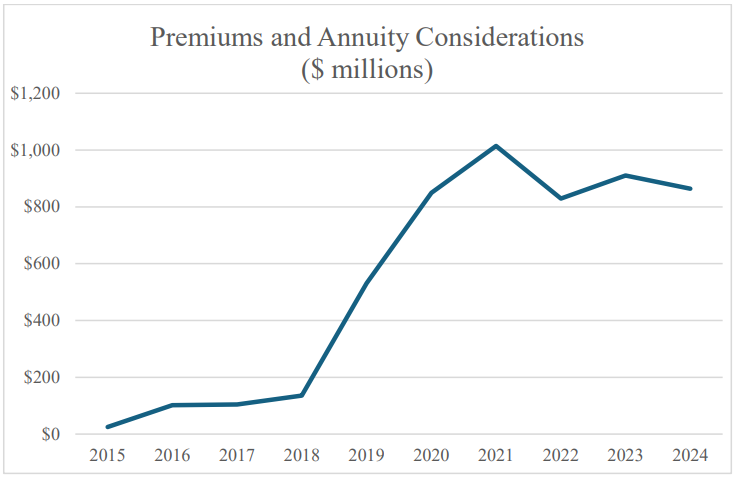
Founded in 1925, Atlantic Coast historically focused on small life insurance and pre-need funeral policies but shifted under A-Cap to selling annuities, regulators say. Its direct premium income and annuity considerations increased from about $25 million in 2015 to roughly $102 million in 2016, the petition says.
“This was a major change in Atlantic Coast Life’s business model and included significant changes to its investment strategy for policyholder funds, resulting in a vastly different risk profile for the company,” the petition states.
Much of the petition focuses on the insurers’ investments in private-credit assets, including unrated collateral loans and below-investment-grade private-placement bonds. Private credit assets are privately negotiated loans and debt negotiated through non-bank lenders.
As of Dec. 31, 2025, Atlantic Coast reported that 23.8% of its cash and invested assets were in non-investment-grade private-credit bonds and unrated collateral loans. Southern Atlantic Re reported 10.8%.
The department says those figures understated the exposure because some assets were classified as highly rated bonds even though they should have been reported as unrated collateral loans.
After adjusting the classifications, regulators say 30.2% of Atlantic Coast’s cash and invested assets and 15.1% of Southern Atlantic Re’s were in those categories. The department alleges the investment levels exceeded limits contained in the companies’ investment-management agreements with Advantage Capital Management, an A-Cap-affiliated investment adviser.
The petition also alleges that investment expenses paid to advisers had grown to more than twice the industry average relative to the insurers’ size by 2025, while investment performance had remained largely in line with the broader life insurance industry.
“Even among life insurance companies owned by private equity firms, Atlantic Coast Life’s share of investments in non-investment grade bonds and unrated investments was double the average for this industry sector,” the petition states.
Troubled investments alleged
The filing points to several investments in financially troubled companies.
Southern Atlantic Re had more than $30 million invested in Film Services, a company created after Film Finances filed for bankruptcy in 2024 and was acquired in foreclosure by an entity 50% owned by A-Cap, according to the petition.
The department also cites a loan to Brickell PC Insurance Holdings that grew from $6 million to $34.5 million by the end of 2025, even as its maturity was extended and there was no indication the borrower was making interest payments.
Regulators said their investigation shows that the Brickell PC loan is likely “collateralized by shares of Randall & Quilter Investment Holdings Ltd., a company that filed for provisional liquidation in Bermuda following a period of financial distress, and which has since sold its profitable division to a third party.”
A major concern involves the insurers’ financial ties to 777 Partners, the Miami-based investment firm whose affiliated companies have faced financial distress, bankruptcy and federal criminal charges.
Southern Atlantic Re had reinsured more than $500 million of business with 777 Re Ltd. before recapturing more than $600 million of that business in 2024, ending the reinsurance relationship. The department says the transaction did not eliminate the insurers’ broader economic exposure to 777-related assets.
The petition claims the insurers and A-Cap-affiliated entities also had substantial investments tied to 777 Partners. One loan that originated at about $46 million grew to more than $700 million, with more than $100 million in accrued and unpaid interest by April 2024, according to the filing.
In 2025, the insurers’ management said the outstanding loan balance, including capitalized interest, had been converted into a new investment in Caboose Holdings, an A-Cap subsidiary. The department alleges that move did not eliminate the underlying exposure to 777-related assets.
The issue became more significant after 777 Partners and affiliated companies sought Chapter 11 bankruptcy protection in August. The petition says bankruptcy filings disclosed nearly $1.3 billion owed to A-Cap-affiliated companies, with all of those loans in default.
The department says that disclosure conflicted with an A-Cap statement from February that certain 777-related loans had been extinguished and that all legacy 777 risk had been removed.
“Personnel from A-CAP have maintained that they were not participants in any aspect of the fraud scheme but instead are pure victim-witnesses,” the petition notes.
RBC ratios deteriorate
The insurers’ risk-based capital ratios are another central issue.
South Carolina had required Atlantic Coast and Southern Atlantic Re to maintain RBC ratios of at least 500% as conditions of their respective regulatory approvals, according to the petition.
Atlantic Coast reported an RBC ratio of 278% at the end of 2024 and 239% at the end of 2025. Southern Atlantic Re reported 485% at the end of 2025. The companies’ second-quarter 2026 financial statements showed additional deterioration, the petition says.
Atlantic Coast Life’s capital and surplus fell from about $81.7 million at the end of 2025 to $47.4 million by June 30, a 42% decline in six months. Its estimated RBC ratio fell below 185%, according to the filing.
The petition says Atlantic Coast Life also had seven of 12 NAIC Insurance Regulatory Information System ratios outside their usual ranges in 2025, up from four in 2024. Southern Atlantic Re had four of 10 applicable ratios outside the normal range in both years.
Regulators further allege that correcting certain investment classifications and reinsurance credits would reduce the reported RBC ratios substantially.
For example, the petition says removing more than $150 million in excess investments tied to King and A-Cap from Atlantic Coast Life’s admitted assets would have pushed its Dec. 31, 2025, RBC ratio below zero.
Reinsurance concerns
The petition also challenges several reinsurance arrangements.
By the end of 2025, Southern Atlantic Re had assumed more than $2.36 billion in policyholder reserves from Atlantic Coast. Atlantic Coast, in turn, had ceded more than $2 billion of policyholder obligations to Southern Atlantic Re, according to the filing.
The department alleges that Atlantic Coast improperly claimed about $180 million in reinsurance credit for business ceded to Converge Re II and that Southern Atlantic Re improperly claimed about $245 million in credit associated with Aureum Re. The petition says certain assets backing those arrangements did not qualify for reinsurance credit under South Carolina law.
A “higher level of capital is necessary when holding unrated collateral loans compared to holding highly-rated long-term bonds to account for the additional risk inherent in the assets,” regulators say.
The department also alleges that some reinsurance arrangements are undercollateralized, potentially leaving Atlantic Coast Life exposed if counterparties cannot meet their obligations.
Liquidity pressures alleged
The petition says liquidity could become an increasing concern as large blocks of Atlantic Coast annuities reach the end of their surrender-charge periods.
According to company records cited in the filing, annuities with about $900 million in gross fund value are scheduled to reach the end of their surrender-charge periods in 2026, followed by another $900 million in 2027 and $800 million in 2028.
Net of reinsurance, the amounts are nearly $400 million, nearly $300 million and $150 million, respectively.
Policyholders surrendered $463 million in annuity value during the first half of 2026, or $165 million net of reinsurance, according to the petition.
“Respondents’ investments should be structured so that sufficient amounts can be turned into cash near the end of the annuities’ surrender charge periods to match the large volume of expected surrenders,” the petition states.
Atlantic Coast Life also reported a 2025 net operating loss of $25.2 million before capital gains and losses, exceeding a statutory threshold cited by the department by about $9.2 million. Through the second quarter of 2026, its year-to-date operating loss was $14.8 million, the petition says.
The department began a full-scale examination of the insurers in August 2025. The examination remains ongoing and a final report had not been issued when the petition was filed.
© Entire contents copyright 2026 by InsuranceNewsNet.com Inc. All rights reserved. No part of this article may be reprinted without the expressed written consent from InsuranceNewsNet.com.


Rising healthcare costs force employers to rethink coverage strategies
AI skills in higher demand than MBAs in financial services
Advisor News
- Retaining clients by giving them a memorable experience
- Addressing the longevity paradox
- Employers shift focus from retirement access to financial outcomes
- Helping widowed clients navigate their new financial reality
- Navigating client communication in a digital age
More Advisor NewsAnnuity News
- Farm Bureau P&C insurers post first underwriting gain since 2021
- Legacy Marketing, Malibu Life launch two fixed indexed annuities
- Changing client priorities are reshaping annuity conversations
- Solen Software acquires annuity software provider Cooperative Technologies
- MassMutual Expands Lending Options With New Secured Credit Line
More Annuity NewsHealth/Employee Benefits News
- Centene sues feds over low ratings for senior health plans
- Terry Savage: Small business owners, now is the time to offer health insurance coverage
- Aldermen select employee medical insurance broker services provider
- Southwest Bridge Health focusing on insurance coverage gap in Berrien County
- HEALTHCARE SHOULDN'T REQUIRE A MAP
More Health/Employee Benefits NewsLife Insurance News