

Higher Education Tax Benefits: Do You Qualify?
Sallie Mae Educates Families About Often-Overlooked Education Tax Credits and Deductions That Can Help Offset Higher Education Costs
This press release features multimedia. View the full release here: https://www.businesswire.com/news/home/20190228005830/en/
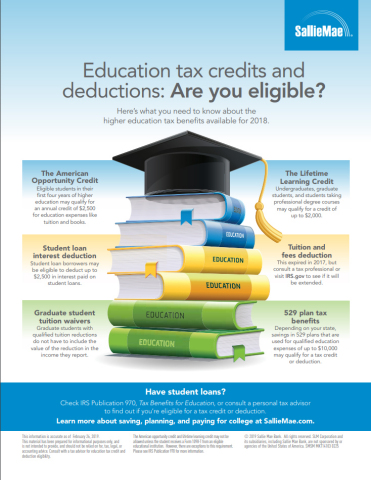
Education tax credits and deductions: Are you eligible?
“Higher education tax deductions and credits are an effective way to reduce your college costs,” said

Here’s what families need to know about available higher education tax benefits:
- The American opportunity (AOC) tax credit. Students enrolled at least half time in a program leading to a degree or other recognized educational credential may be eligible for a tax credit of up to
$2,500 per year in tuition, enrollment fees, and course materials expense during the student’s first four years of higher education. Single filers with a modified adjusted gross income (MAGI) of up to$90,000 and married filers with a MAGI up to$180,000 may qualify for this credit. - The lifetime learning credit (LLC). Covers up to
$2,000 per year in expenses related to all years of post-secondary education, as well as non-degree courses to acquire or improve job skills, and there is no limit on the number of years it may be claimed. For 2018, the amount is gradually reduced if MAGI is between$57,000 and$67,000 ($114,000 and$134,000 if you file a joint return).Important Note: Either the American opportunity credit or the lifetime learning credit may be claimed in one tax year, but not both.
- Student loan interest deduction. Taxpayers with federal or private student loans may be eligible to deduct up to
$2,500 of interest as an adjustment to taxable income. The student must be enrolled at least half time in a program leading to a degree or other recognized educational credential. Single filers with a MAGI of between$65,000 and$80,000 , and joint filers with a MAGI between$135,000 and$165,000 may qualify for this deduction.Important Note: The tuition and fees deduction expired in 2017. Consult a tax professional or visit IRS.gov to see if this deduction has been extended for 2018.
- Tuition waivers for graduate students. Graduate students with qualified tuition reductions do not have to report the value of the reduction as taxable income.
- Expanded eligibility for 529 savings plans (Qualified Tuition Program). Beginning
Jan. 1, 2018 , 529 plan savings may be used for qualified education expenses of up to$10,000 per student per year at elementary and secondary public, private, or religious schools.
Information in this release is not intended to provide, nor should it be relied on, for tax, legal, or accounting advice. For more information on eligibility for higher education tax deductions and credits, consult
Find additional information on saving, planning, and paying for college at SallieMae.com.
View source version on businesswire.com: https://www.businesswire.com/news/home/20190228005830/en/
[email protected]
Source:


EDITORIAL: California AG Becerra must stop protecting bad cops
Sanders tries to convince wary Democrats he’s one of them
Advisor News
- Your client wants to cash out an annuity. Here’s what to consider
- How student loan debt impacts 401(k) balances
- The ‘sandwich generation’ faces compounded barriers to retirement savings
- Benefit Costs Squeeze Schools, Driving Cuts, Tax Hikes And Difficult Tradeoffs
- Why client insurance needs could change even if their life doesn’t
More Advisor NewsAnnuity News
- OID recovers $260M in life insurance benefits
- NUNN BILLS TO COMBAT PAYMENT SCAMS, CUT FINANCIAL RED TAPE PASS FINANCIAL SERVICES COMMITTEE
- SS&C Black Diamond Expands Annuities & Insurance Marketplace with New Insurance Capabilities and Carriers
- Regulators urged to sharply limit hypothetical data in annuity illustrations
- Your client wants to cash out an annuity. Here’s what to consider
More Annuity NewsHealth/Employee Benefits News
Life Insurance News