

What a 50-year mortgage could mean for homebuyers

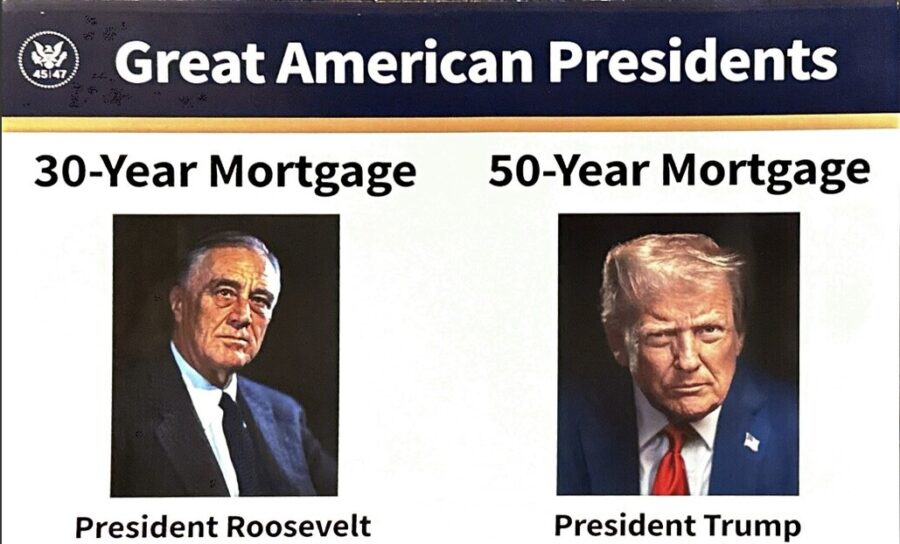
As he’s done several times during his administration, President Donald Trump threw out an idea on Truth Social. This time it was for a 50-year mortgage. No details; just the idea.
InsuranceNewsNet asked some industry trade association experts to weigh in on what the proposal could mean for future homebuyers.
The 30-year mortgage was created in 1948 for new homes and extended to existing homes in 1954. This was a major change from previous, shorter mortgage terms and was authorized by Congress as part of a government effort to make homeownership more accessible and to support the post-war economy. By the 1960s, it had become the dominant mortgage product in the U.S., with nearly 90% of Americans having this type of mortgage.
According to Bankrate, as of Nov. 6, the average rate for a 30-year fixed-rate mortgage is 6.3%, down from a peak of 8% in October but far above the 3% range in 2020.
What it could mean for homebuyers
Lawrence Yun, National Association of Realtor's chief economist, said in a statement that "Extending mortgage terms from 30 to 50 years can modestly reduce monthly payments, making homeownership slightly more accessible for some buyers. For example, on a $420,000 loan with 20% down and a 6.3% interest rate, the monthly payment would be about $236 lower than on a 30-year loan.”
He adds that those small savings come with significant trade-offs. “The slow equity build would make trading up or down very difficult. Furthermore, the total cost of the home would rise to roughly $1.1 million, with nearly $360,000 more in interest paid over the life of the loan. It would also take almost 40 years to pay off half the balance, meaning most borrowers would not begin building meaningful equity until the final decade.”

He adds that a 50-year mortgage may offer a way to enter the market with lower monthly payments, and in many cases, provide a better long-term outcome than renting. But they would require a clear strategy to refinance or sell once the home appreciates in value.
The true cause of home affordability challenges
“Longer loan terms do not address the true cause of today’s affordability challenges, which is the limited supply of homes in the low- and middle-price ranges," he adds.
Cameron Saemann with Second Story Realty agrees. “While the proposed 50-year mortgage may allow more people to become homeowners, we need to look at the long-term ramifications for the client who may need to sell that home a few years down the road with much less equity than their neighbor with a standard 30-year mortgage.”
“For those who want to move quickly, unless they have put a substantial down payment into the purchase, there is a scenario where it may cost more to sell the home than what it is worth, “ he adds.
Kimber White, president of the National Association of Mortgage Brokers (NAMB), said in a statement, “While the concept of a 50-year mortgage is being discussed, NAMB recommends careful consideration, especially given today’s realities of high inflation, rising interest rates, and ongoing housing affordability concerns.”
He adds that bringing together thought leaders to the table to address homeownership obstacles is always a productive step forward and one that NAMB strongly advocates for every day.
White notes that there might be other initiatives that could help homebuyers, including: reducing loan-level pricing adjustments, revamping first-time homebuyer credits, encouraging builder-broker partnerships, modernizing down payment assistance, and exploring flexible mortgage options.
“Consider 30-year fixed mortgages with a limited interest-only period to help with affordability before converting to a standard 30-year fixed covered loan,” White wrote.
“We at NAMB remain committed to working with policymakers to advance solutions that make homeownership more attainable and sustainable for all Americans,” he said.
50-year mortgage: Interest payments would double
Joel Berner, a senior economist with Realtor.com, explained in an email statement that the appeal of a 50-year mortgage is to offer lower monthly payments to homebuyers, but in the long term, it would result in almost double the interest payments of a 30-year mortgage.
“Rates would be higher on the 50-year loan in the same way that 30-year rates are higher than 15-year rates. The longer the life of the loan, the more compensation the lender will demand,” he wrote in the statement.
“The design of this proposal is to boost homebuyer demand, which has been subdued for the last several years as mortgage rates have been stuck in the 6+% range. More flexible financing is essentially a subsidy for housing demand, which will add to the pool and buying power of homebuyers without increasing the supply of homes, which will drive home prices up. The "savings" from 50-year mortgages may be totally negated by rising home prices.”
Berner notes that the administration would do better to reverse tariff-induced inflation, which is keeping the rates on existing mortgages high, and to encourage the expansion of housing supply by promoting homebuilding. Buyers do benefit from spreading out the high cost of a home purchase over a longer period, but lenders certainly benefit too by having a longer period to charge higher interest rates.
© Entire contents copyright 2025 by InsuranceNewsNet.com Inc. All rights reserved. No part of this article may be reprinted without the expressed written consent from InsuranceNewsNet.com.



Underwriting and the rise of early adult-onset cancer
Annuity Trends to Watch For in 2026: Products, tech, and market shifts
Advisor News
- Majority of Americans concerned recent market highs are unsustainable
- GLP-1 users choose between medication and retirement saving
- Gen X and millennials seek new retirement model
- Are families ready for the costs of aging at home?
- When a client moves, their insurance plan needs to move, too
More Advisor NewsAnnuity News
- A client remarried: Does their annuity still fit?
- Gen X and millennials seek new retirement model
- Global Atlantic names Dan Farrelly head of IMO and IBD channels
- A rising retirement challenge: The license to spend
- What lower interest rates mean to annuity payouts
More Annuity NewsHealth/Employee Benefits News
Life Insurance News