

Closing gaps in group disability coverage

A senior executive came to see me after a colleague went out on leave for a serious illness. He was in his mid-40s, had three children in private school, and wanted to know whether his group disability plan would hold up. On paper, it looked substantial, at 60% of earnings up to $15,000 a month. But the plan counted only his $300,000 base salary, not the bonuses and incentive pay that took his total income past $1 million. Because his employer paid the premium, the benefit was taxable, and what was left wouldn’t cover his mortgage.

The disabled colleague’s case was worse. He did some consulting from home during treatment for the disabling condition, and when the group insurer learned he was earning income, they stopped his monthly benefit. He hired an attorney to try to recover it.
For the senior executive, the shortfall, only $300,000 of covered earnings against $1 million in income, results from the group disability plan's definition of covered earnings. For an employee paid mostly in bonus, that definition governs how much income the benefit replaces.
Three documents describe an employee’s group disability coverage. The benefits summary, an overview given at enrollment, states the share of covered earnings that long-term disability replaces, usually 60%, and does not define covered earnings. The certificate is the insurer’s full written description of the coverage, and it defines covered earnings. The plan document describes the benefit plan the employer offers.
In a report my firm published on how group plans define earnings, most of the group disability certificates we examined defined covered earnings as base salary and excluded bonuses, commissions and overtime. Fewer came closer to total cash compensation. Because the certificates came from public employers, they show how insurers write group plans, not the terms at any one company.
In 10 of those certificates, the definition of covered earnings appeared 2 to 18 pages after the page stating the benefit percentage, never alongside it, and insurers sometimes name it insured, predisability or monthly earnings. An employee can’t tell whether bonuses count without reading that far.

Consider a hypothetical regional bank vice president with a $150,000 base salary and a $250,000 bonus. An employer-provided group plan replaces 60% of base pay, $90,000 a year, or 22.5% of the $400,000 in total pay, before any monthly maximum. Where covered earnings means total cash compensation, the same 60% would pay $240,000 a year.
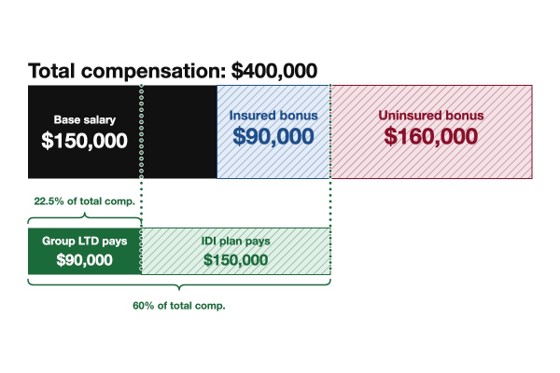
| Hypothetical regional bank vice president, amounts per year. The employer’s group disability plan defines covered earnings as base salary. Actual benefits depend on each plan’s definition of covered earnings, percentage, monthly maximum and dollar cap. Bars share one scale, before any monthly maximum. Source: Set for Life Insurance, Disability Coverage Stops at Base Salary (2026) |
An individual disability policy, which the employee owns and keeps when changing employers, is underwritten on total earnings including bonus, and it pays the difference between the group plan and 60% of total pay.
Employer picks definition
Insurers draft the language and price the variants, and employers select one when buying group long-term disability, so two employers with the same insurer may provide different coverage.
The plan document may define covered earnings differently from the certificate, as one commercial bank we examined did. An employee can request the plan document in writing from the plan administrator, usually human resources or an outsourced benefits firm. Employees in private-sector plans are legally entitled to a copy.
Open enrollment is under way at most companies, so now is a good time to ask.
Filings are inconclusive
Private-sector employers with 100 or more plan participants file a Form 5500 with the Labor Department, and its Schedule A names the insurer and coverage type for insured benefits.
Of 2,912 financial services employers that filed an insured long-term disability contract in the 2023 filings, 37 (1.3%) reported an individual or multi-life layer above it. The filings don’t show the earnings definition, the replacement percentage, the monthly maximum or any individually owned policy, so only the documents show what an employee has.
For each bonus-heavy employee, write down three items from the certificate and plan document: the wording of the definition of covered earnings, the replacement percentage, and the monthly maximum.
The employee carries whatever the group plan doesn’t replace.
© Entire contents copyright 2026 by InsuranceNewsNet.com Inc. All rights reserved. No part of this article may be reprinted without the expressed written consent from InsuranceNewsNet.com.



MassMutual announces record $3.3 billion policyowner dividend for 2027
Severe storms drive $43B in U.S. insured losses as 2026 winds down
Advisor News
- How advisors can help frugal retirees finally enjoy their savings
- Wealth planning vs. estate planning: Honoring your client’s wishes
- What to discuss during the first retirement planning meeting
- Inflation, competing priorities and uncertainty erode retirement security
- As health premiums rise, 1 in 8 workers cut retirement savings
More Advisor NewsAnnuity News
- Jackson Announces New Annuity Offering for AARP Members
- National Life Group expands annuity portfolio
- AM Best to Join Life/Annuity Insurance-Focused Panel Discussion at Capitol Forum Event
- USAA Earns No. 1 Ranking in JD Power Individual Annuity Study for the Third Consecutive Year
- How flexible annuities fit today’s retirement portfolios
More Annuity NewsLife Insurance News
- Corebridge Financial Announces Third Quarter 2026 Results
- MassMutual announces record $3.3 billion policyowner dividend for 2027
- Protective Completes Acquisition of Obsidian, Establishing Specialty Property and Casualty Business Line
- Jackson Announces New Annuity Offering for AARP Members
- Open Enrollment Starts November 1: Tampa Broker Ryan Michalek Urges Families and the Self-Employed to Check 2027 Costs Before They Auto-Renew
More Life Insurance NewsProperty and Casualty News
- Severe storms drive $43B in U.S. insured losses as 2026 winds down
- Bowhead Specialty Holdings Inc. Reports Third Quarter 2026 Results
- The insurance retention challenge: Why customers shop around and switch
- Flood insurance now available through FEMA sponsored website
- Not in a FEMA flood zone? Your home could still be at risk – and you could suffer more than your neighbor
More Property and Casualty News